


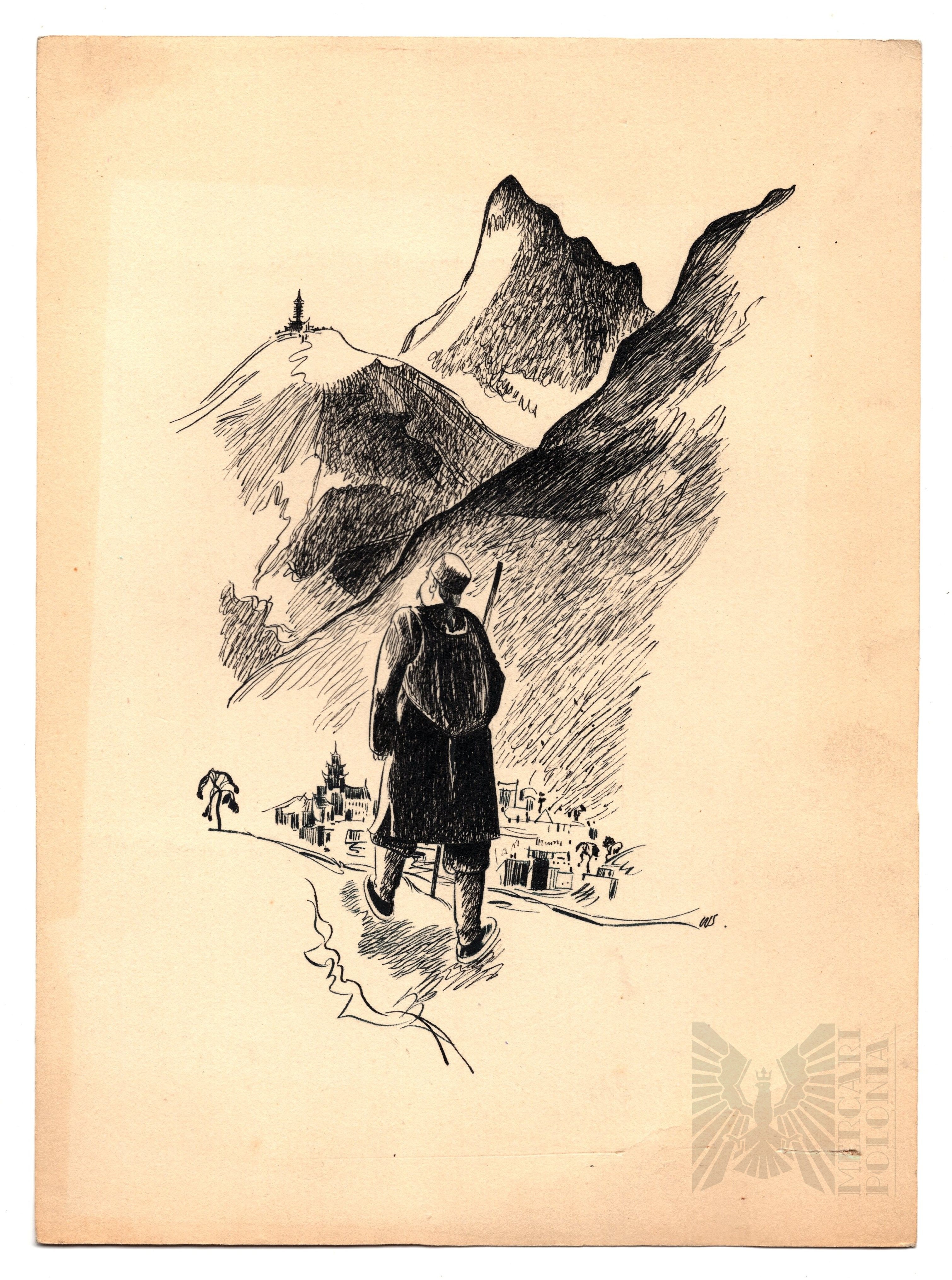
The composition is dominated by a centrally placed human figure seen from behind. The figure depicts a man walking on rough terrain; he is dressed in a long coat or robe, carries a backpack or bundle on his back, and holds a walking stick or staff in his hand. Surrounding the figure is a vast mountain landscape. The upper part of the work shows sharp, soaring peaks with irregular contours, marked with dense hatching. On the left, on one of the hills, there is a small building with a slender, vertical form.
The lower part of the composition outlines a settlement or town, composed of small geometric blocks and several taller pagoda-like structures. The whole composition is maintained in black and white tones, with a clear contrast between the densely hatched parts and the paper fragments left behind. The initial signature "W.S." is visible in the lower corner.
Ink drawing on paper
Dimensions: approx. 24.5 x 18 cm.
Condition as in the photos.
The work is part of the popular trend in 20th century art of inspiration from Far Eastern cultures, evident both in the composition of the landscape and in the way the lone figure of the wanderer is portrayed. The simplified form of the architecture and the characteristic soaring peaks may bring to mind the landscapes of China or Tibet, although the representation is synthetic and not topographically explicit. The contrast between the small human silhouette and the monumental natural surroundings plays an important role here. The signature "W.S." makes it possible to connect the work with a set of drawings of a similar nature, but the lack of unambiguous data does not allow certain attribution. The connection to Władysław Strumiłła, indicated in the literature, remains a hypothesis that requires further research.










最近浏览过的
登录以查看拍品列表
收藏
登录以查看拍品列表