


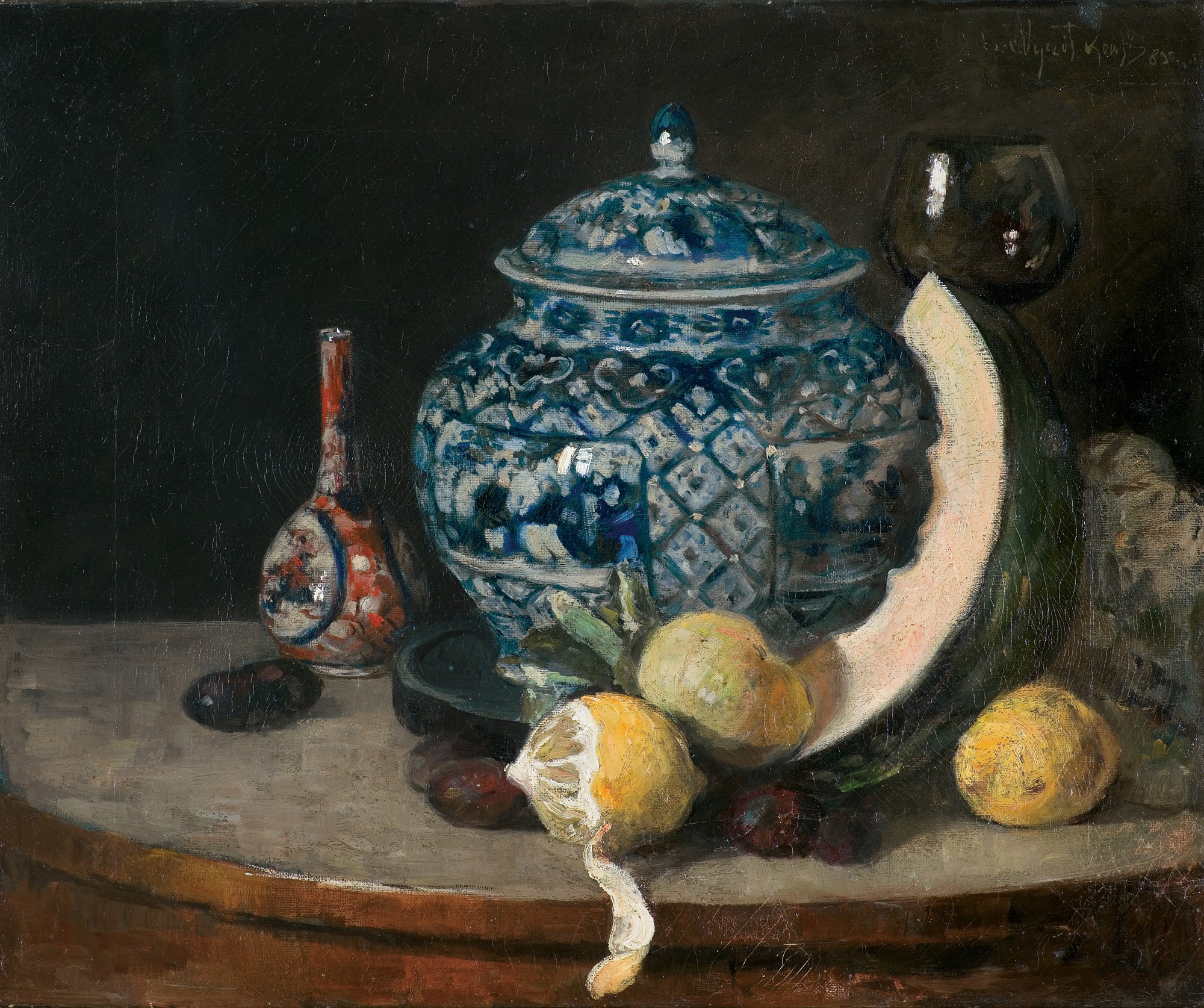
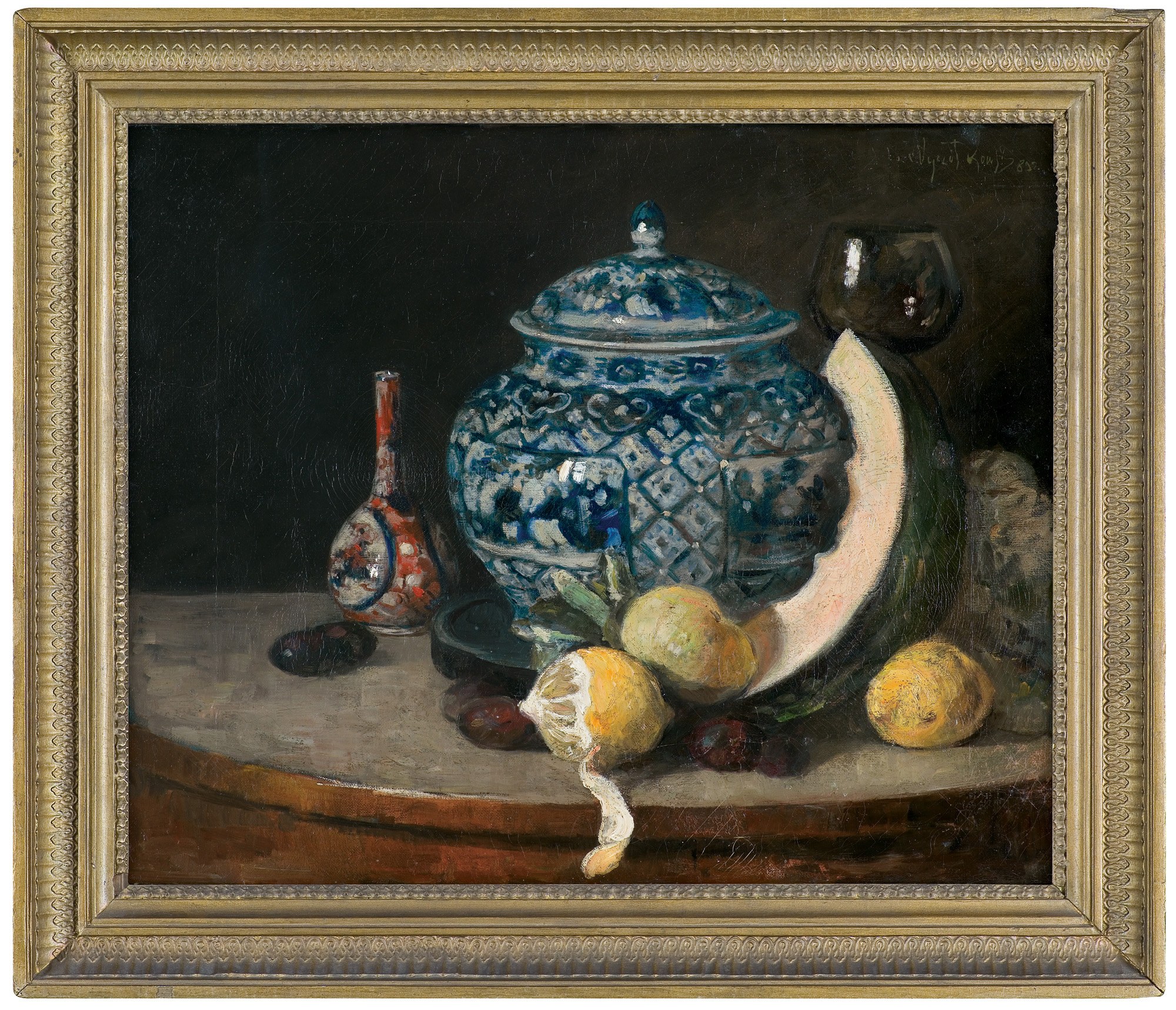
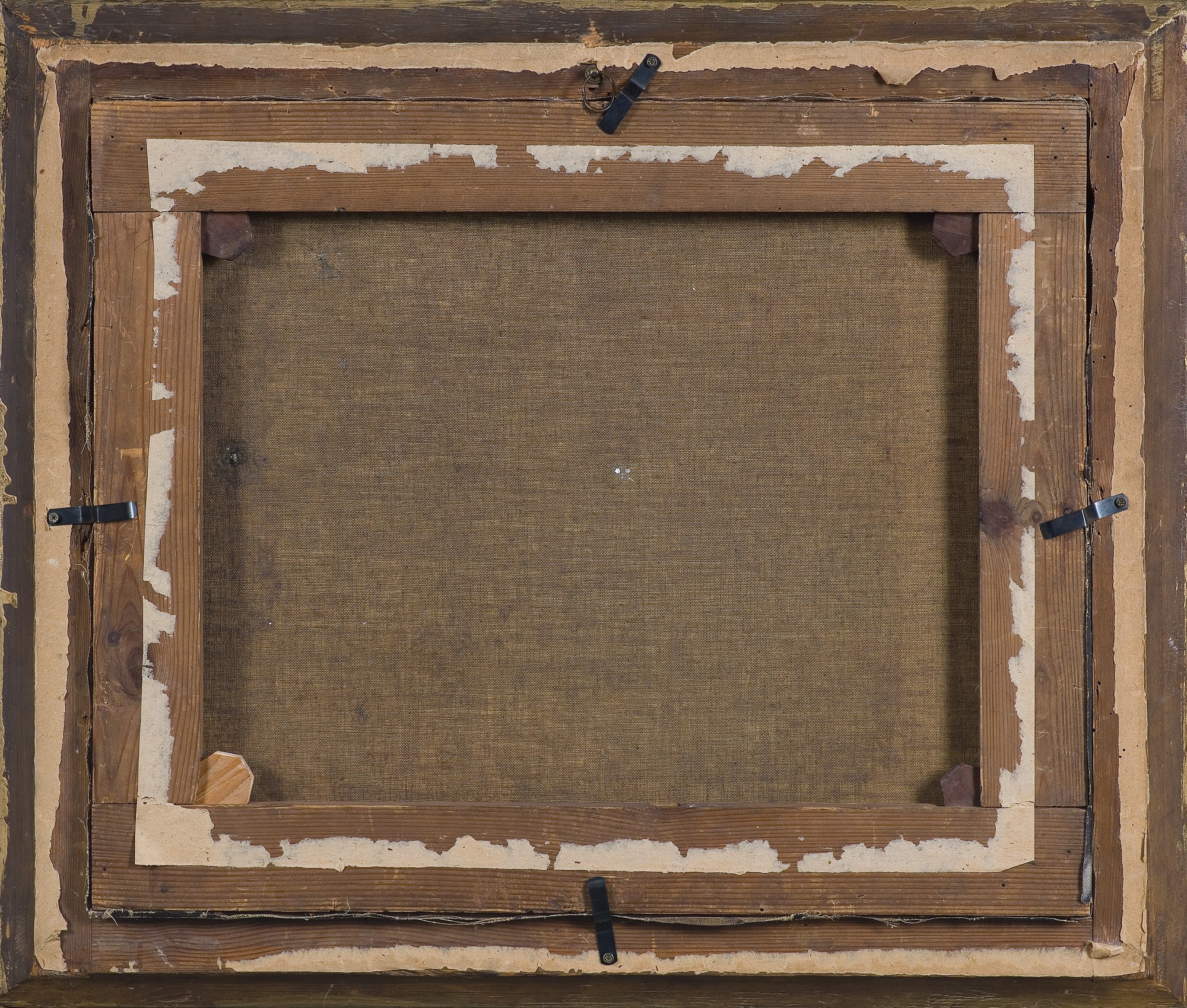
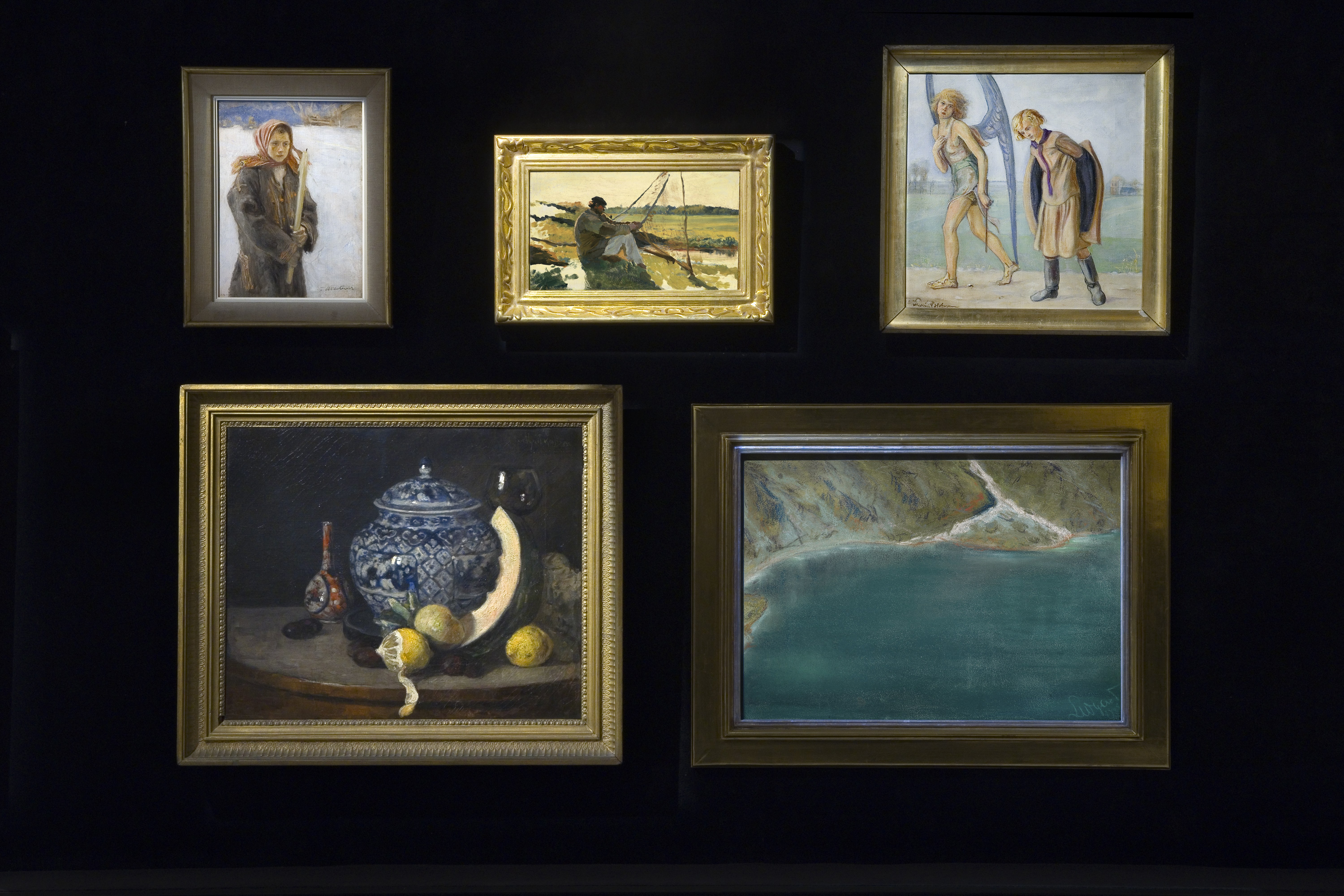
47.8 x 58.3 cm - oil on canvas
signed lower left: L. Wyczółkowsk[i] | 892
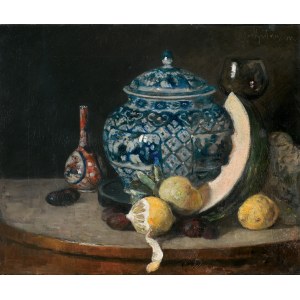
This still life is most likely one of the earliest identified still lifes by Leon Wyczółkowski, one of the most outstanding Polish artists of the turn of the 19th and 20th centuries. Dated 1892 next to the signature, it dates from a period of intense artistic exploration in which light and color played an increasingly important role. Wyczółkowski, who was experimenting extensively at the time, tackled various subjects, which he rendered in a variety of styles. Porcelain, faience, and glass vessels also appear in his salon scenes and interior depictions from that period, later becoming the central motifs of his standalone still lifes.
The still life on offer was clearly inspired by 17th-century Dutch painting: Far Eastern porcelain, a glass goblet, a slice of melon, dates, and a peeled lemon arranged on a marble console table—this composition is typical of the Old Masters. The use of color—contrasting the vibrant hues of the vessels and fruit with the dominant, dark background—also follows the tradition of 17th-century painting. The painting, however, stands out for its much freer, fleshy brushwork and lively painterly texture. Instead of the cool, polished realism of the Old Masters, Wyczółkowski reveals his emerging individual style through a sensual play of light, the absolute primacy of color, and the pure spontaneity of impression.
The vessels depicted in the painting are so-called temple vases (altar vases, sometimes called “potiche”), possibly dating from the era of Emperor Kangxi of the Qing Dynasty, that is, from the turn of the 17th and 18th centuries, and a small Japanese Imari vase with a form typical of that style. The subject matter of the work and the artifacts depicted in it are linked to Wyczółkowski’s collecting interests, and the Still Life on offer was created at the very beginning of this journey. It is worth noting here that the artist’s passion led to the creation of an exceptionally valuable collection of Oriental art, comprising military items, textiles, and decorative arts.
The particular significance of the presented painting stems from its early date. Wyczółkowski’s better-known still lifes date primarily from the first decades of the 20th century, when decorative vessels and flowers became subjects he frequently explored. This 1892 composition reveals an earlier stage of these interests—an independent study of objects, their texture, and color, guided by the observation of light. It thus serves as an interesting testament to the development of the artist’s painterly language and a foreshadowing of the explorations he would pursue in his later work.
Leon Wyczółkowski (Huta Miastkowska near Siedlce 1852 – Warsaw 1936) —painter, printmaker, and educator—was one of the most outstanding Polish artists working at the turn of the 19th and 20th centuries. He began his artistic studies in Warsaw’s Drawing Class under the guidance of Wojciech Gerson and Aleksander Kamiński (1869–1873), then continued them at the Munich Academy of Fine Arts under Aleksander Wagner (1875–1877), in Kraków under Jan Matejko (1877/78), and during two trips to Paris (1878 and 1889). After completing his studies, he settled in Lviv and later moved to Warsaw. He spent the years 1883–1893 traveling through Ukraine and Podolia. In 1895, he moved to Kraków after being appointed a lecturer at the local School of Fine Arts. In the following years, he traveled extensively—to Italy, France, Spain, the Netherlands, and England. He was one of the founding members of the “Sztuka” Society of Polish Artists. He exhibited extensively both in Poland and abroad. He spent the years 1929–1936 in Poznań and Gościeradz, commuting to Warsaw, where (beginning in 1934) he headed the Department of Graphic Arts at the Academy of Fine Arts. He painted landscapes, portraits, genre scenes, still lifes, and flowers. He readily employed the techniques of pastel and watercolor; he was an outstanding printmaker and also worked in sculpture.













最近浏览过的
登录以查看拍品列表
收藏
登录以查看拍品列表