


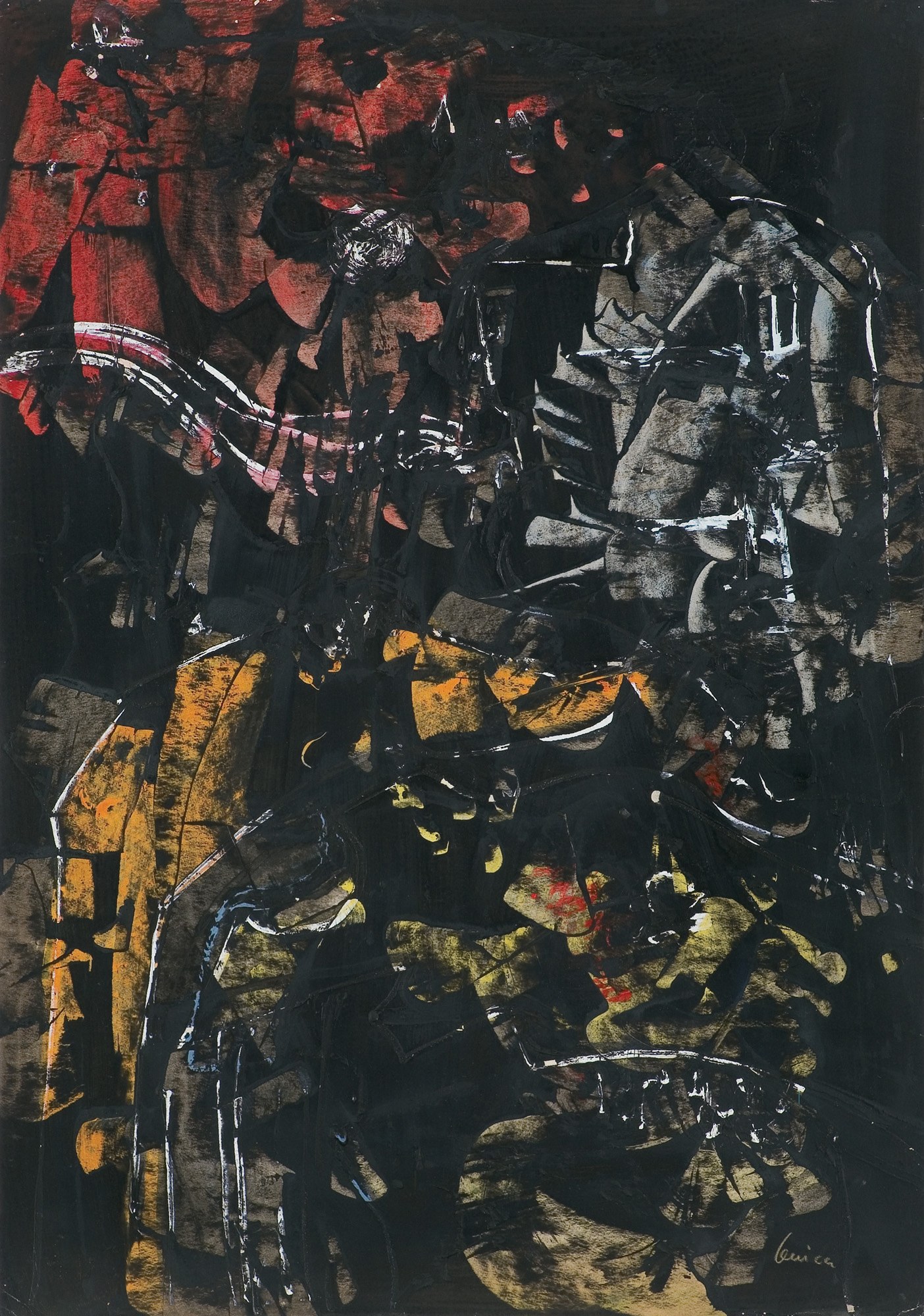
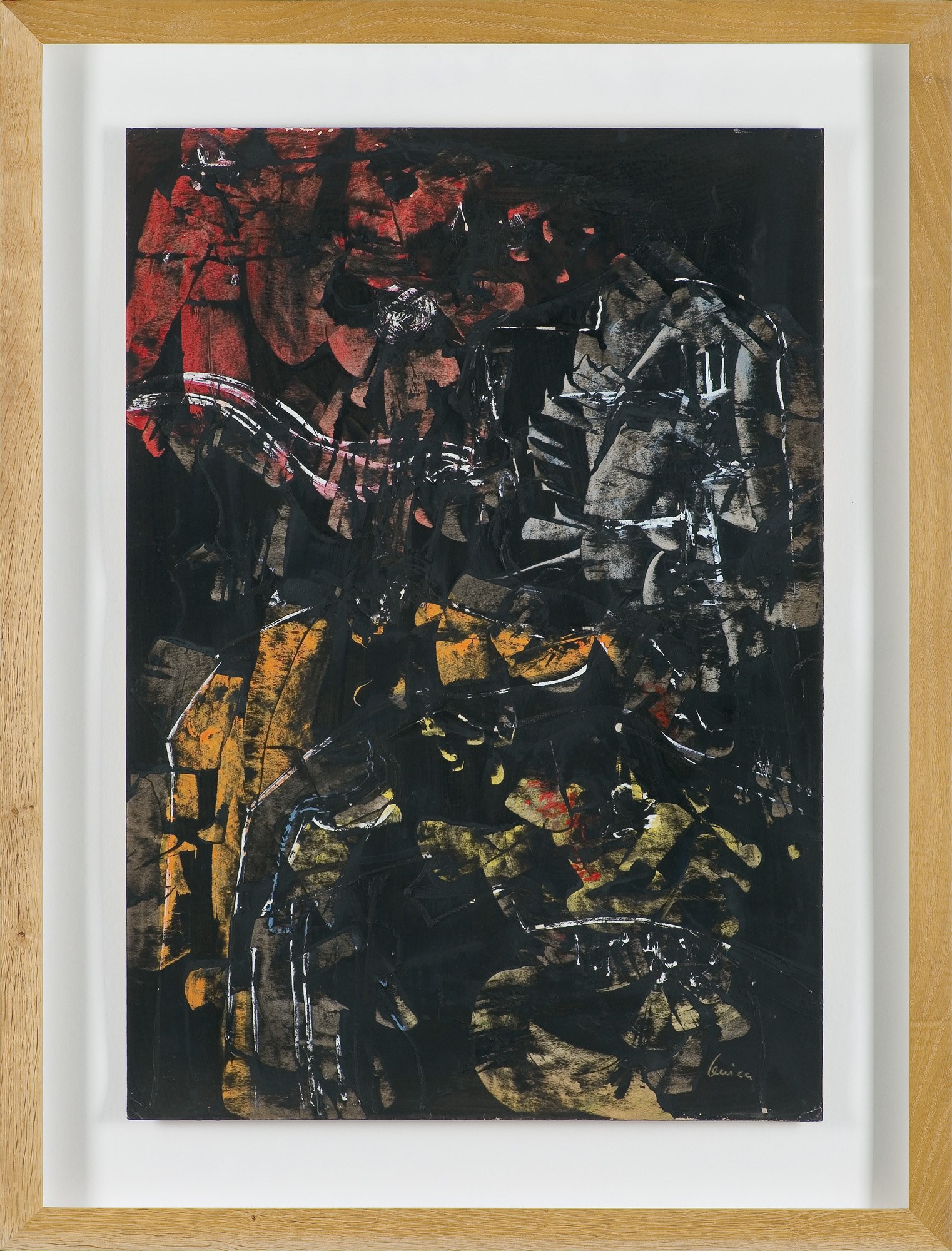
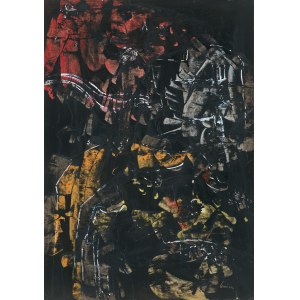
70 x 50 cm - ink, gouache, watercolor, paper
signed in light pastel lower left: Lenica
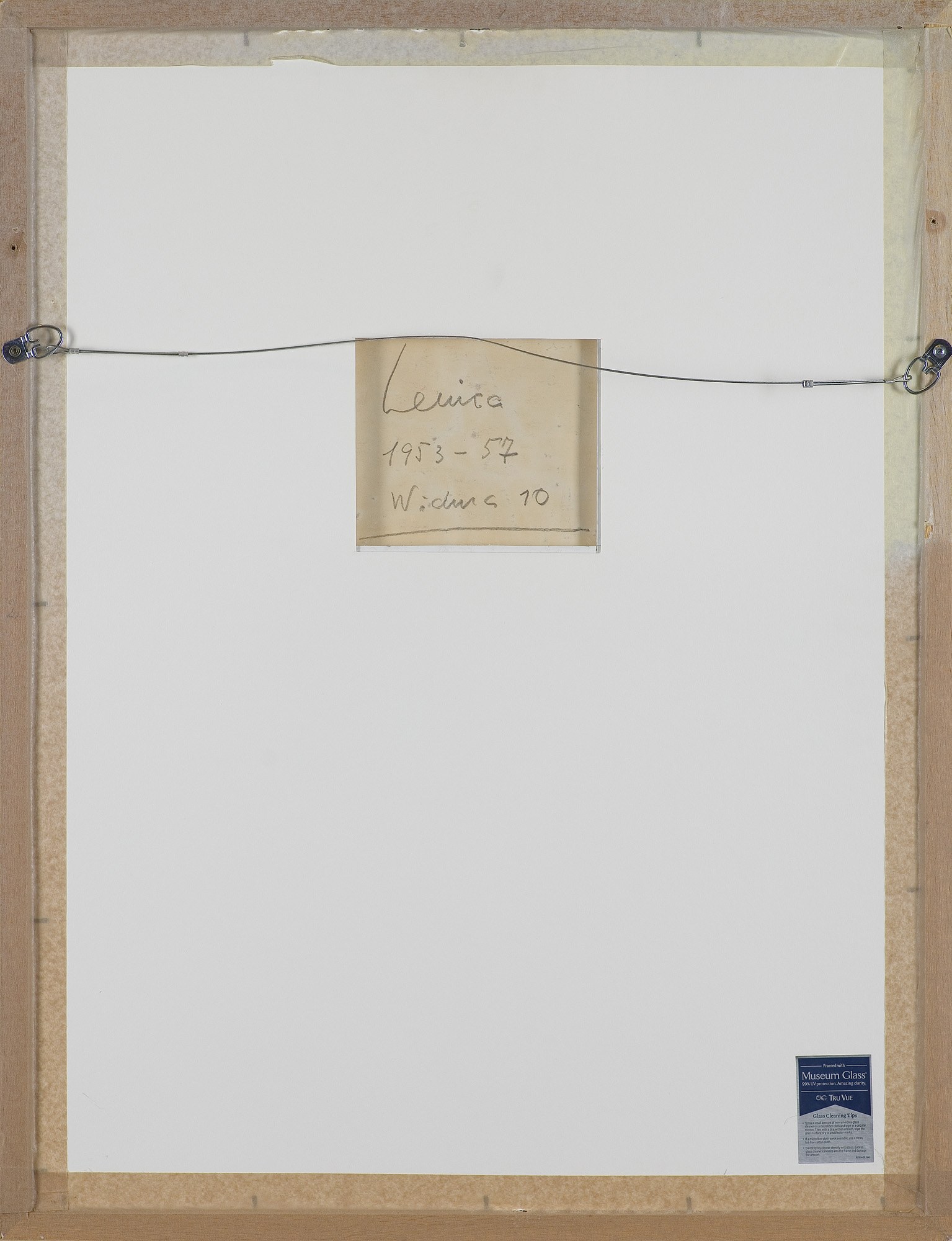
signed in lead on the reverse: Lenica | 1953–57 | Widma 10
Painting exhibited, mentioned, and reproduced in, among others: Exhibition entry:
– Alfred Lenica, Museum Umeni, Olomouc, July 2014;
– Alfred Lenica. Spots in the Sky and on Earth, Piekary Gallery, Poznań, May–July 2022.
Work mentioned and reproduced:
– Alfred Lenica. Spots on Heaven and Earth / Alfred Lenica. Spots on Heaven and Earth, 9/11 ArtSpace Foundation, Poznań 2022, p. 225 (ill. no. 33), pp. 40–41 (black-and-white insert).
– In the artist’s oeuvre catalog: Alfred Lenica. Painting, CBWA Zachęta, Warsaw 1974, unnumbered page, section “Tempera Portfolios from the 1960s,” item 94. Spectra (65 [pieces]).
♣ Droit de suite: ♣ A fee resulting from the right of the artist and his heirs to receive remuneration in accordance with the Act of February 4, 1994, on Copyright and Related Rights (droit de suite) will be added to the Purchase Price.
Alfred Lenica (Pabianice 1899 – Warsaw 1977) studied drawing and painting privately in the studios of Artur Hannytkiewicz and Piotr Kubowicz in Poznań (1925–1928). In the 1930s, he painted figurative works stylistically reminiscent of Cubism. A little later, he came under the influence of Surrealism, which—setting aside the years of Socialist Realism—would become the most significant area of his artistic exploration. From the mid-1940s, he maintained regular contact with the circle of the “Krakow Group” and was friends with Jerzy Kujawski. After moving to Poznań, he became a co-founder of the avant-garde group “4F+R” in 1947 (paint, form, fantasy, texture + realism). He is the creator of the first Polish Tashist painting (*Paints in Motion*, 1949, tempera). During the era of Socialist Realism, he became involved in the official art movement, while also working as an organizer of the artistic scene, president of the Poznań District of the Association of Polish Artists and Designers (ZPAP) (1948–1950), and director of the Fine Arts Studio there. In the late 1950s, he moved to Warsaw, where he also held leadership positions in the ZPAP until 1969. In the second half of the 1950s—following his experiments of the 1940s—he returned to Informel, frequently employing the dripping technique. Around 1958, he developed his own distinctive style characterized by swirling, colorful, and at times calligraphically rendered forms that dynamically filled the canvas. He created them using a technique similar to surrealist decalcomania. This style became the artist’s trademark for the rest of his life. In his paintings, he did not shy away from shapes referencing natural forms (his painting was called “biological”), and in the 1970s, he occasionally incorporated figurative motifs into his compositions. A retrospective exhibition of the artist’s work was held at the Zachęta Gallery in Warsaw in 1974.













最近浏览过的
登录以查看拍品列表
收藏
登录以查看拍品列表