


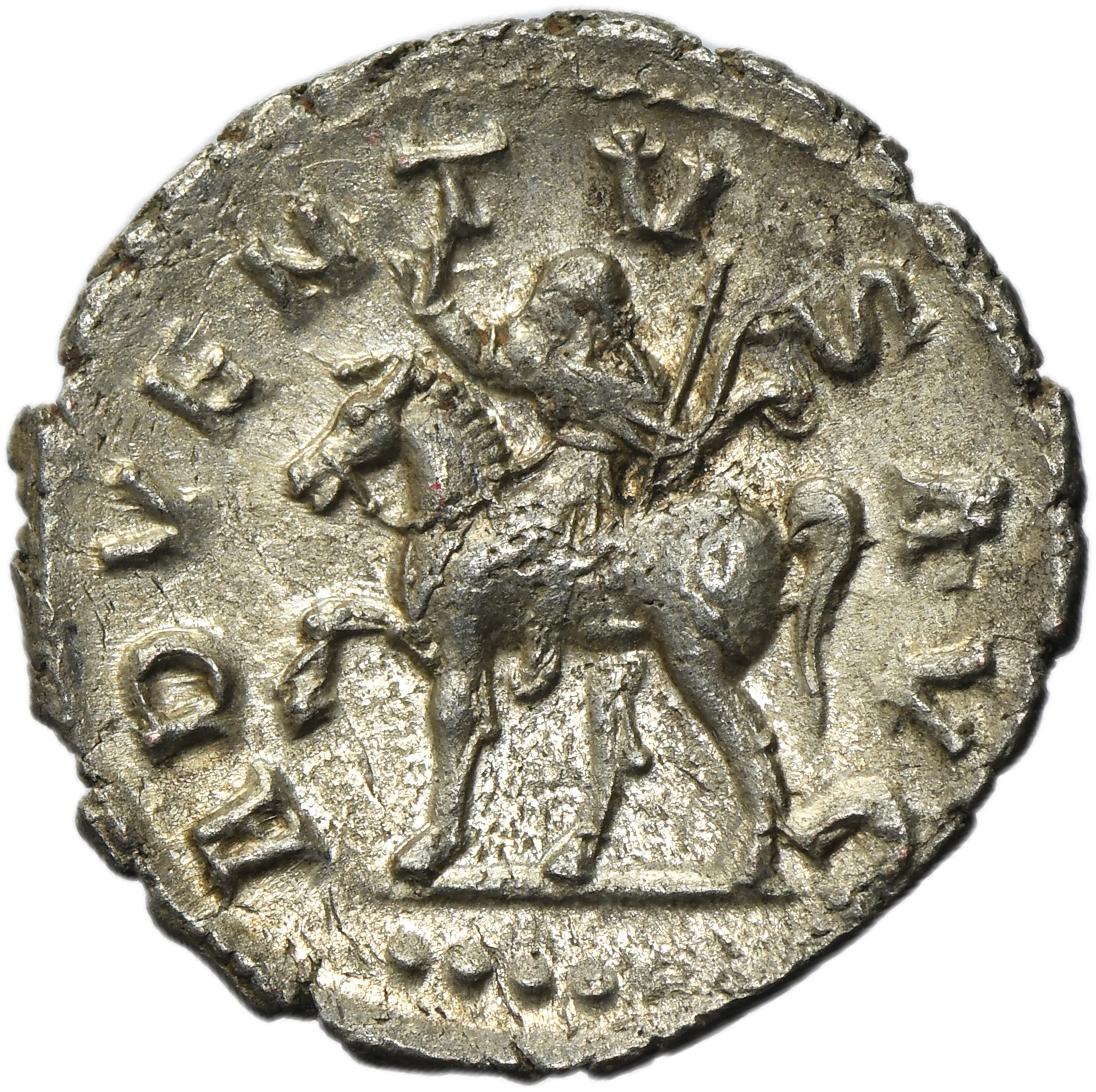


Antoninian of Trebonianus Gallus (AD 251–253), struck at the Rome mint, belongs to issues of his reign in which ceremonial imagery played a key role, emphasizing the emperor’s presence and his function as head of the state.
The obverse presents a radiate, draped and cuirassed bust of the emperor facing right, with the legend IMP C C VIB TREB GALLVS P F AVG, giving his full titulature as pius felix augustus. Beneath the bust appear four dots (••••), part of the control-mark system used in the coinage of this period.
The reverse depicts the emperor on horseback riding left, with the legend ADVENTVS AVG, and likewise four dots (••••) in the exergue. This type belongs to a well-established iconographic repertoire in Roman coinage and refers to the ceremonial arrival (adventus) of the emperor, a key element of imperial ritual.
The adventus motif carried clear propagandistic significance, emphasizing the legitimacy of rule and the visible presence of the emperor as guarantor of order. In the context of the reign of Trebonianus Gallus, marked by political instability and external threats, such imagery served as an important tool in reinforcing imperial authority.
Roman Imperial
Trebonianus Gallus (251-253), Antoninianus 251-253, Rome mint
Obverse: radiate, draped and cuirassed bust right, below ••••
IMP C C VIB TREB GALLVS P F AVG
Reverse: emperor on horseback to left, •••• in exergue
ADVENTVS AVG
Diameter 22 mm, weight 3.36 g











