


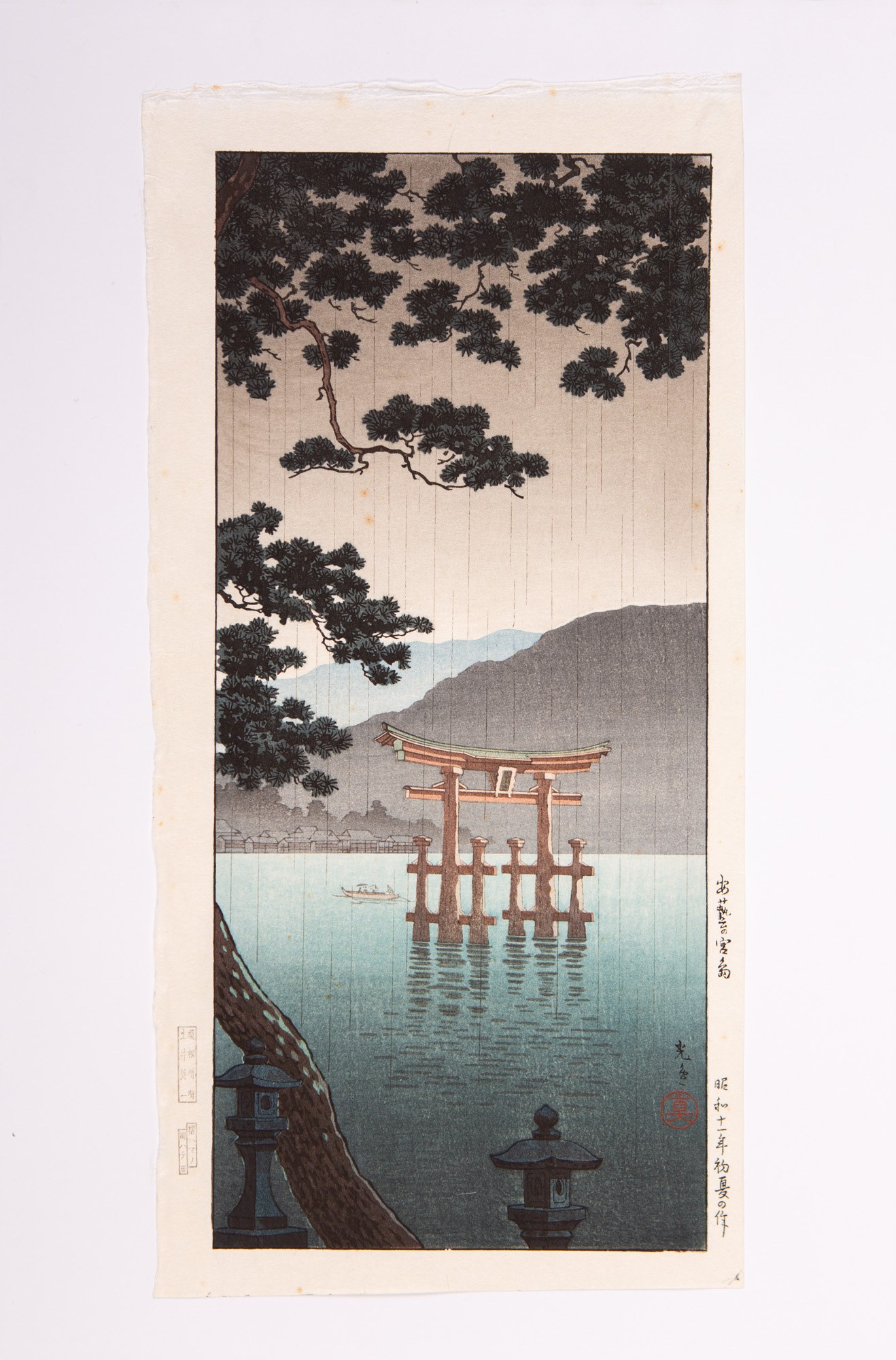
color woodcut on washi paper; print 36 x 16 cm, sheet 40 x 20 cm
signed on the plate: 光逸 (Koitsu), red stamp of the artist
Dated: shōwa 12 (1937), Doi Hangaten edition
State of preservation: the work has been glued in fragments (in the corners) to the sheet.
Provenance: private collection Poland
The composition depicts the monumental torii of Itsukushima Temple on the island of
Miyajima in Hiroshima Prefecture, seen in the rain from the shore with the
stone lanterns in the foreground. The woodcut is an example of the shin-
hanga, in which Koitsu became famous for his masterful handling of light and mood.
Tsuchiya Kōitsu is one of the most prominent artists of the revival of Japanese
woodcut in the first half of the 20th century. His teacher and mentor was
Kobayashi Kiyochika - the precursor of shin-hang, with whom Kōitsu lived and worked
for nineteen years. Initially he worked in war illustration, and from the 1930s onward.
In the 1930s he worked with the Doi Hangaten publishing house, creating landscapes showing
Japan's famous sites - temples, gardens, bridges or night scenes.
Characteristic of his works are light effects, rainy landscapes and atmospheric
depictions of architecture blended with nature. Tsuchiya Koitsu's works can be found in
many museum collections around the world including: Tokyo National Museum (Tokyo,
Japan), The British Museum (London, UK), Los Angeles County
Museum of Art (LACMA, USA) and many private collections around the world.









最近浏览过的
登录以查看拍品列表
收藏
登录以查看拍品列表