


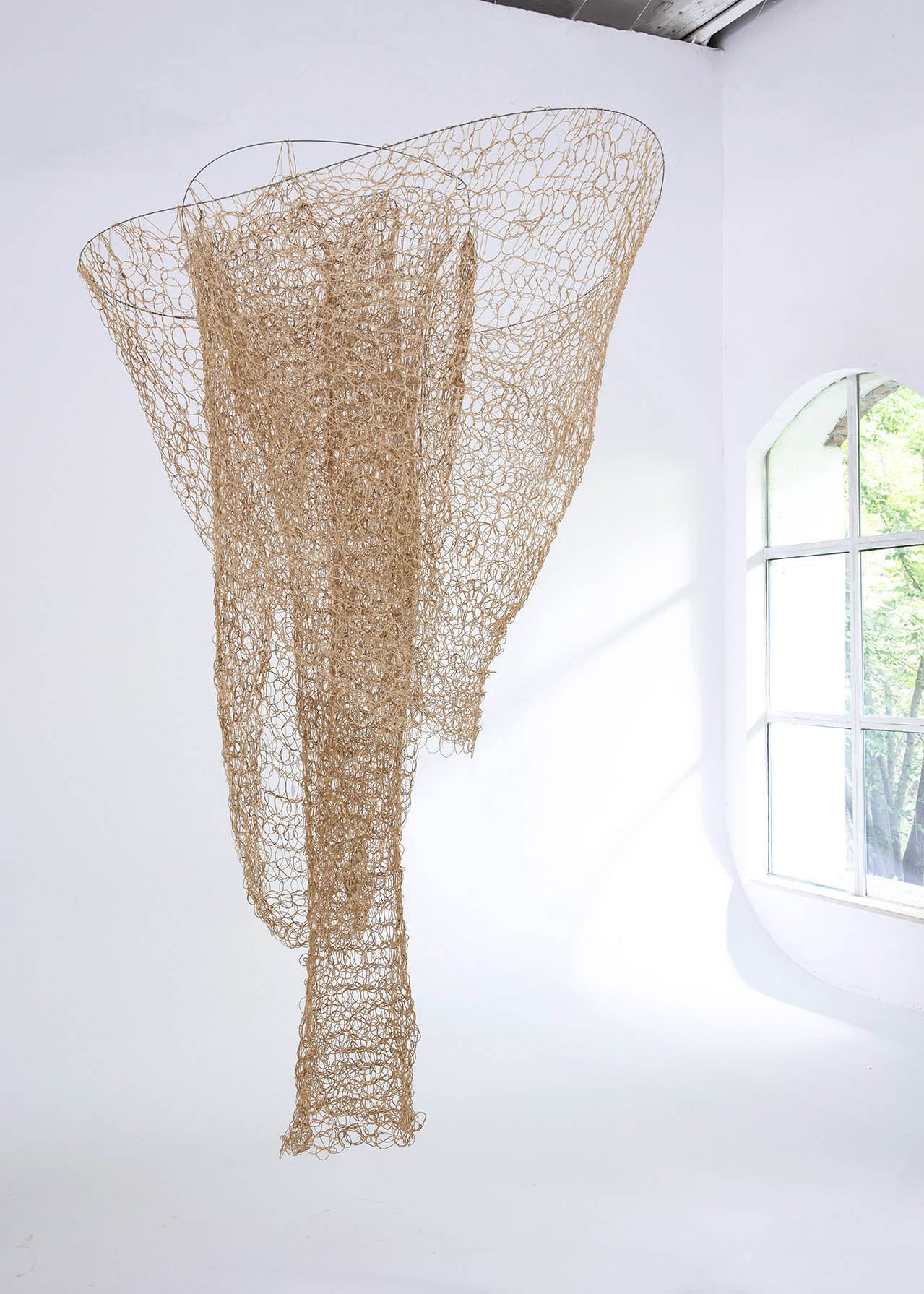


Dimensions: 280 x 210 x 180 cm
The work is accompanied by a certificate of authenticity dated 2026, signed by the artist’s daughter.
Provenance
Warsaw, private collection. Collection of the artist’s heirs.
The work is accompanied by a certificate of authenticity dated 2026, signed by the artist’s daughter.
“Core” is a monumental spatial work created in the 1970s. This piece is an excellent example of Barbara Levittoux-Świderska’s explorations in the field of so-called experimental textiles and soft sculpture. In the 1970s, the artist moved away from the traditional loom in favor of forms constructed in space. To this end, she utilized the natural plasticity and weight of the materials, which, under the influence of gravity, arranged themselves freely. “Core” is made entirely of sisal—a hard, highly durable, natural cellulose fiber derived from the leaves of the sisal agave (Agave sisalana). Since the 1960s, leading female artists of the Polish School of Textiles have successfully used sisal, valuing this natural raw material for its rigidity and simplicity, which allow their works to take on an independent form in space. The nearly three-meter-tall structure is an independent sculptural form that interacts with the surrounding architecture. The title “Core” draws the viewer’s attention to the interior, to a hidden force, or to an organic trunk or biological structure. The raw weave of sisal rope creates a dense, three-dimensional material with a strong expressive power.
Levittoux-Świderska’s monumental, soft structures fit very well into the space. Art critic Danuta Wróblewska wrote about this in the catalog for the artist’s solo exhibition at the BWA Gallery in Opole (1981): “(…) they serve to enliven the interior architecture, which is not a privilege of every form. Not arbitrary in relation to the existing space, they coexist harmoniously with everything within it. Their openwork filters the light, and the background image shines through the light weave; they function both through their surfaces and by drawing space into their depths, integrating with it” (quoted from: Barbara Levittoux-Świderska. Old and New Works, Warsaw 2009, p. 22).
It was precisely with her large-format, spatial textiles that Barbara Levittoux-Świderska captivated the world, joining Magdalena Abakanowicz and Jolanta Owidzka at the very forefront of the artists shaping the New Polish School of Textiles. Beginning in the 1970s, her participation in prestigious exhibitions—including the International Textile Biennale in Lausanne—secured her status and recognition, and the vast majority of her works found their way into European institutional and private collections. Levittoux-Świderska’s body of work is not extensive—the artist wove on her own, without a support network of collaborators and working from home, while raising two children in a small apartment in Warsaw’s Żoliborz district. She was characterized by great diligence and passion, which allowed her to participate regularly in numerous exhibitions.
The appearance on the auction market of a work of such significance as the monumental “Rdzeń” is an unprecedented event. It is a once-in-a-lifetime opportunity for collectors wishing to enrich their collections with a unique work by one of the greatest figures in Polish artistic weaving.










