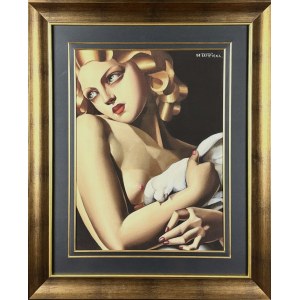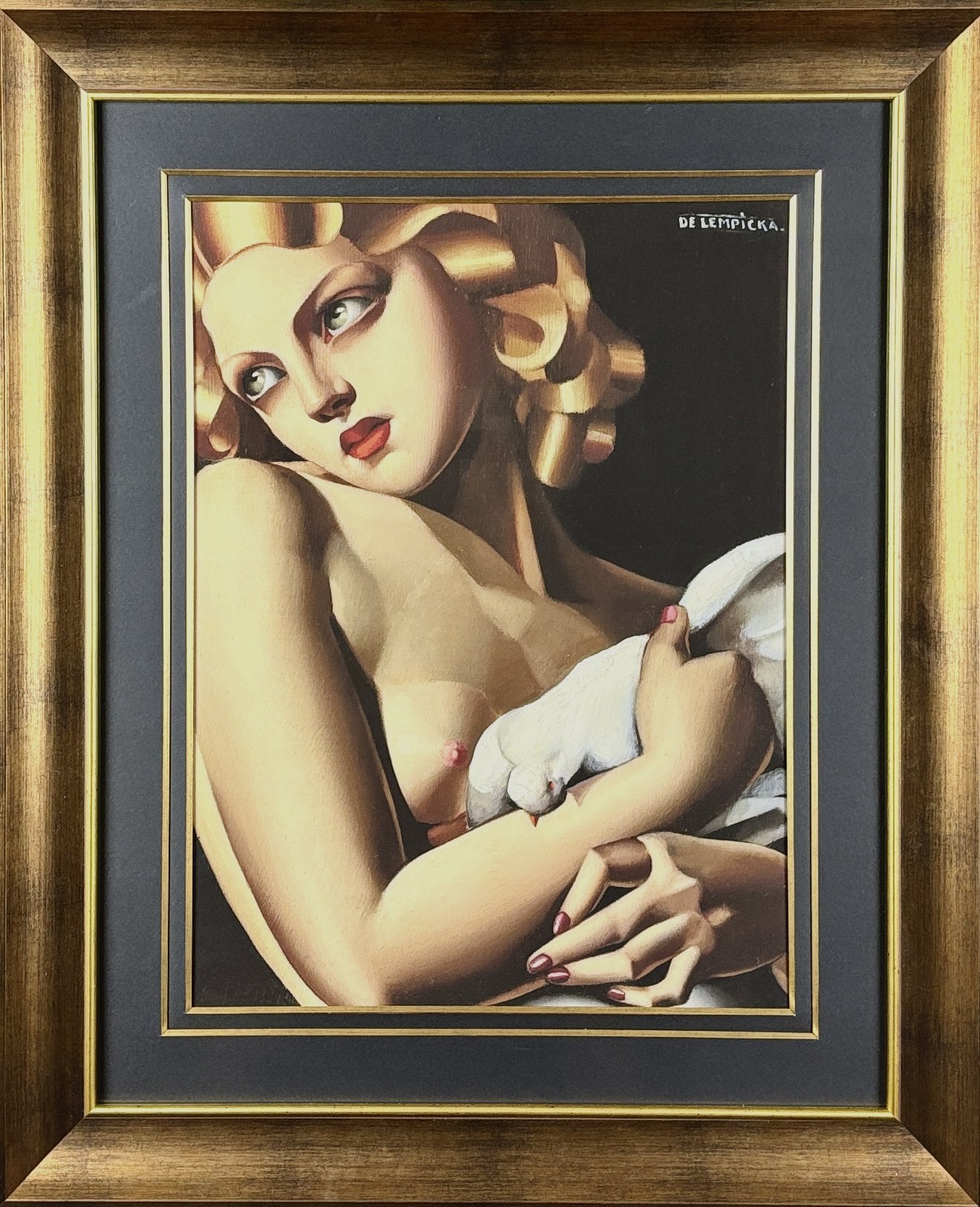
Giclee, Arches velvet paper, 77 x 60 cm unframed; framed and double passe - partout with gold slipcovers
Signature from plate p.d. "LEMPICKA"
Artist: Elite Lithoraphers, Edmonton, Canada
License: Tamara de Lempicka Estate, LLC Canada
Reference: A. Blondel, Tamara de Lempicka, Catalogue raisonné, 1921-1979, Lausanne, 1999.
This is a painting for the connoisseur who looks for more than just scandal in Lempicka. It is a testament to her amazing painting technique - her ability to convey the softness of her feathers, the warmth of her skin and the serenity of her spirit.
One of the most lyrical and subtle paintings in Tamara Lempicka's entire oeuvre, this painting is different - it is Tamara's "gentle face." Instead of a defiant look, here we have melancholy, thoughtfulness and gentleness....
The model's golden hair, painted in the form of regular, geometric waves, is the quintessential hairstyle of the 1920s.Their metallic shine, combined with a dark, deep background, makes the figure.
Many researchers trace the features of Tamara's daughter Kizette to this face, albeit in a slightly more idealized, mature form.
The original painting was for some time (from about 1978) in the private collection of Jack Nicholson, who is a great admirer and collector of Lempicka's work.
"She followed her rules, and they were the rules of the 1920s. She was only interested in people she called "the best" - The aristocracy, the rich and the intellectual elite. Like any gifted person, her mother was convinced that she was due everything the world could give - it was natural for her to meet people who could provide help or contribute to her ego. She lived on Rive Gauche, where artists dutifully lived, and detested anything bourgeois, average or "nice." She wore only luxurious clothes, wanting to dazzle the public and create an aura of mystery around her past, her age, her life in Poland and Russia, and even around her family. A Polish girl from a good home, a minor bride, an emigrant, a young mother - all these figures like screens from a diva's closet were subverted by her painting. In their place came a modern, fascinating, sophisticated, even decadent beauty from the famous self-portrait she painted shortly thereafter for the cover of the fashion magazine Die Dame. "I live on the margins of society," Tamara used to say, "for people like me the common rules do not apply. From the very beginning, my mother's only goal was style."
Literature:
T. de Lempicka, Annotated Photo Albums, Houston, 1923, no. 63 (illustrated).
K. de Lempicka-Foxhall & C.L. Phillips, Passion by Design, the Arts and Times of Tamara de Lempicka, New York, 1987, p. 110 (illustrated).
E. Thormann, Tamara de Lempicka, Kunstkritik und Künstlerinnen in Paris, Berlin, 1993, no. 58 (illustrated p. 189).
Tamara Lempicka - world -renowned Polish artist, icon of art deco and the interwar period. She spent her early youth in Warsaw (where she was born), Switzerland (where she attended boarding school) and St. Petersburg (where she met her first husband Tadeusz Lempicki). During this period she became acquainted with Italy and with it the Renaissance masters who were an inexhaustible source of inspiration.In 1918 she moved to Paris. In the French capital she began to study painting and discovered Cubism which became the flagship of her work. With the outbreak of World War II, she moved to the United States to then spend the rest of her life in Mexico. There she was also "buried", according to the artist's last will her ashes were scattered at the Popocatepetl volcano.
"I painted kings and prostitutes. I paint those who are inspiring to me and make me feel vibrations."