


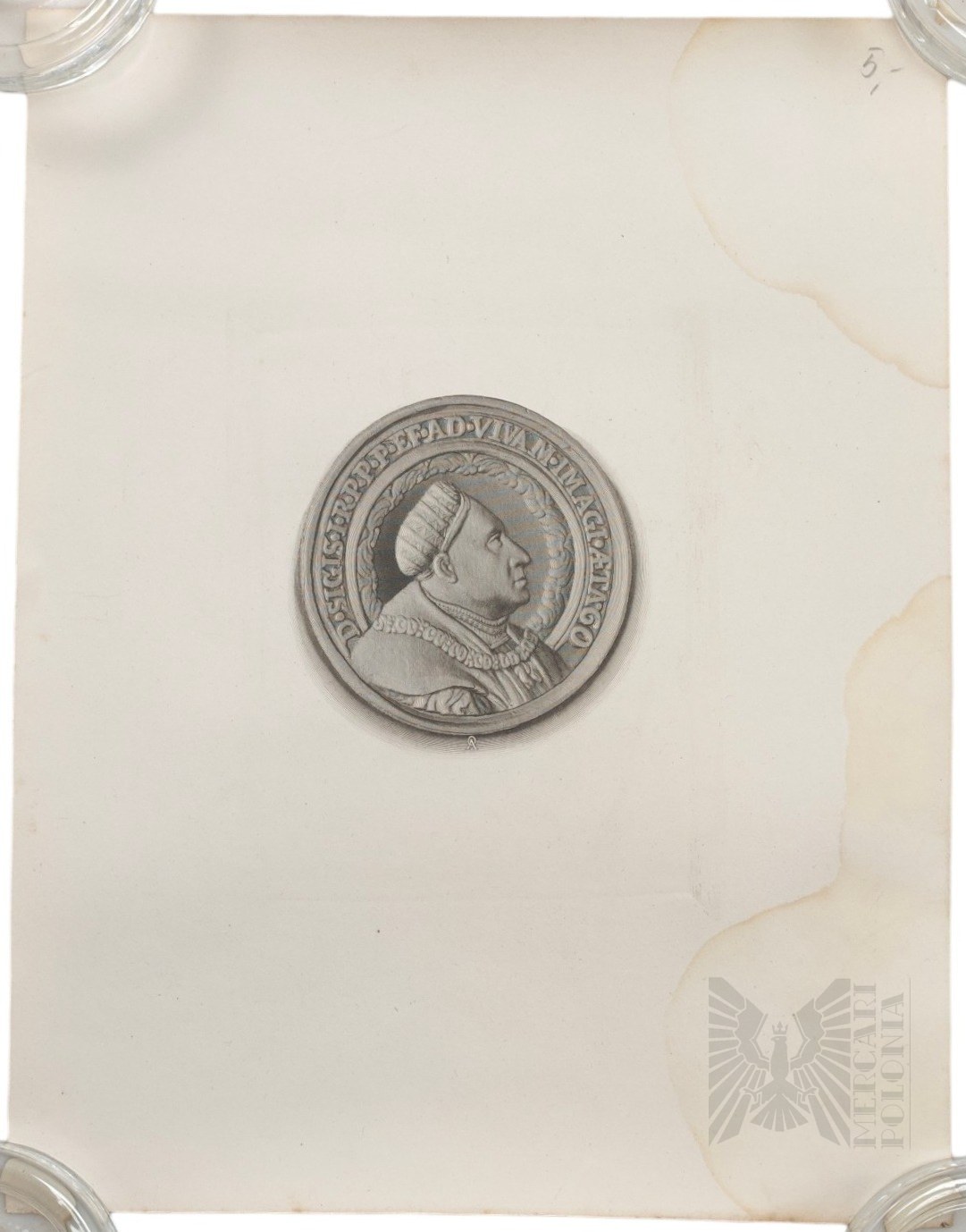
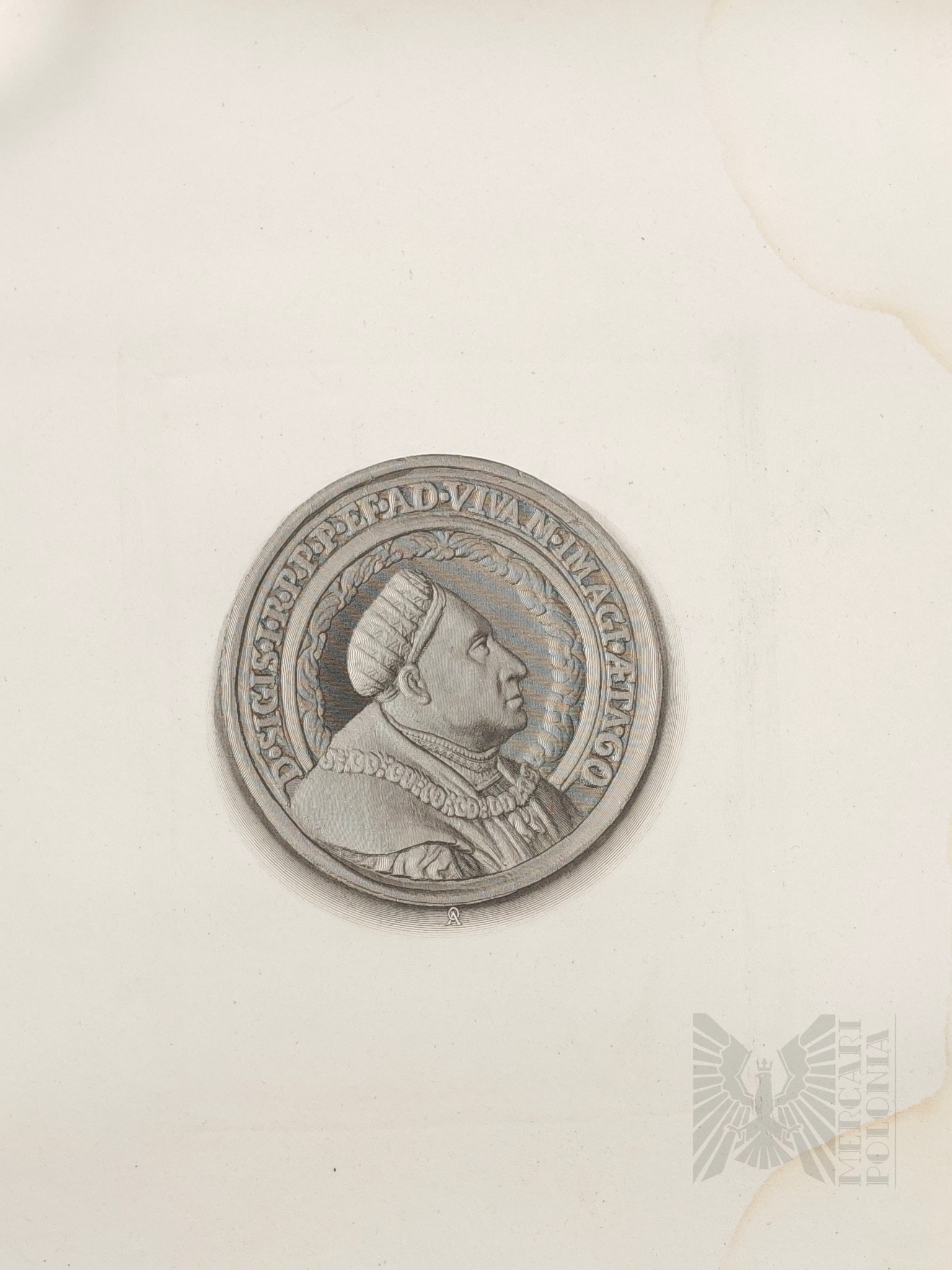
The medallion depicts a profile bust of a man facing right. The figure has short hair hidden by a headpiece or headgear, a well-defined nose and a calm, dignified expression. She is dressed in a robe with softly modeled folds. Around the image runs an ogive with a Latin inscription made in majuscule. The Latin inscription on the surround proclaims: "Divine Sigismund I king of Poland father of the fatherland from nature image pictured at the age of 60". The background of the medallion is delicately shaded, which emphasizes the relief nature of the representation. In the lower part a small monogram composed of the letters "A" and "O" is visible. The whole is surrounded by wide, unprinted paper margins.
Steel engraving
Dimensions: 27,5 x 21,5, medallion 7,5 x 8 cm
Condition as in the photos
The original medallion was created already during the lifetime of Sigismund the Old, drawn up in 1527, came from the circle of Hans Schenk called Scheusslich (or was based on his works).
The presented intaglio is a 19th century interpretation of a Renaissance portrait medallion of King Sigismund I the Old, one of the most important rulers in Polish history. The original medallion was created in 1527, in the circle of Hans Schenk, known as Scheusslich, and is an example of the high-class art of medallic art of the Renaissance era.
The author of the engraving is Antoni Oleszczynski (1794-1879), an outstanding Polish engraver active both at home and in exile. His work is characterized by attention to detail and the ability to translate sculptural and medal forms into the language of printmaking. In the work in question, the artist faithfully reproduces the character of the original, emphasizing its classical, monumental expression. The engravings were printed in Poznań, in/after 1856 (there are discrepancies as to the date of execution).
The graphic was created during the period of heightened interest in national history in the 19th century, when reproductions of images of rulers and heroes played an important role in shaping historical consciousness. This type of work was not only of artistic value, but also educational and patriotic.
The work is part of the trend of 19th-century reproduction graphics of a high technical level and is a valuable example of the reception of Renaissance art in the later period. Thanks to the precision of its execution and its reference to the historical original, it has both collector and documentary significance.
Antoni Oleszczynski was one of the most outstanding Polish engravers and printmakers of the 19th century, respected both at home and in exile. He was born in 1794 in Krasnystaw and died in 1879 in Paris, where he spent much of his creative life. He gained his early artistic training in Warsaw, where he studied drawing and printmaking. Soon, however, he traveled abroad, continuing his studies in the artistic centers of Europe, above all in Paris, which at the time was one of the most important centers of graphic art. There he perfected engraving techniques, especially intaglio, achieving a high level of precision and workshop virtuosity.
Oleszczyński became famous as a creator of numerous reproduction engravings, portraits and historical representations. His oeuvre includes images of prominent historical figures, scenes of a patriotic nature and illustrations for publications on national themes. Works documenting Poland's cultural heritage - including medallions, royal portraits and illustrations for historical and numismatic publications - occupy a special place. The artist collaborated with leading publishers and participated in the realization of prestigious editorial projects aimed at recording and popularizing Polish history during the partition period. His engravings are characterized by exceptional attention to detail, subtle handling of chiaroscuro and high compositional culture.
Oleszczyński's work should be seen not only in artistic terms, but also as an important element of patriotic activity. At a time when Poland did not exist as a state, his works contributed to maintaining national consciousness and popularizing historical iconography. Today, Antoni Oleszczyński's works can be found in museum and library collections, providing an important testimony to the development of 19th century printmaking and a visual documentation of Poland's cultural heritage.











最近浏览过的
登录以查看拍品列表
收藏
登录以查看拍品列表