


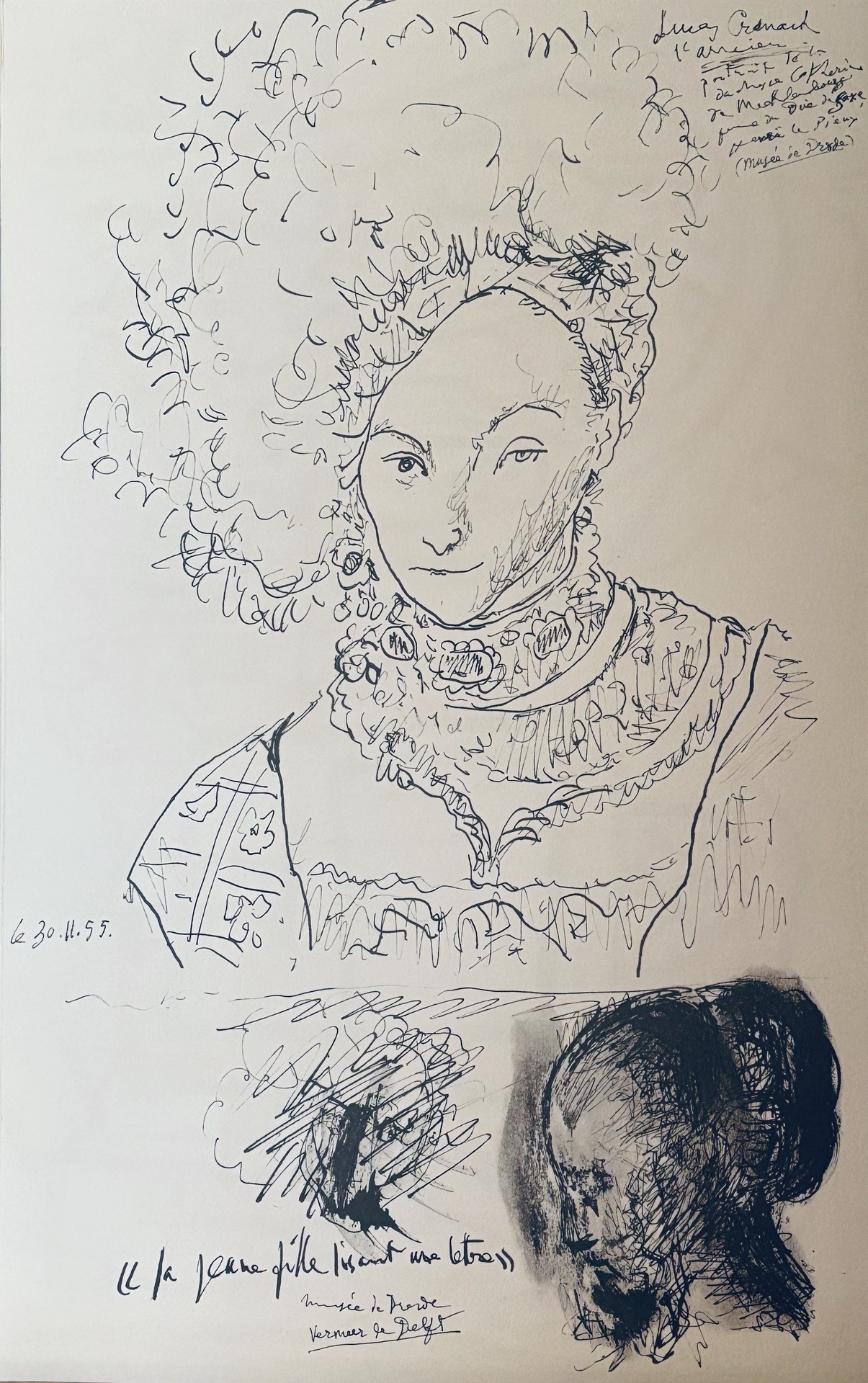
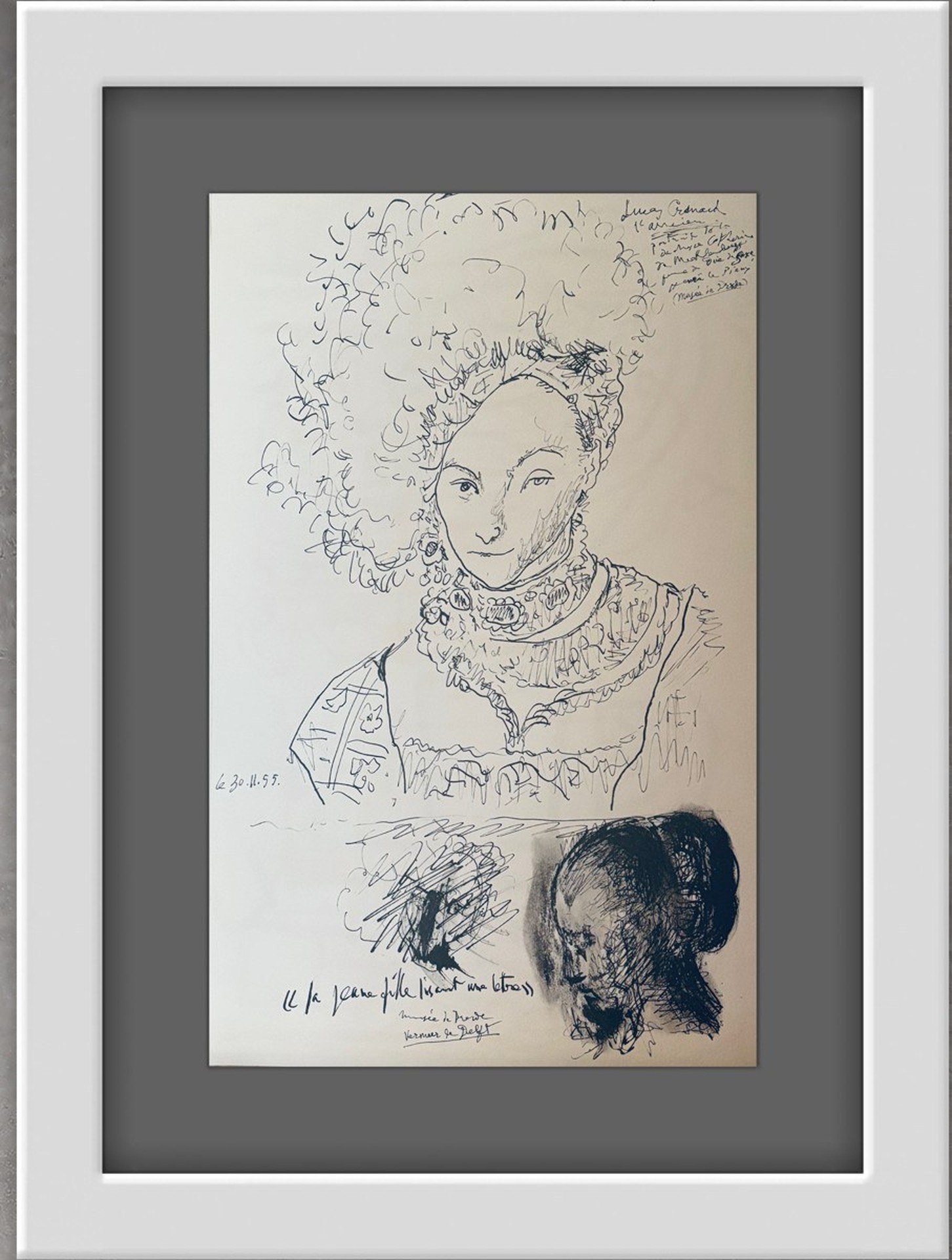
Collector's lithograph on Velin de Rives handmade paper, 42 x 26 cm (composition);
dated on the plate, lower left: "30.11 55.";
French edition; limited edition; inscription on the portfolio cover: "Edizione Unica" (Unique Edition).
Publisher: Cercle d’Art, Paris; produced by the renowned Atelier Mourlot Frères.
The Éditions Cercle d'Art edition is considered a masterpiece of the art of publishing. The artist personally supervised the creation of the lithograph to ensure that its colors and texture perfectly captured his original drawings; the famous Parisian studio Mourlot Frères was the world’s premier location for creating artistic lithographs, a guarantor of the highest artistic quality in lithography—the studio’s name alone guarantees the highest quality and prestige in the world of collecting. A magnet for geniuses: It was here that such giants as Picasso, Matisse, Chagall, Miró, and Braque worked
(Edizione Unica—This term is a declaration of exclusivity. It is used almost exclusively for bibliophile editions, art portfolios, and luxury albums. In this way, the publisher declares that this specific publication has been issued only once. There will be no reprints, reissues, or subsequent editions in exactly the same form).
The work comes from a unique collector’s edition titled “Carnet de la Californie” (Sketchbook from California)—Pablo Picasso’s personal sketchbook, which the artist kept in late 1955 and early 1956. In 1955, Picasso moved into a magnificent 19th-century villa in Cannes known as La Californie. It was there that these sketches were created. The artist turned the large living room into his studio, and the sketchbook is an intimate record of how he lived and created during that period.
The work presented here is a unique page from Pablo Picasso’s sketchbook “Carnet La Californie.” It reveals the artist’s fascinating dialogue with the great masters of early European painting.
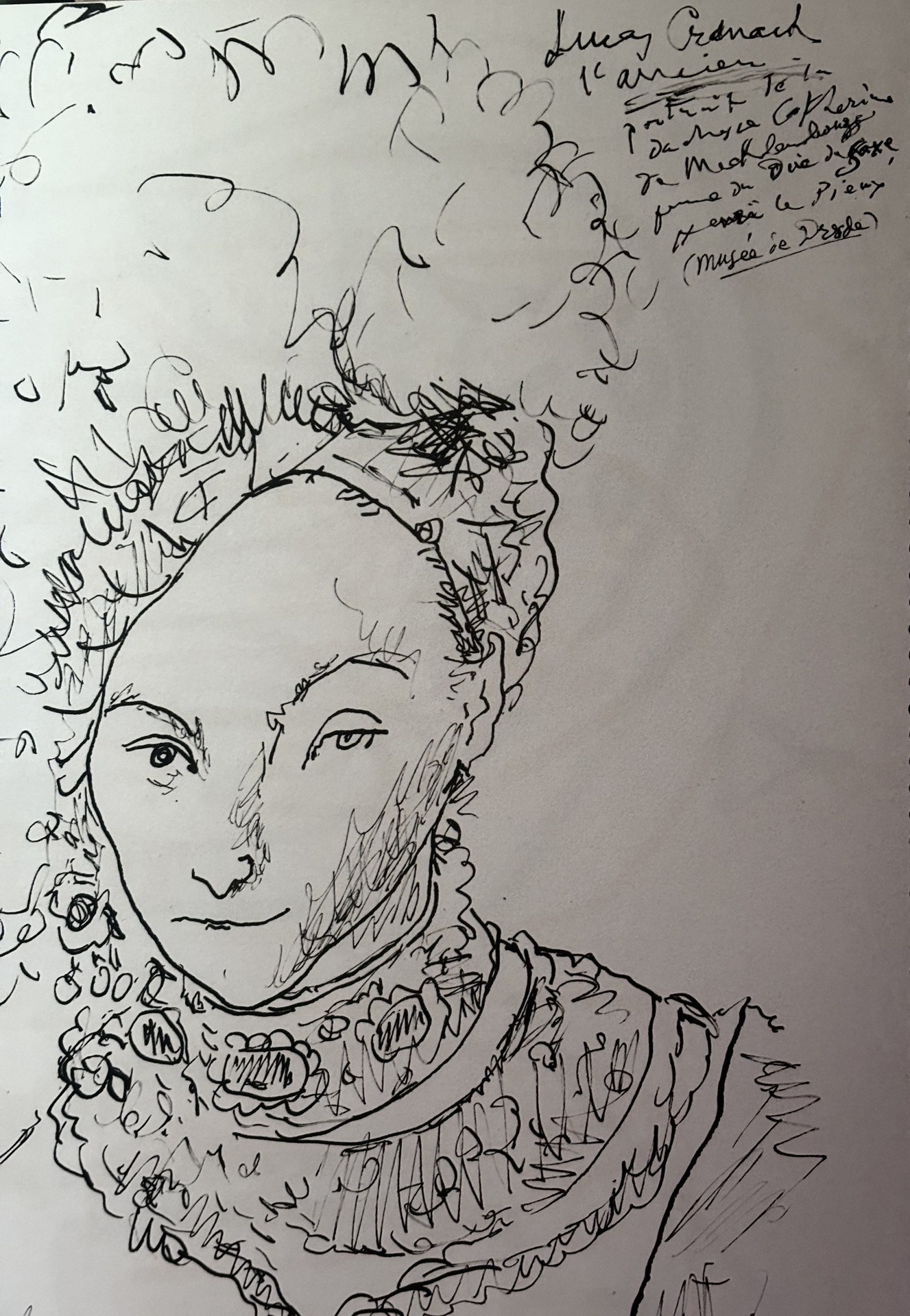
The main part of the page is occupied by a sketch of a woman in elaborate attire and a fanciful headdress or hairstyle. Picasso wrote by hand in the upper right corner: Lucas Cranach the Elder / portrait of Duchess Catherine of Mecklenburg, wife of Duke Henry the Pious of Saxony (Dresden Museum). This refers to the famous portrait of Catherine of Mecklenburg (1514) by Lucas Cranach the Elder, housed in the Gallery of Old Masters in Dresden (Gemäldegalerie Alte Meister).
Picasso interprets this Renaissance work with fluid, almost calligraphic ink lines full of swirls and loops. He very precisely captures the characteristic “Cranach-esque” shape of the face, the slanted eyes, and the intricate, even opulent ornamentation of the collar and hairstyle, transforming them into his own free-flowing graphic language.
At the bottom of the card are two smaller compositions and inscriptions referring to Baroque art.
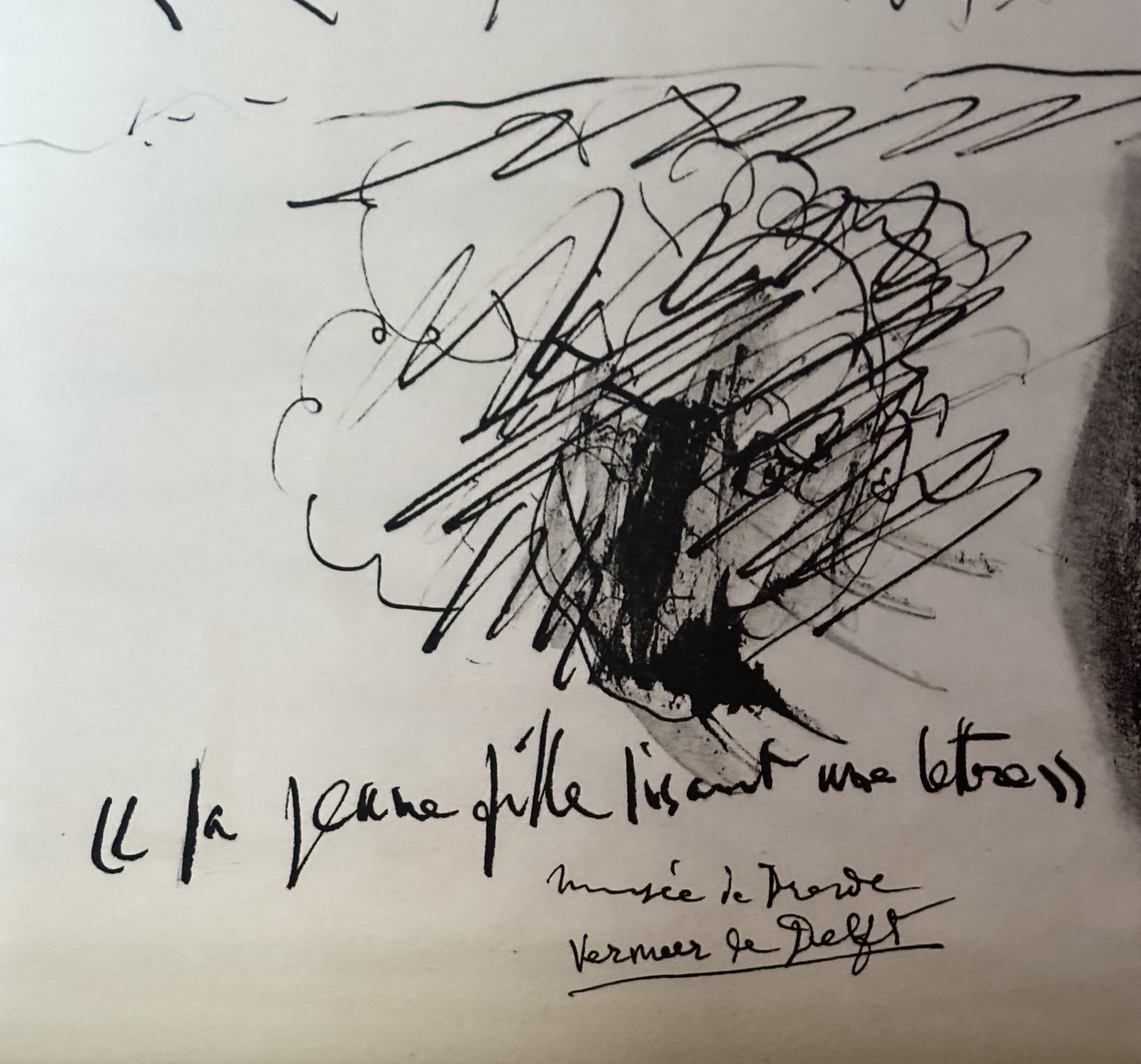
The artist’s inscription: “la jeune fille lisant une lettre” / “Musée de Dresde” / “Vermeer de Delft.” A reference to Jan Vermeer’s painting—“Girl Reading a Letter at an Open Window” (also from the Dresden collection).
On the left side of the sketch: an aggressive, rapid, expressive tangle of sharp lines with a heavily shaded vertical patch in the center.
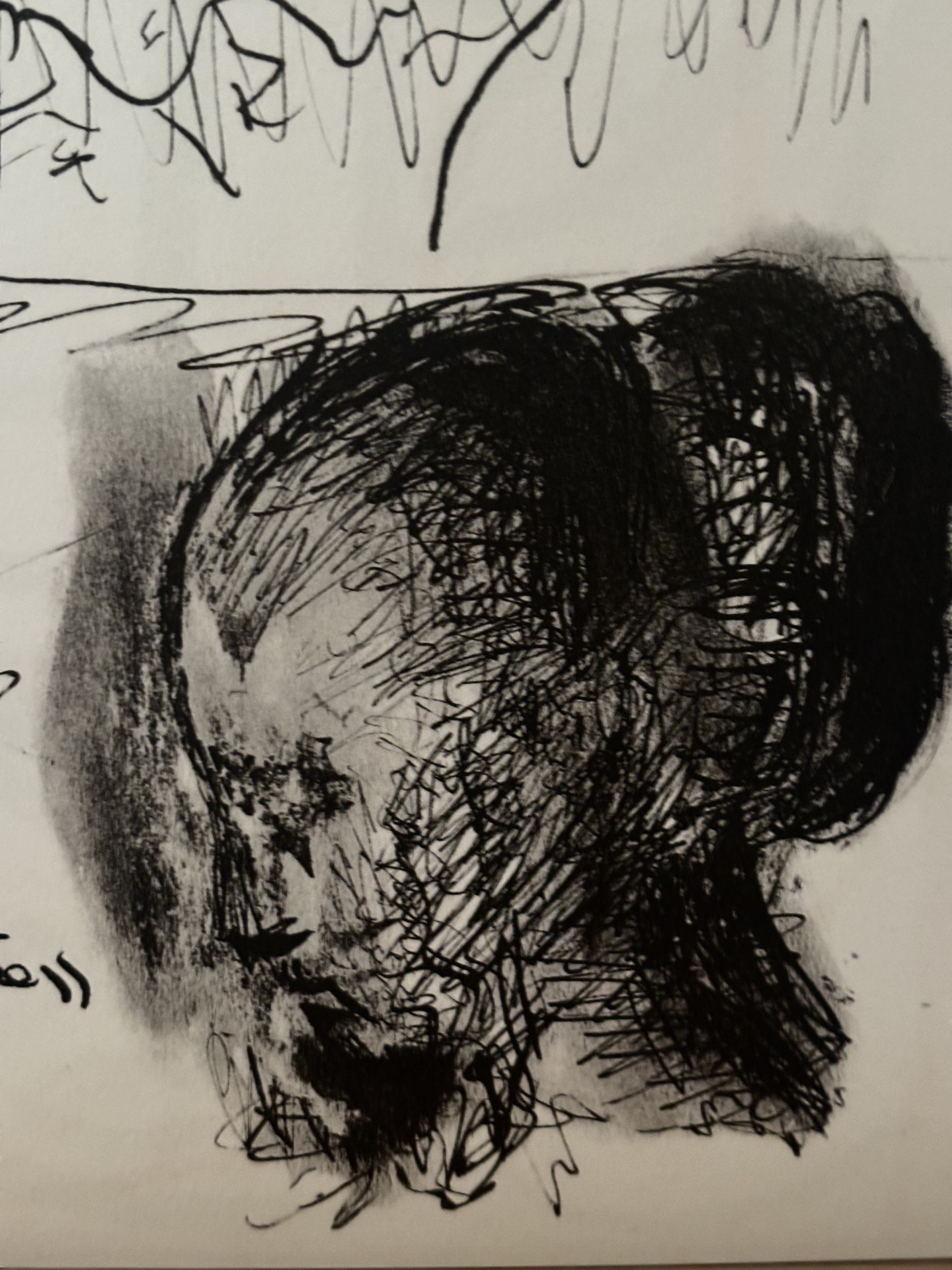
Right sketch: an extremely intense, densely lined and shaded study of a head in profile/half-profile, with an almost sculptural, dark character. Here, Picasso explores mass, chiaroscuro, and the plastic structure of form through dense ink hatching and smudges.
Picasso often worked from art albums and postcards. In this case, on a single page, he gathered his reflections on two masterpieces from the Dresden Museum—Cranach’s decorative, linear elegance and Vermeer’s depth and form. This is a perfect example of how Picasso “appropriated” and transformed the old masters—he did not copy them literally, but translated their style into the dynamic language of modern drawing.
Villa La Californie: In 1955, Picasso moved into the Villa La Californie in Cannes. This was a period during which he intensively produced sketchbooks (carnets) documenting his daily thoughts, studies of form, and dialogue with art history. This is a unique page from Pablo Picasso’s sketchbook “Carnet La Californie,” dated November 30, 1955 (date visible). It reveals the artist’s fascinating dialogue with the great masters of early European painting.
The binding shown in the images is for illustrative purposes only and does not constitute a commercial offer.










最近浏览过的
登录以查看拍品列表
收藏
登录以查看拍品列表