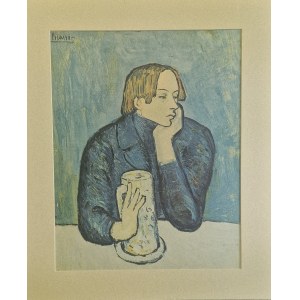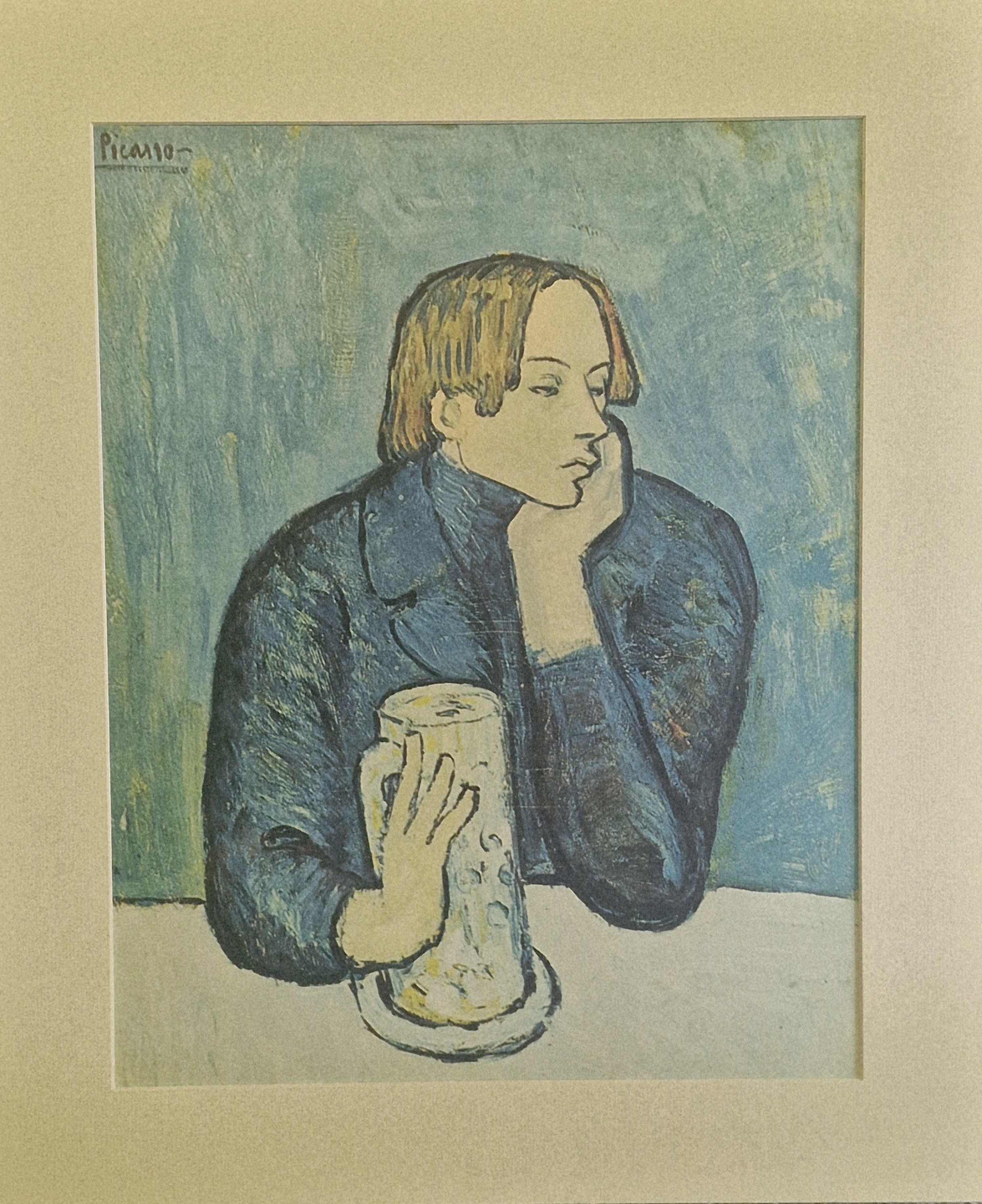
Workshop lithograph, paper 300 g, 47 x 32 cm in light passe - partout, 57 x 42 cm; publisher Centro Diffusione Cultura Milano; paper specially produced for this edition by Cartier Sterzi; edition of 1000 copies; lithographic plates were destroyed to avoid unauthorized prints.
The image according to which, the presented lithograph was created Picasso painted in 1901 beginning his "blue" period (1901-1904) . The original in oil is in the Pushkin Museum in Moscow.
The figure in the painting: The portrait depicts Jaume (Jaime) Sabartés - a Spanish poet, sculptor and close friend of Picasso, who in later life became his personal secretary and custodian of his memory.Composition: Sabartés sits alone at a café table, resting his chin on his hand, with his gaze fixed on space, expressing deep seclusion and melancholy. In front of him is a large mug of beer (le bock).
Among the earliest paintings from his second stay in Paris, this painting shows a move away from the diffuse brushstroke typical of his earlier works to a definite reduction of the image to two-dimensionality. From the subjects of typical folk life, crowds in multicolored places, Picasso moves on to solitary figures, couples and "half-world" characters, grouped in a parsimonious, seemingly flat icon, sculpted like a model print, expressing reality and emotion in mere lines and colors. His anonymous life in the slums of Montmartre, like that of his friend, the poet Sabartès, who described this period in his book "Picasso, Portraits and Memories," the solitude and nocturnal inertia of the café are somehow reflected in this synthesis of color and form. Picasso also resolutely abandons the characterization of the model. Immersed in monochromatic blue tones, once faded, once darkened, the figure becomes impersonal, to instead define the idea of a pensive and melancholic trace of a man.
The Blue period in Pablo Picasso's work, which lasted from 1901 to 1904, was a watershed time marked by a deep personal tragedy - the suicide of the artist's friend Carlos Casagemas in 1901.This event became a turning point for Picasso, which triggered intense melancholy and depression, reflected directly in his paintings. The blue style is characterized by the dominance of cold, muted shades of blue - a color symbolizing sadness, loneliness and introspection. Picasso consciously used this color palette to emphasize the emotional weight of his works, giving them a deep, psychological expression. His paintings from this period are almost a visual poetry of suffering, in which the aesthetics of color are combined with the expressive, simplified forms of the figures.
The blue period was followed by the pink period in Picasso's work between 1904 and 1906. It was a time of optimism and a warming of the image of his works after the melancholic blue period.