


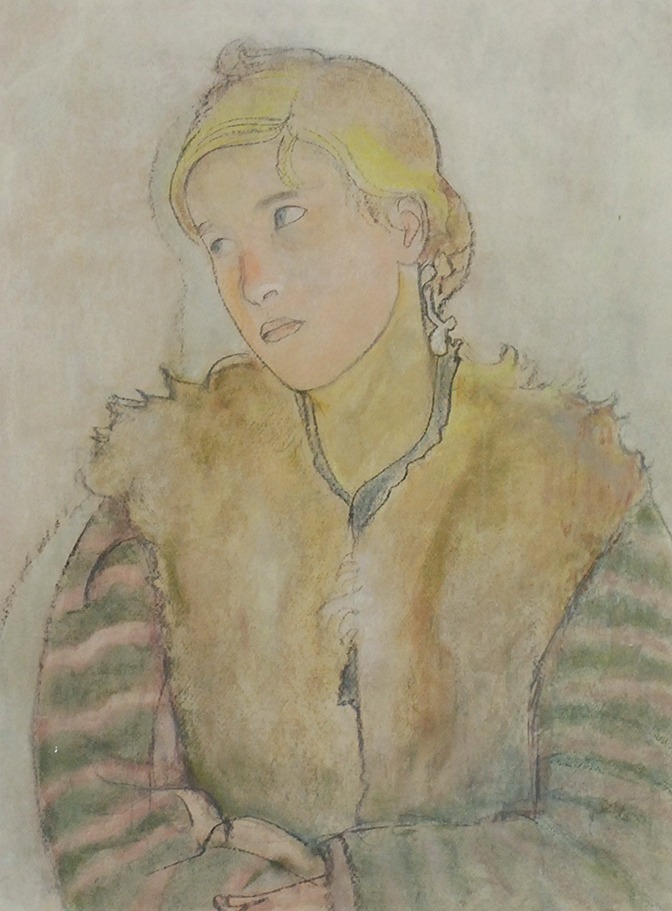

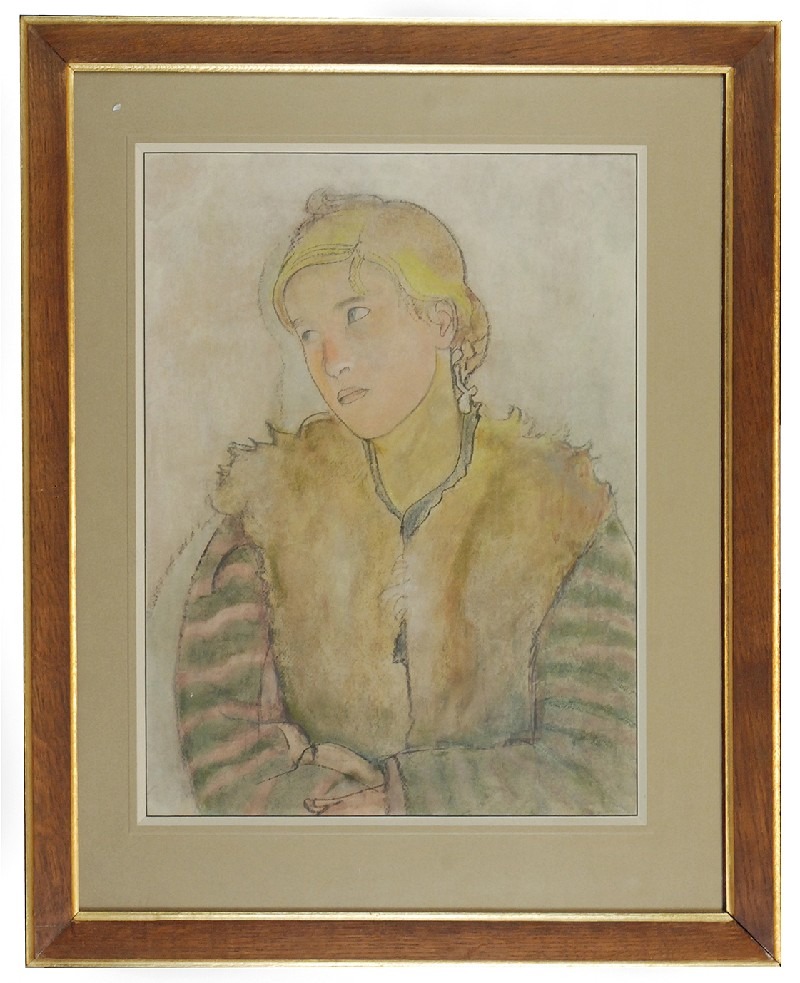
Bust of a country girl,
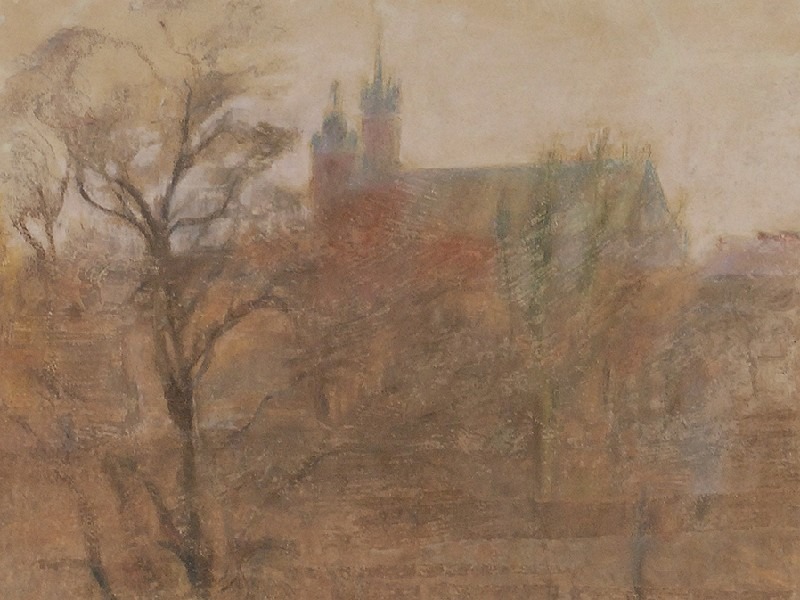
Landscape with St. Mary's Church from the Planty, after 1900
Obverse: Bust of a country girl in a serdak; pastel, ribbed paper; 60.5 x 45.5 cm (light frame);
reverse: Landscape with St. Mary's Church from the Planty; pastel, ribbed paper; 45 x 60 cm (clear to frame);
paintings after conservation;
Authorship of the painting determined by Marta Romanowska (1998) curator of the Stanisław Wyspiański Museum in Kraków.
Obverse of painting reproduced from: Marta Romanowska, Stanisław Wyspiański, Kluszczyński Publishing House, [2004], p. 19, il. nlb.
The offered two-sided composition, which has the expertise of Marta Romanowska from 1998, shows on the reverse a landscape with St. Mary's Church as seen from the Cracow Planty and, on the obverse, a portrait of a country girl in a serdak. Marta Romanowska's discussion of Stanislaw Wyspianski's work begins with the reverse of the composition. Thus, one can
thus, it can be concluded that she appreciates more the artistic qualities of the reverse of the painting, as may also be evidenced by the color reproduction of the composition found in one of the more extensive publications on the artist, in which the landscape from the reverse is more closely dated, namely to around 1900: [reverse] Despite its less than ideal state of preservation, it should be assumed that this is a landscape
evening, night landscape. This is evidenced by the relatively dark and monochromatic tonality of the painting, the preserved light reflections on the trees and the clear horizon - roofs - of the painting. The painting betrays the high level (...) of the pastelist's technique and stylistic features characteristic of the artist's mature style. (...) Thus, another landscape by Stanislaw Wyspianski with the Planty was recovered. Despite
incomplete image of the Planty, this landscape preserves and builds the mood. In turn, one study of Stanisław Wyspiański's work concludes: The Krakow landscape is such an evocative element of Wyspianski's work that one is used to seeing the city through his eyes. Some of the views captured by the artist have remained unknown in the cityscape. His general
principle was to paint from nature. Very rarely were separate preliminary sketches created ahead of the final work. Most often, the artist limited himself to a single study, made at once without returning to it. He had a gift for instantly and infallibly registering form, and equally quickly finishing the entire composition. It is likely that this ability was served by the chosen and perfected
pastel technique to perfection (p. 42).
He discusses the face of the offered work next, to conclude with suppositions about the artistic quality and the time of the work's creation: [obverse] Entire work sketchily drawn with Stanislaw Wyspianski's typical cloisonistic line-contour. The artist marked the shadow cast on the background by the model behind her right shoulder. He subtly emphasized and delineated the
parts of the face modeled more delicately, both with contour and filling in the oval with pastel, from the bust treated sketchily.
Presumably this work was created after 1900. This is indicated on the reverse side by the way in which the trees are worked out, especially their upper parts, and the way in which shadows are laid down and reflections of light are brought out in parts of the horizon - the roofs of the church. In the case of the obverse, the certainty of the contour surrounding the face and "selecting" the figure from the background is closer to his more mature painting experience. As an aside
it should be added that the figures of village girls passed through the Wyspianski household more frequently in the era of their joint ownership after 1900.
In the publisher's entry, Marta Romanowska, discussing the specific technique that Stanisław Wyspiański chose, writes as follows: When deciding to use pastel, Wyspiański had to develop his original technique and find his own form of expression. The original feature of his pastels is the combination of the rough surface of the sub-image - cross-streaked, handmade paper, called Ingres,
with the texture of dry and greasy pastel. The pastel was deposited in the grooves between the lines, creating a unique structure of finely veined "coarse grain." By consciously dosing its amount and exposing the raw subpainting, the artist achieved the intended effect of density and transparency of the painting structure (p. 27).
Other well-known images of Krakow are the works: Chochoły - an expressive nocturnal composition showing Krakow's Planty Park, and a series of pastels - views from the window of the "sapphire" studio to the Kosciuszko Mound - painted at various times of the day and in changing weather conditions. In turn, the portraits, as seen by Wyspiański, are sometimes portraits of
psychological, reflecting the character of the figure immortalized on paper, as may have been the case at the end of the 19th century, when the author frequented the Paon café in Cracow. They can also constitute a "frozen frame" of the everyday life of household members, such as portraits of sleepy or slightly embarrassed children. Nevertheless, each time, the mentioned
compositions are accompanied by the artist's characteristic painting technique, mentioned above by Marta Romanowska, combined with a keen observation of the surroundings and an extremely skilled "artist's hand", which created his compositions in a short time, usually without preliminary sketches. Despite conservation treatments, the offered painting is an excellent example of the artist's use of
by the creator of the artful technique, which Marta Romanowska calls "the artist's masterful claw."
Elaborated. based on: Marta Romanowska, Stanisław Wyspiański, Kluszczyński Publishing House, [2004].










最近浏览过的
登录以查看拍品列表
收藏
登录以查看拍品列表