


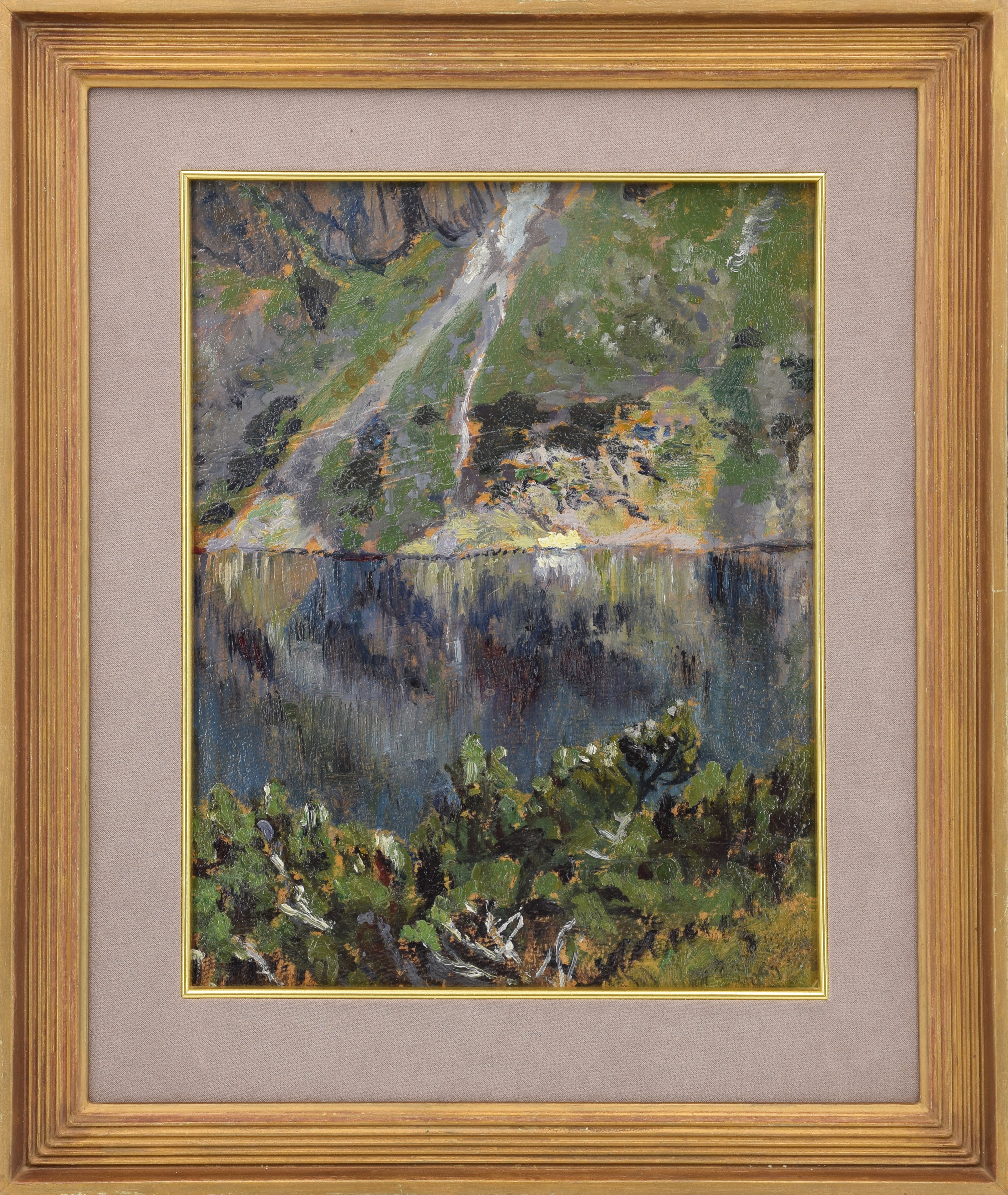
oil on cardboard; 30 x 22.5 cm;
with a National Museum in Kraków deposit label on the reverse.
Provenance:
- collection of Prof. Kazimierz Kostanecki
- on deposit at the National Museum in Kraków until 1957
- 66th Art and Antiques Auction, Rempex 2002
- private collection, Warsaw
The painting comes from the collection of Kazimierz Kostanecki (1863–1940), an eminent physician, anatomist, professor, and rector of Jagiellonian University (1913–1916), as well as vice mayor of Kraków (1914–1918). He was a respected collector and art connoisseur who possessed an impressive collection of works by leading Polish artists, including Artur Grottger, Jan Matejko, Aleksander Orłowski, Jacek Malczewski, Julian Fałat, Teodor Axentowicz, Leon Wyczółkowski, Józef Chełmoński, and others. After the outbreak of World War II, Kazimierz Kostanecki was arrested by the Nazis on November 6, 1939, as part of Sonderaktion Krakau, and deported to the Sachsenhausen concentration camp, where he died. His collection was deposited at the National Museum in Kraków in 1939; some of the paintings were added to the museum’s permanent collection in 1956, while the remaining works were returned to the family.
Leon Wyczółkowski’s Tatra Mountains series represents one of the most iconic and groundbreaking chapters in the history of Polish modernist painting. The artist’s fascination with the Tatra Mountains, which began at the turn of the 19th and 20th centuries, was not merely a capitulation to the Young Poland movement’s craze for Zakopane, but a profound, almost mystical experience of the power of mountain nature. Wyczółkowski returned to the Tatra lakes time and again, creating entire series of studies and landscapes in which the legendary Morskie Oko, Czarny Staw, and Mnich took center stage.
The presented “View of Morskie Oko” is an excellent, intimate example of the artist’s exploration of color and texture. Here, Wyczółkowski abandoned the traditional, panoramic view of the mountains in favor of an extremely modern, even abstract synthesis. The composition is based on a horizontal division, where the water’s surface perfectly reflects the mountain range, blurring the boundary between reality and its reflective image. In the foreground, the artist introduces a dynamically painted wall of mountain pine, which creates depth and frames the bottom of the composition.
The specific nature of the work reveals Wyczółkowski’s mastery in handling color patches. Although the artist is primarily associated with his later, monumental Tatra Mountains pastels, his early, intimate oil studies on cardboard bear the unique mark of a vigorous, almost intuitive painterly gesture. The texture is dense, applied with expressive brushstrokes, which captures the roughness of the rocks and the shimmer of light refracting on the water. The influence of Japanese aesthetics—so prominent during the Young Poland period—is evident in the asymmetry, tight framing, and decorative treatment of patches of green, earthy flashes of sunlight, and deep navy blue shadows










最近浏览过的
登录以查看拍品列表
收藏
登录以查看拍品列表