


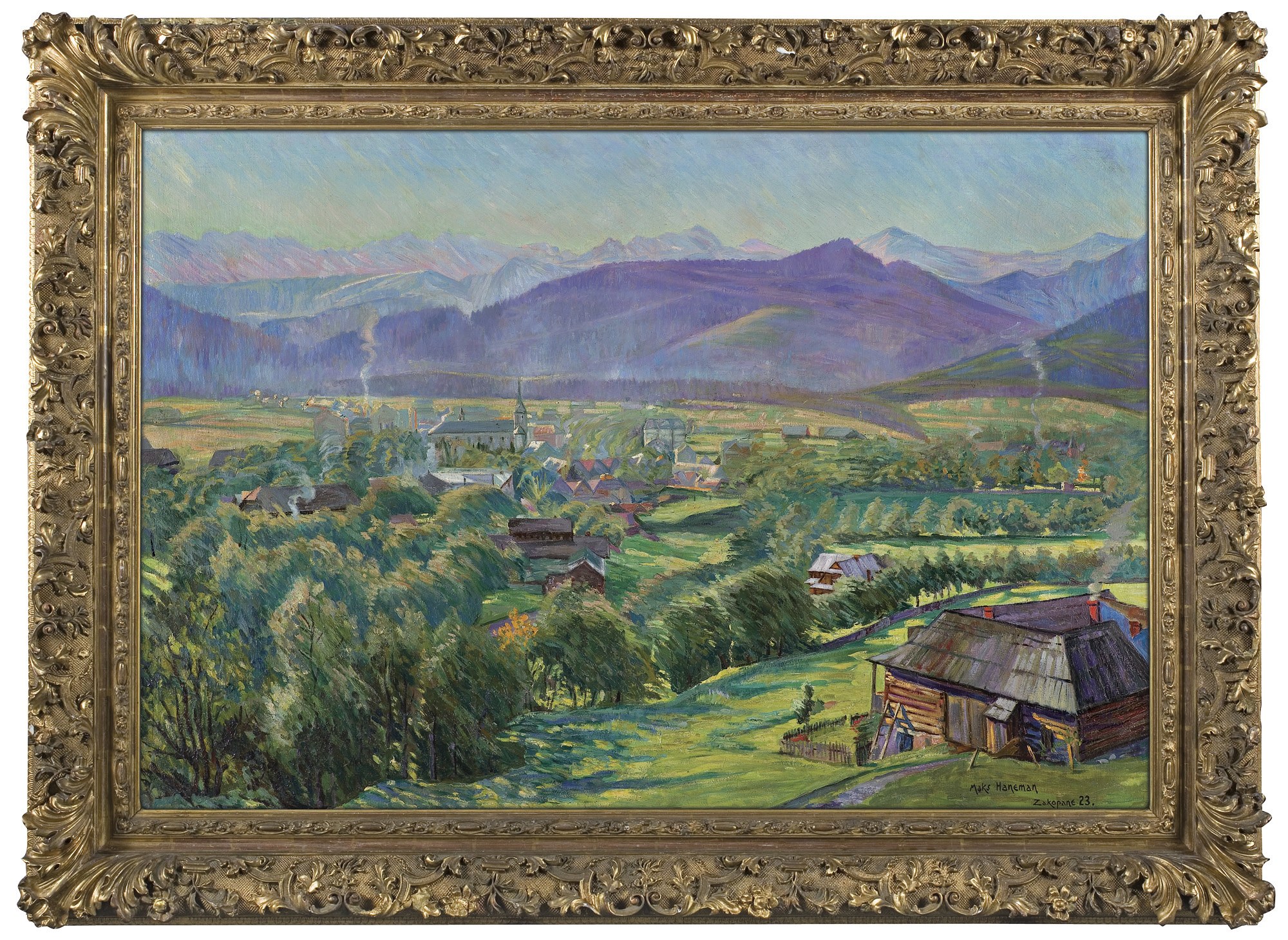
95,0 x 137,7 cm - oil, canvas
Signed p.d.: Maks Haneman | Zakopane 23.
A significant part of the painting oeuvre of Max Haneman, a pupil of Teodor Axentowicz and Leon Wyczółkowski, are Tatra landscapes. The artist settled in Zakopane, while he exhibited his works in Poland (Krakow, Warsaw, Lodz and Lviv) and in Budapest (1930). Among his best-known compositions are views of the Tatra Mountains. Nevertheless, another landscape from Zakopane, with a view of Giewont, was reproduced on a postcard published in 1930.
Maks Haneman (Max Hanneman) (Lodz 1882 - Lodz ? 1941/1944 ?) - studied at the Cracow Academy of Fine Arts under Leon Wyczółkowski and Teodor Axentowicz (1907-1908, 1911-1914, 1919-1920) and at the Warsaw School of Fine Arts (from 1916). He debuted at the Jewish Art Exhibition in Lodz in 1921, showing paintings with Jewish, Oriental and Christian motifs created during a trip to Palestine (including Panorama of Jerusalem, Wailing Wall, Morning Prayer, Al Aksa Mosque, Bedouins in Jericho, Via Dolorosa, Ecce Homo). He belonged to the "Muse" Association, founded by Jewish artists in Warsaw. At the beginning of the 1920s, he settled permanently in Zakopane and there - on Krupówki Street - ran a store selling souvenirs and his own Tatra landscapes, which - along with his Jewish-themed paintings - he showed at numerous exhibitions, including in Lviv (MGS 1924, 1927), Krakow (TPSP 1928), Warsaw (TZSP 1925), Lviv (1927), Zakopane (1930 and 1933) and Budapest (1930). He maintained constant and lively contacts with the Lodz community of Jewish artists; in 1937 he had a large solo exhibition in the hall of the Bnei Brith lodge. At the beginning of World War II, displaced by the Germans from Zakopane, he returned to Lodz. According to uncertain information, he died in the ghetto there. The artist's paintings can be found, among others, in the collections of the Jewish Historical Institute in Warsaw, in the Tatra Museum in Zakopane and in numerous private collections.













最近浏览过的
登录以查看拍品列表
收藏
登录以查看拍品列表