


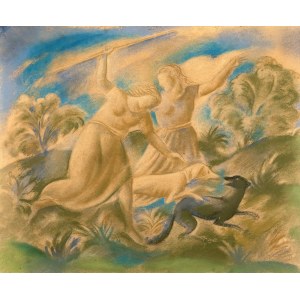
pastel, paper, 32 × 38.5 cm in light passe-partout
Signed and dated p. d.: W Borowski/1934
"Elements of classicism appear in the work of most members of Rhythm, especially in the works of the group's founder. They are a characteristic feature of Waclaw Borowski's painting (...). However, the classicism of the Rhythmists is fundamentally different from what we could observe before. Husarski writes: "it differs in that, among other things, the model is now the art of the early classical periods: the early Renaissance, a bit of pre-Idyslamic Greece (...). In Borowski's case, it is combined with a striving for a harmonious, very balanced and highly decorative composition of solids and colors, at times faintly resembling the calm and bright work of Poussain."
A. Zabiegalowska-Sitek, Warsaw Association of Polish Artists Rhythm: works of rhythmists in the collection of the Historical Museum of the City of Warsaw, "Museum Almanac" vol. 7, 2013, p. 151.
"Borowski represented the classicizing trend in Polish painting of the 1920s and 1930s, while defining his own style perfectly expressing the aesthetics of the interwar period. During the years of his affiliation with the Rhythmists, he shared a special bond of friendship with Eugeniusz Zak. They developed similar motifs with idyllic expression, lyrical mood and allegorical content. They also similarly stylized the landscape and figures of people, reducing facial features (...) Borowski used pastel colors. He brought out forms through subtle chiaroscuro modeling. (...) His depictions also include mythological themes, allegories of the seasons and stages of human life..."
A. Zabiegałowska-Sitek, Warsaw Association of Polish Artists Rhythm: works of rhythmists in the collection of the Historical Museum of the City of Warsaw, "Museum Almanac" vol. 7, 2013, pp. 173-174.










最近浏览过的
登录以查看拍品列表
收藏
登录以查看拍品列表