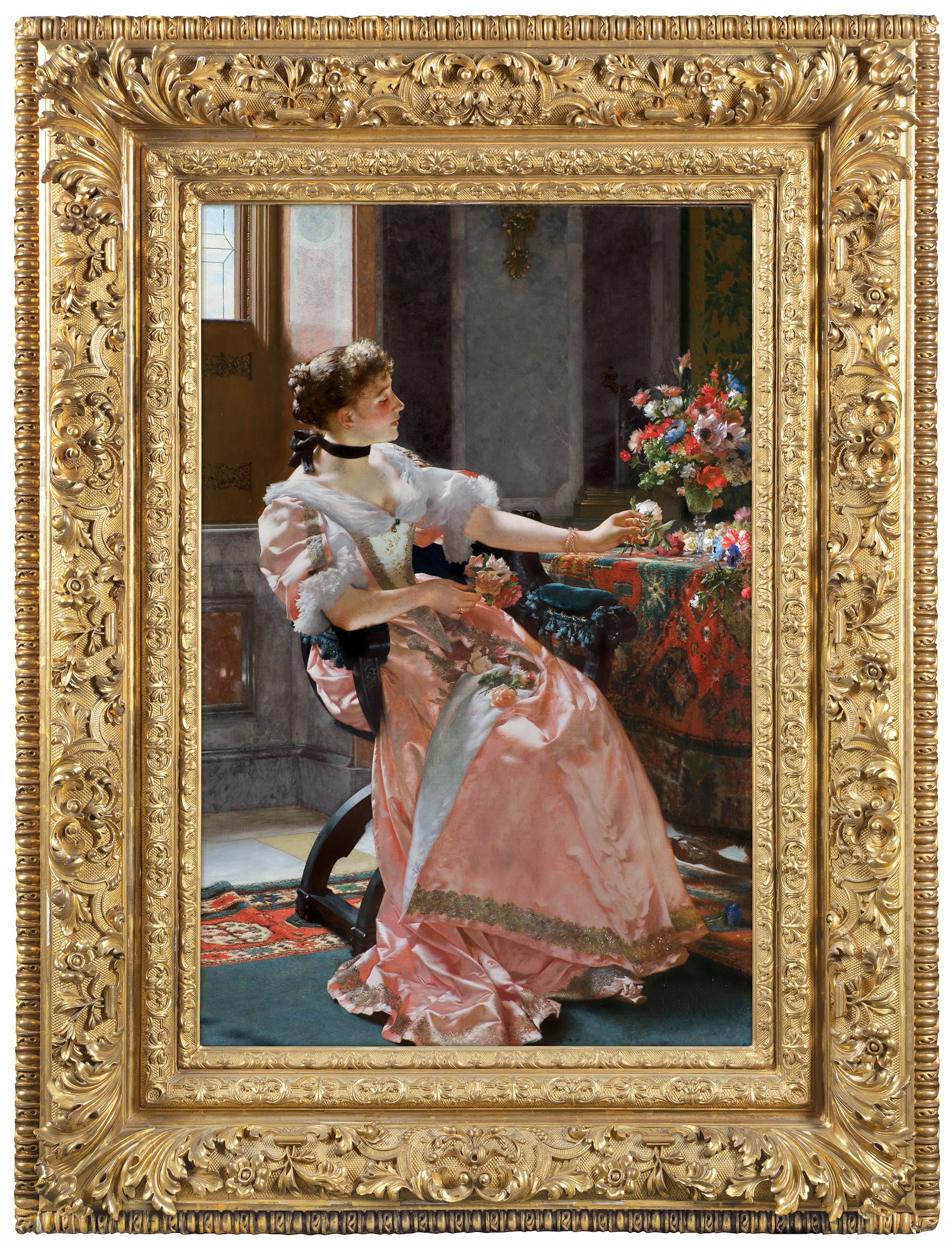
91.40 x 60.80 cm - oil, canvas
Signed on the left (on the pedestal): Czachórski 1891
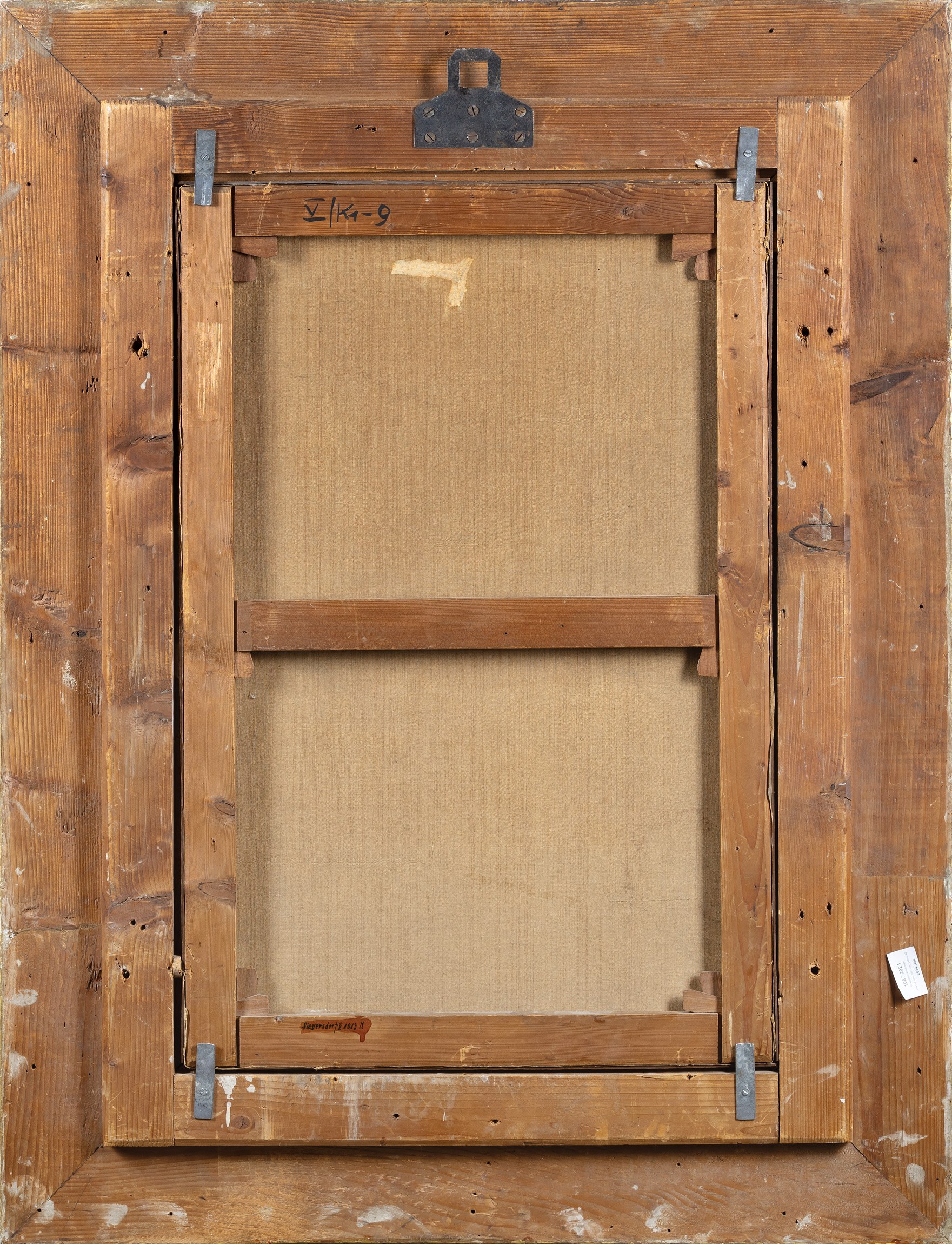
On the reverse, on the loom, l.g. trace of a circular stamp; next to it (in black paint): V /K 1-9; on the crosspiece of the loom, trace of an oval stamp, probably of a store of painting implements; on the bottom strip l.d. (in black paint): Sieversdorf V 1013 K.
Composition described and reproduced, among others, in:- "The Illustrated London News", London, 22 Aug. 1891, no. 2731, vol. 99, p. 241 (The Time of Roses, woodcut by Richard Bong);- Our Engravings, "Tygodnik Ilustrowany" 1892, no. 131, text. p. 15, il. pp. 8-9 (woodcut repr. by R. Bong);- "Illustrated Modern Art and Literature," London, VII 1895 (The first roses, woodcut repr. by R. Bong);- "Literary Feast," 1900, no. 30, il. p. 70 (Spring and Summer, woodcut repr. by R. Bong);- "Wanderer," No. 26, June 17, 1905, p. 484 (The first roses, photo repr.);- Postcard from the series Polish Painting, order of A.J. Ostrowski, Lodz-Warsaw, 1920s, (photo repr.);- Władysław Czachórski 1850-1911 on the ninetieth anniversary of the artist's death, cat. exhibition (texts by L. Lameński, D. Kubacka), Lublin Museum, Lublin 2001, p. 14;- W. Jaroszyński, Władysław Czachórski's life and affairs, Lublin 2004, p. 80 (First rose);- A. Staszewska, Rola kostiumu historycznego w malarstwie Władysława Czachórskiego, [in:] Ateny nad Izarą. Munich Painting. Studies and Sketches, edited by E. Ptaszyńska, Suwałki 2012, p. 261 (First Roses).
His works will become even more valuable with the years, as the flare of actuality will wipe off from them, and they will instead acquire a museological patina. Then they will appear in the full light of their essential value and will last as a symptom of the peculiar mastery of a great artist.
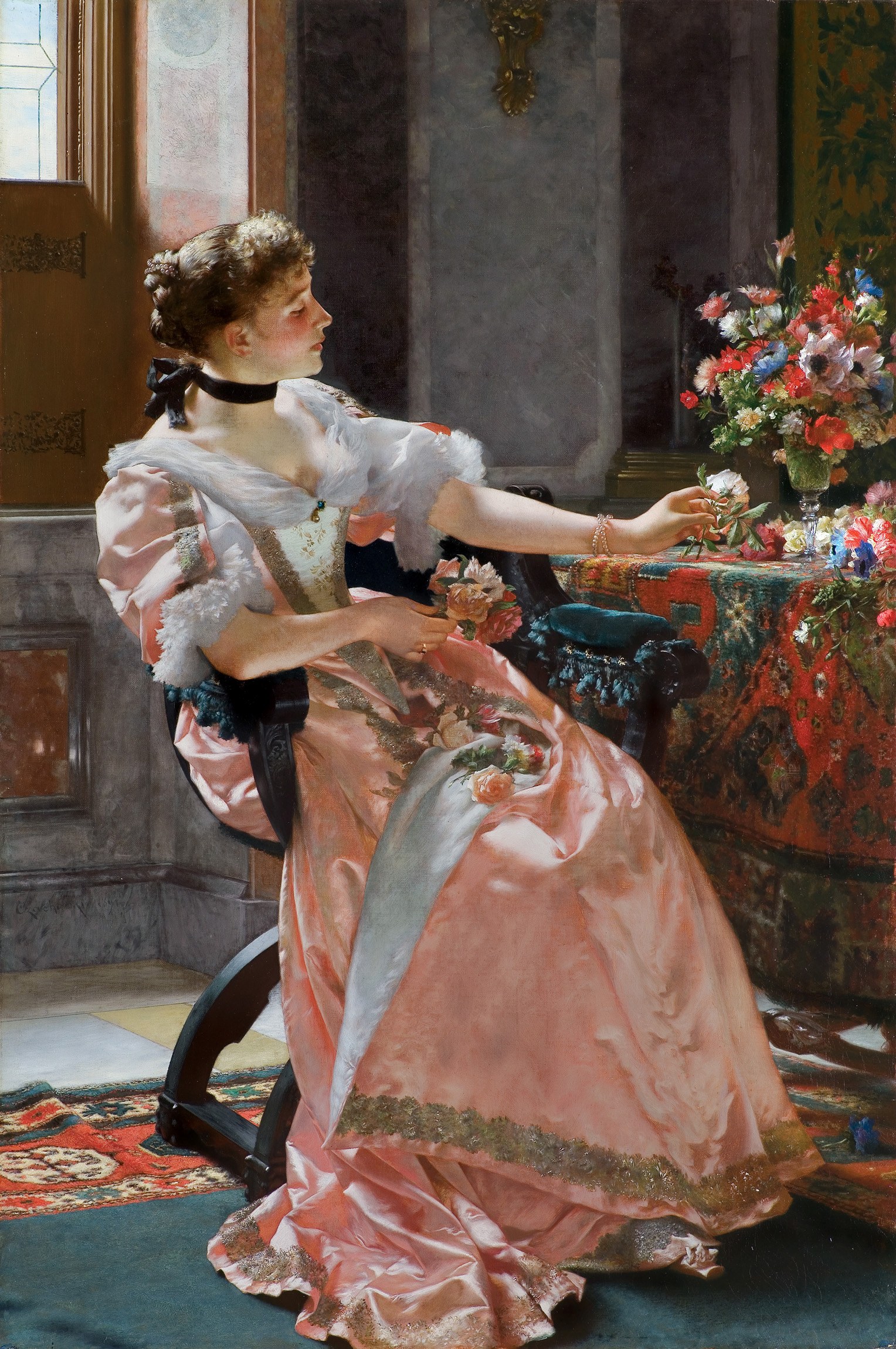
This is what his contemporary art critic, the author of the first biography of the painter and his friend Henryk Piątkowski wrote about Czachórski's work (H. Piątkowski, Władysław Czachórski, Artistic Monographs, T. XI, Krakow 1927). An excellent example of this thesis is the presented canvas First Roses. The composition, known from reproductions in the old press, depicts a charming young lady, who, looking thoughtfully at the first roses that were brought to her from the garden this year, perhaps contemplates at the sight of these flowers that her dreams, her youth, her charms must also wither like a rose in the autumn of life, and this reflection, sad for every woman, coats her beautiful face with a cloud. (quoted in "Tyg. Il." 1892)
The viewer's attention, in addition to the extremely realistic flowers, is drawn primarily to the young lady's dress. Dr. Anna Straszewska, author of The Role of Historical Costume in the Paintings of Wladyslaw Czachórski, describes the various dresses appearing in the artist's work over the years. The first creation used by the painter in salon scenes was a white satin gown a la van Dyck. Familiar to us from the exquisite composition Do You Want a Rose? from 1879 (see Agra-Art auction, III 2021), the next was a white costume inspired by paintings of the third quarter of the 17th century, seen in the painting Lady with a Book, from around 1886 (see Agra-Art auction, XII 2024). The next dress, which has become a hallmark of Czachórski's works, is shown in our painting First Roses. As Dr. Anna Straszewska writes, its cut is similar to the previous white satin coiffure, from which it differs only in color and trim. It was sewn from light pink satin, depending on the version first in a shade of salmon, then lilac. The skirt slit shows a satin underskirt of a slightly darker color - first beige-pink, then apricot, and finally purple. The elbow-length sleeves have the same cut as before, but Czachórski picked up another detail of 17th-century fashion, which was the elongated slits trimmed with metal lace on their inner side, through which the shirt's delicate sleeves are visible. Metal lace was also trimmed around the edges of the top skirt and the front of the bodice, where it highlights the diagonal seams. However, the triangle thus formed was, contrary to 17th century fashion, filled with a decorative insert made of a different fabric, probably silver brocade with a floral pattern (in the first version these are rather large bouquets). This insert refers to bouffant, already characteristic of Rococo fashion. Also reflecting Rococo tastes is the pink color of the dress, not present in 17th century fashion, while an element taken from the 18th century-inspired fashion of the 1880s is the black velvet, adorning the necks of some of Czachórski's models.To the fashion of the second half of the 17th century, however, the trim of the neckline with a thin, transparent white shawl with a teardrop-shaped pearl or brooch pinned in the center is a reference.
When composing First Roses, the artist took inspiration from an earlier piece titled Wedding Gift, 1890 (see Agra-Art auction from December 2015, item 10). Czachórski repeated the figure of a seated woman, but placed flowers in her hands instead of jewels. As always, he recreated the model's delicate beauty, her grace, elegance, the fluffiness of her hair, the softness of her features and her petite hands with remarkable subtlety. He also treated the fleeting beauty of the flowers with equal attention and masterfully recreated the texture of the fabrics, the fleshiness of the carpets, the airiness of the lace and the shimmer of the satin from the light seeping through the window.
The artistry, luxury and splendor portrayed by Wladyslaw Czachórski became the hallmark of his canvases, which were sought after by art dealers and collectors. The aforementioned art critic Henryk Piatkowski wrote with great appreciation about the artist's work: In the plethora of stars that shone on the horizon of Polish art in the last few decades of the last century and gilded with their brilliance this wonderful period of its development, Czachórski's name will remain in the first row as a high expression of technical painting culture and professional excellence. (...) In time, he took a position of such prominence that his works, paid for at a premium by amateurs and collectors, competed victoriously with works by artists of such stature as Florent Willems and Alfred Stevens. (...) Each new work by Czachórski, came out of his Munich studio, was surrounded by the halo accorded to masterpieces. Most of them, passing immediately into the hands of buyers. (H. Piątkowski, Władysław Czachórski, Artistic Monographs, T. XI, Kraków 1927)
This was also the case with the presented work. After being painted, the painting went to a private Berlin collection, where it remained for several generations. Then in 2000 it came to Poland, where, purchased at our auction, it pleased subsequent owners for decades. Today we are pleased to present this outstanding work to you again. The artist spent 1891 organizing the Polish section at the International Art Exhibition in Berlin, where he also served as a commissioner and juror. In recognition of his merits, he was awarded the Order of Prussia, and the Society for the Encouragement of Fine Arts in Warsaw granted him the title of honorary member. The enormity of the work associated with the Berlin exhibition meant that the work presented here is the only known work to date that left the painter's studio in 1891.
All available reproductions - both the woodcut one by the excellent German engraver Richard Bong, published in the Illustrated Weekly in 1892 and in Illustrated Modern Art and Literature in 1895, and the photographic reproduction known from the 1905 Wanderer and a postcard published in the 1920s - present a composition different from ours. The difference is the floral composition on the table. In the reproductions, lilies in full bloom reign in a vase. Our painting is dominated by beautiful anemones. The Literary Feast in 1900 also featured a woodcut reproduction by Bong, but it was titled, not First Roses as before, but Spring and Summer. This may therefore suggest the existence of twin images referring to the two seasons, depending on the flowers placed in the bouquet.
The anemones in our bouquet (right) hint at the spring version, while the lilies featured in the reproduced image (above, repr. from "The Wanderer") allude to summer. There are known instances of Czachórski reproducing his compositions. One example is the story described by Waclaw Jaroszyński in Wladyslaw Czachórski's Life and Affairs, based on the artist's Diary: in 1881 Czachórski painted two paintings for New York; one of them so appealed to the Munich art dealer Kaesser that he asked the painter for a replica.
In his canvases, Władysław Czachórski combines academic perfection of technique with extraordinary sensitivity to beauty, both of the woman and the objects with which she is surrounded. His paintings pay tribute to the elegance, subtlety and sophistication of a bygone era. The women depicted by the artist are not just models in glamorous dresses. They become the embodiment of luxury and romance. The artist emphasizes their sensuality through small gestures - a slightly bowed head, a slender hand that holds a sprig of rose in just three fingers, the neck line is emphasized with a velvet ribbon. Czachórski understood that true beauty lies in harmony, so light also played an important role in his works. Coming in from the side, it illuminates the model, leaving the background in a slight twilight. This treatment makes the woman become the center of the composition and shines like a diamond against the rich interior.
The women painted by Czachórski embody the ideal of late 19th century femininity: delicacy, sophistication, elegance, calmness and dignity. They are not heroines of dramatic scenes, but embodiments of harmony and aesthetic order. The artist created a vision of an orderly world, full of soft light and luxurious interiors, in which the woman is the most precious element of the composition. Today, Władysław Czachórski's paintings delight not only lovers of academic painting, but also all those who appreciate the beauty of classical form. His women wearing gowns from more than a century ago, full of grace and subtlety, still attract numerous gazes from contemporary audiences.
Origins
- From late 19th century private collection, Berlin.
- Heirs of the above.
- Christie's Amsterdam auction, October 2000.
- Private collection in Warsaw (purchased at Agra-Art auction in December 2000).
Painting exhibited, mentioned and reproduced in, among others:
- "The Illustrated London News," London, August 22, 1891, no. 2731, vol. 99, p. 241(The Time of Roses, woodcut by Richard Bong);
- Our Engravings, "Tygodnik Ilustrowany," 1892, no. 131, text. p. 15, il. pp. 8-9 (woodcut repr. by R. Bong);
- "Illustrated Modern Art and Literature," London, VII 1895(The first roses, woodcut repr. by R. Bong);
- "Literary Feast," 1900, no. 30, il. p. 70(Spring and Summer, woodcut repr. by R. Bong);
- "Wanderer," No. 26, June 17, 1905, p. 484(First Roses, photographic reproduction);
- Postcard from the series Polish Painting, order of A.J. Ostrowski, Lodz-Warsaw, 1920s, (photo repr.);
- Władysław Czachórski 1850-1911 on the ninetieth anniversary of the artist's death, cat. of the exhibition (texts by L. Lameński, D. Kubacka), Lublin Museum, Lublin 2001, p. 14;
- W. Jaroszyński, Władysław Czachórski's life and affairs, Lublin 2004, p. 80 (First Rose);
- A. Staszewska, The role of historical costume in Władysław Czachórski's painting, [in:] Athens on the Isar. Munich Painting. Studies and sketches, edited by E. Ptaszyńska, Suwałki 2012, p. 261(First roses).
Władysław Czachórski (Lublin 1850 - Munich 1911) - next to Jozef Brandt and Alfred Wierusz Kowalski, was the most highly regarded and well-known representative of the Polish artistic colony in Munich at the turn of the 20th century. He began his artistic studies with R. Hadziewicz at the Warsaw Drawing Class (1866-1867), then studied at the Academy of Fine Arts in Dresden (1868) and from 1869 at the Academy in Munich, under H. Anschütz, O. Seitz, A. Wagner and K. Piloty. He graduated from the Academy in 1873, awarded a silver medal for his Scene from "The Merchant of Venice." In 1874-1877 he traveled to Italy, France and came to the country several times. In 1879 he settled permanently in Munich and took part in the Second All-World Art Exhibition in Munich's Glaspalast, where he received a gold medal for his painting Actors before Hamlet. Widely appreciated and respected, he was awarded the Bavarian Order of St. Michael in 1893. He was a member of the Munich Kunstverein, a member of the Berlin Academy and an honorary professor at the Munich Academy. He has taken part in numerous exhibitions, including in Munich, Vienna, Berlin, Dresden, as well as in Krakow, Warsaw, Lodz and Lviv. He painted Shakespearean paintings, still lifes, interiors, landscapes, portraits and - above all - intimate salon scenes with figures of beautiful and delicate ladies, who seemingly "enchanted princesses in satin robes live in a world of happiness, carefree, eternal serenity, constant smiling and refinement." The perfection of the workshop, elegance, finesse and mastery in reproducing the details of rich costumes, fabrics, flowers and superfluous objects made these very paintings find the most buyers. Czachórski's success and enormous success on the European art market meant that only a few of his works found their way into Polish collections. Most of them were gathered by a monographic exhibition of the artist's works prepared in 2001 by the Lublin Museum in Lublin.