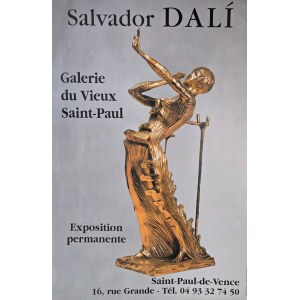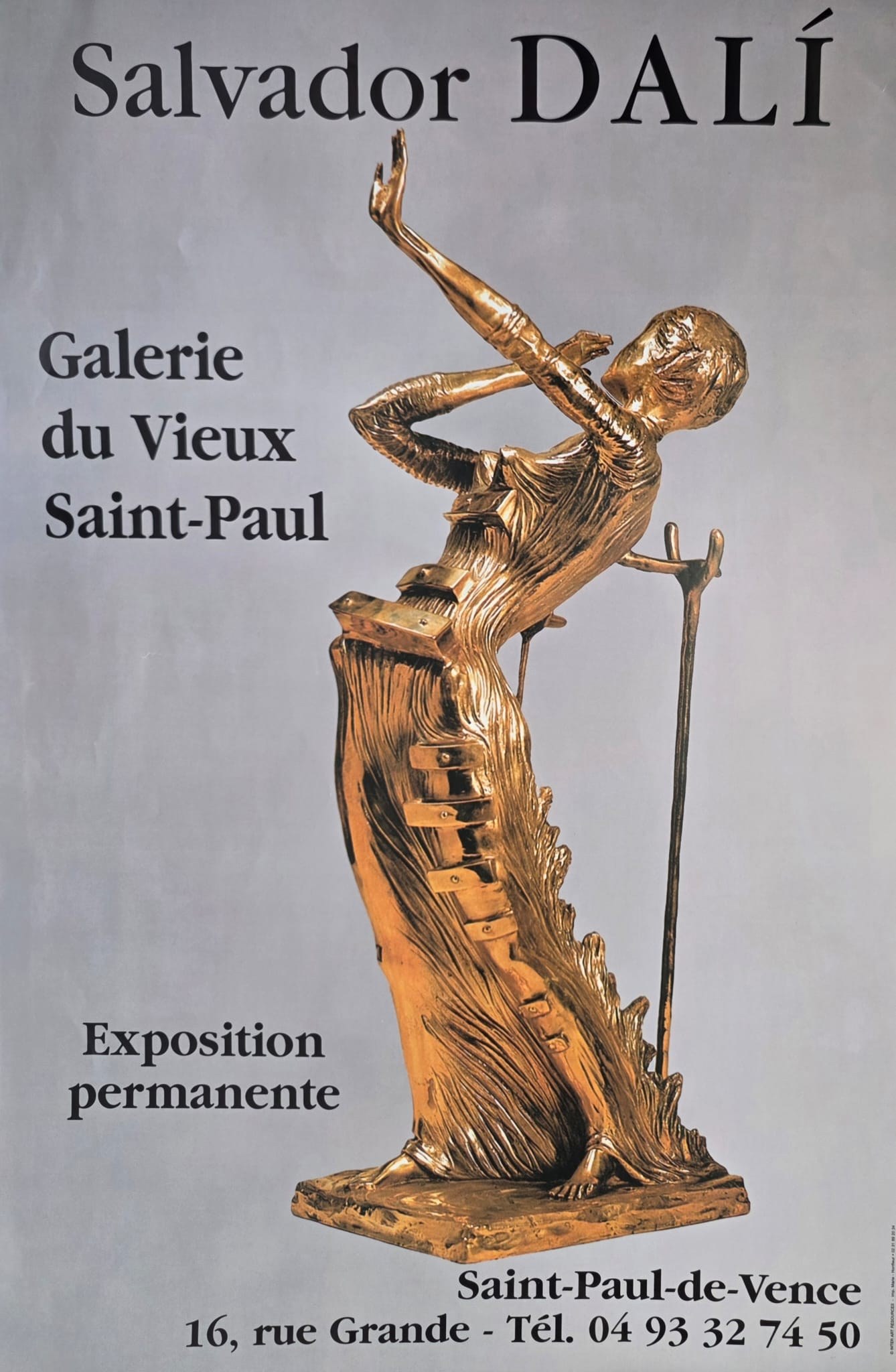
Salvador Dalí Poster, *La femme en flammes*—Poster from the Galerie du Vieux Saint-Paul
Technique: Paper mounted on foam board
Exhibition venue: Galerie du Vieux Saint-Paul—a French art gallery belonging to the well-known Galeries Bartoux chain.
Exhibition type: Permanent exhibition—this indicates that the exhibition is on permanent display.
Location and contact: Saint-Paul-de-Vence, 16, rue Grande –
Main visual motif
At the center of the poster is the sculpture “La femme en flammes” (Woman in Flames), rendered in gilded bronze with a patina. The work combines key motifs from Dalí’s surrealist universe:
Drawers: Placed on the figure’s torso and leg, they symbolize the mysteries of the human subconscious, secrets, and a direct inspiration from Sigmund Freud’s psychoanalysis.
Flames: Shooting out from the bottom of the figure and from her back, they illustrate the intensity of hidden, unconscious desire and passion.
The sphere (support): An element characteristic of the artist, supporting the woman’s limp body arched backward, signifying weakness, stability, and fears.
Dimensions of the sculpture “La femme en flammes”
Edition (gallery version): The sculpture featured on the poster and most commonly found in collections is a bronze edition approximately 84–85 cm tall.
Monumental version: The original 1980 concept of the sculpture also resulted in an impressive large-scale version (often displayed in public spaces in cities), which reaches a height of approximately 3.5 meters (some unique municipal castings are even taller).
Dali’s key symbols in this work
Drawers (Woman-Drawer): The artist drew this idea from Sigmund Freud’s theory of psychoanalysis. Dalí believed that the human body is full of secret drawers that can only be opened by exploring dreams and the subconscious.
Flames: These allude to one of the painter’s most important works—the 1937 painting “The Burning Giraffe.” The flames symbolize inexplicable, primal impulses and a premonition of impending wartime destruction.
Spheres and supports: They appear in nearly every one of Dalí’s surrealist compositions. They represent the fragile nature of humanity, the need for support in the face of our weaknesses, and protection against spiritual collapse.