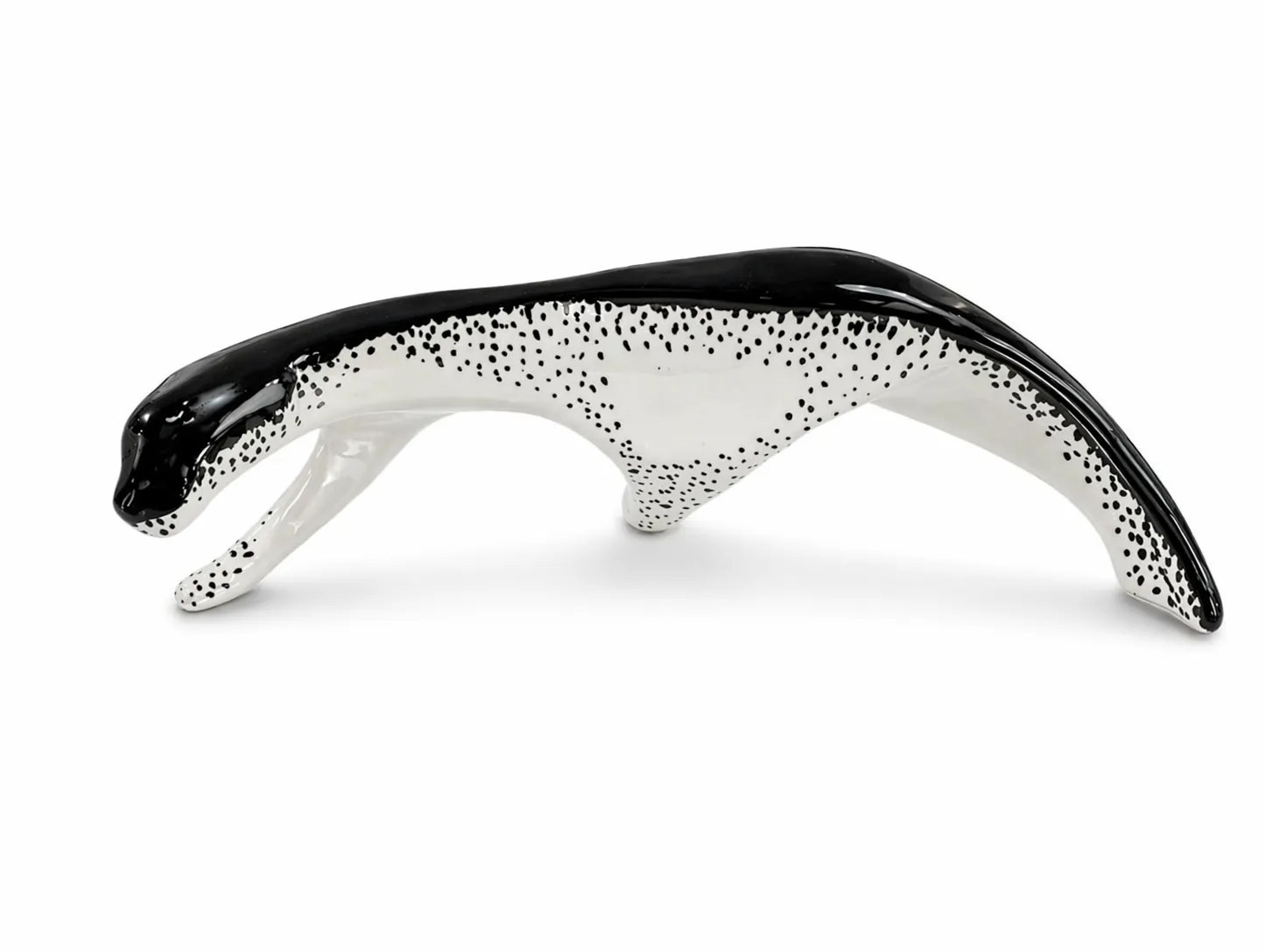
Hand-painted porcelain, signed.
Dimensions: 21x6.5x3 cm
Mieczysław Naruszewicz (Warsaw 1923–2006 Warsaw)—Polish sculptor and industrial designer. From 1947 to 1949, he studied at the Faculty of Sculpture at the Academy of Fine Arts in Kraków under the guidance of Xawery Dunikowski. From 1949 to 1951, he continued his studies at the Academy of Fine Arts in Warsaw, where he received his diploma in 1953. He is credited with work on the reconstruction of reliefs in Warsaw’s Old Town Square (including *The Weasel* and *The Rooster*). Naruszewicz was also a member of the team responsible for the reconstruction of the Fryderyk Chopin monument in Łazienki Park. In 1956, he joined the Institute of Industrial Design; initially, he worked as a designer in the Ceramics and Glass Department, where, starting in 1958, as part of a team with Henryk Jędrasiak, Hanna Orthwein, and Lubomir Tomaszewski, he designed small, intimate sculptures known as “Ćmielów figurines.” B. Banaś identified 44 forms created by Naruszewicz. They mainly depict animals; they are characterized by a synthetic style, expressed, among other things, in the reduction of the number of points of support by joining the animals’ limbs. Naruszewicz’s figurines are also among the most dynamic in the IWP’s collection; the way the object’s silhouette is curved conveys a sense of movement. Starting in 1961, he designed for the IWP’s Department of Transportation Vehicle Design. He developed designs for car bodies (the Warszawa 210 and Star 200 models), scooters (the Osa), trams, locomotives, and passenger railcars. However, none of his designs went into mass production—proposals from other teams were selected (as in the case of the Osa), or the designs remained at the prototype stage (as in the case of the Star 200) or as conceptual studies. In addition to his design work, the artist also served on ministerial selection committees—from 1958 to 1970, he was a member of the Evaluation Committee of the Ministry of Culture and Art, and from 1963 to 1964 — the Evaluation Committee of the Ministry of Education. From 1976 to 1983, the artist headed the Design Studio at the “Predom” Association of Mechanized Household Equipment. He designed household appliances such as irons, mini toasters, waffle makers, butter churns, fans, coffee makers, refrigerators, juicers, vacuum cleaners, and shower stalls. In the 1980s, he continued his design work as a freelance designer. In the field of monumental sculpture, the artist created the Monument to the 1,000th Anniversary of the Polish Cavalry in Warsaw. Other works by Mieczysław Naruszewicz are held in the collections of the National Museum in Wrocław, the Museum of the History of the Polish Revolutionary Movement in Warsaw, the museum in Halle, and in private collections.