


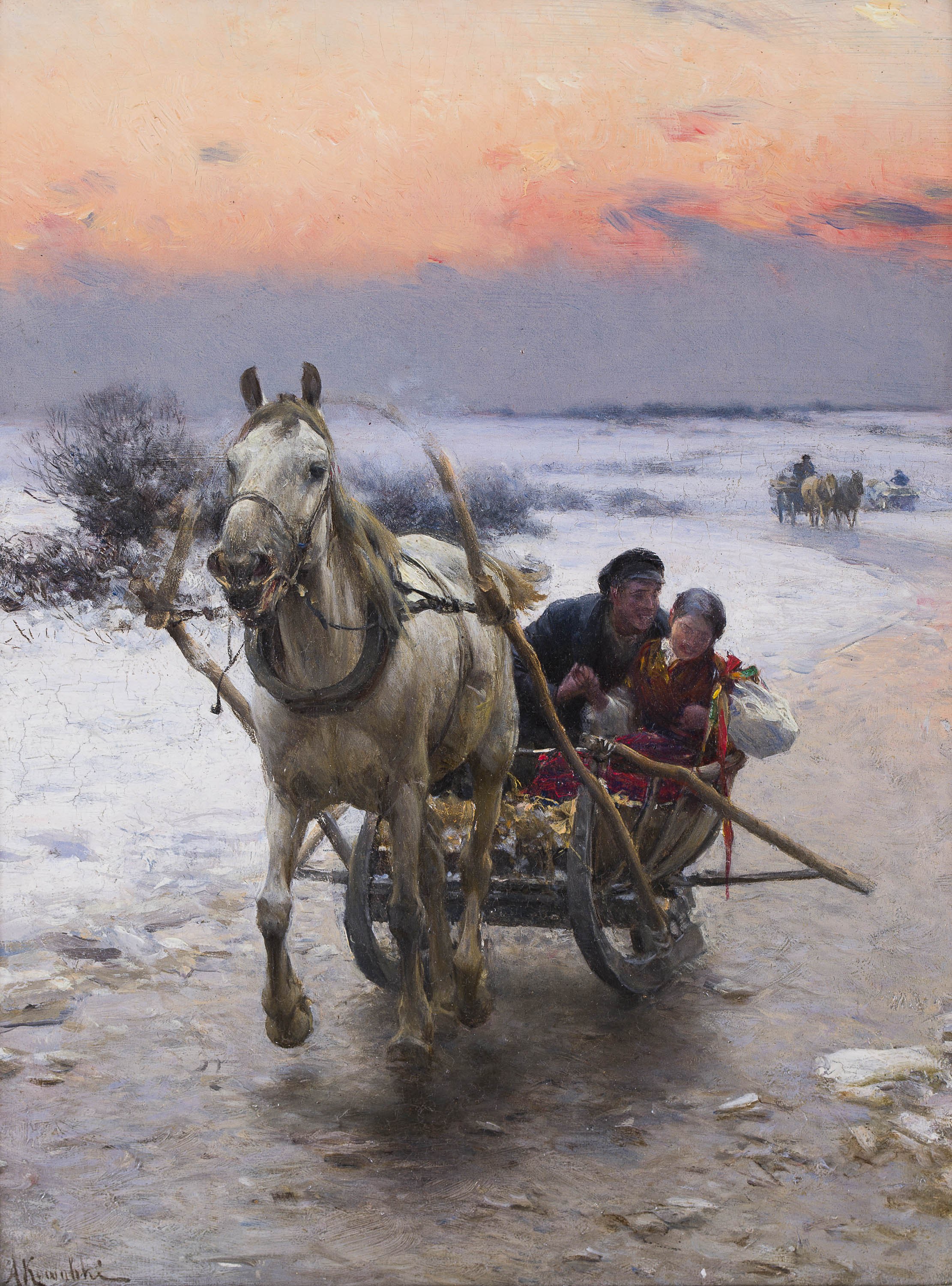
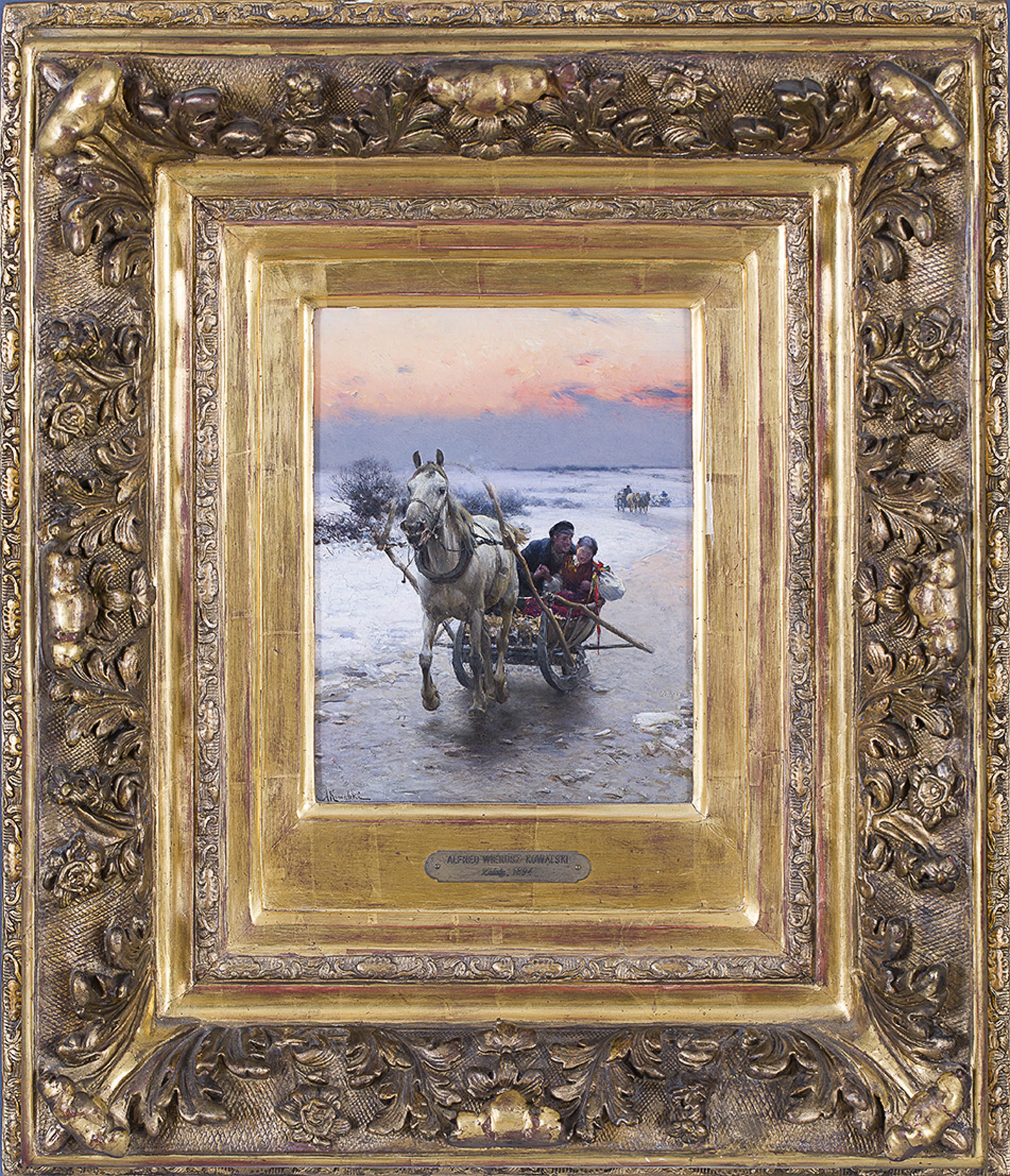
oil, board, 24.5 × 18.8 cm
signed l. d.: A. Kowalski
on the reverse a transport sticker dated 1894.
Attached to the painting is an opinion by Eliza Ptaszyńska
Started in 1868 studying at the Warsaw Drawing Class under Rafał
Hadziewicz and Wojciech Gerson, he continued at academies in Dresden and Prague. At
the turn of 1872/1873 he took up studies in Munich in the studio of Alexander Wagner,
followed by Jozef Brandt. Starting in the 1870s, he presented and sold his paintings
in Munich galleries, including the prestigious Wimmer Gallery. He exhibited annually
at the Glaspalast there, winning a gold medal in 1892. These exhibitions, which lasted
4-5 months, were well attended. They were opened by Prince Regent Luitpold (son of
Ludwig I Wittelsbach), whose collection included paintings by Polish painters, including
Wierusz-Kowalski. From 1887 he was a member of the Munich Society of Fine Arts,
In 1889 he received the title of professor at the academy there, and a year later became an honorary
member. In addition to Munich, he presented his work in Berlin, Vienna and Lviv, among other places.
While living abroad, he also participated in national exhibitions, including the TZSP, where he
in 1884, he won first prize for his painting "Autumn." In the 1890s, he established cooperation with Polish
cultural and social magazines, such as "Wędrowiec," "Kłosy" and "Tygodnik Ilustrowany," in the
pages of which he presented his work. Reproductions of the artist's works also appeared
in the German press and painting albums. Wierusz-Kowalski's paintings, in addition to the museums of
Poland, can be found in the New Pinakothek in Munich, museums in Dresden, among others,
Moscow, Berlin and the United States.
Prevalent in the early Munich years, reflecting the influence of Brandt,
historical and Caucasian themes, gave way in the 1980s to genre themes,
drawing abundantly from the customs of the Polish countryside. Thus, the subjects of the paintings became scenes
illustrating it: horse rides, carriages, sleigh rides, wedding processions, hunting, games, courtship,
as well as motifs of Jewish towns and their inhabitants. The background for these images is the
Polish landscape, snowy fields, vast meadows, muddy roads. The artist was eager to repeat
successful themes. One of them was the motif of young peasants riding in a horse-drawn carriage
young villagers, often a couple. This type of representation, present in the works of Wierusz--Kowalski already in the 1970s, is characterized by a high emotional charge and a
psychological differentiation of the figures.
An example of this is the painting presented at the auction, showing a couple of young people
in a horse-drawn sleigh on an icy road. In the distance, visible following
them two horse-drawn carriages. The background is a winter evening landscape. Here we see the artist's characteristic
artist's characteristic compositional solution, based on diagonals determined by the movement of the
of individual sleds, introducing balanced dynamics. The viewer's gaze is focused on the characters
of the show placed in the foreground in the setting of a vast, atmospheric landscape,
built with gentle toning of colors. The slowly fading day, the setting sun,
tinting the snow with shades of purple, the isolation of the foreground scene foster a mood of
of intimacy. The excellent painting technique is evident in the details.
As painter and art critic Henryk Piatkowski wrote in 1895: "Today, already thanks to the wide
recognition he has gained abroad, Kowalski has been counted among that tight circle of
of our painting greats, which until recently still included: Matejko, Siemiradzki
and Brandt."
after: H. Stępień, M. Liczbińska, Polish Artists in the Munich milieu in the years
1828-1914: source materials, Cracow 1994
The painting "Courtship" comes from the mature period of Alfred Wierusz-Kowalski's work.
It has all the hallmarks of his educated artistic technique and talent.
It is characterized by an excellent, balanced, thoughtful composition and a similarly subtle,
refined colors. Dynamism, harmonization of all formal elements of the
of the work, moodiness make "Courtship" a work of high artistic value.
From the opinion of Eliza Ptaszynska.










最近浏览过的
登录以查看拍品列表
收藏
登录以查看拍品列表