39.00 x 50.00 cm - oil, duplicated canvas,
Signed l.d.: A. Wierusz-Kowalski
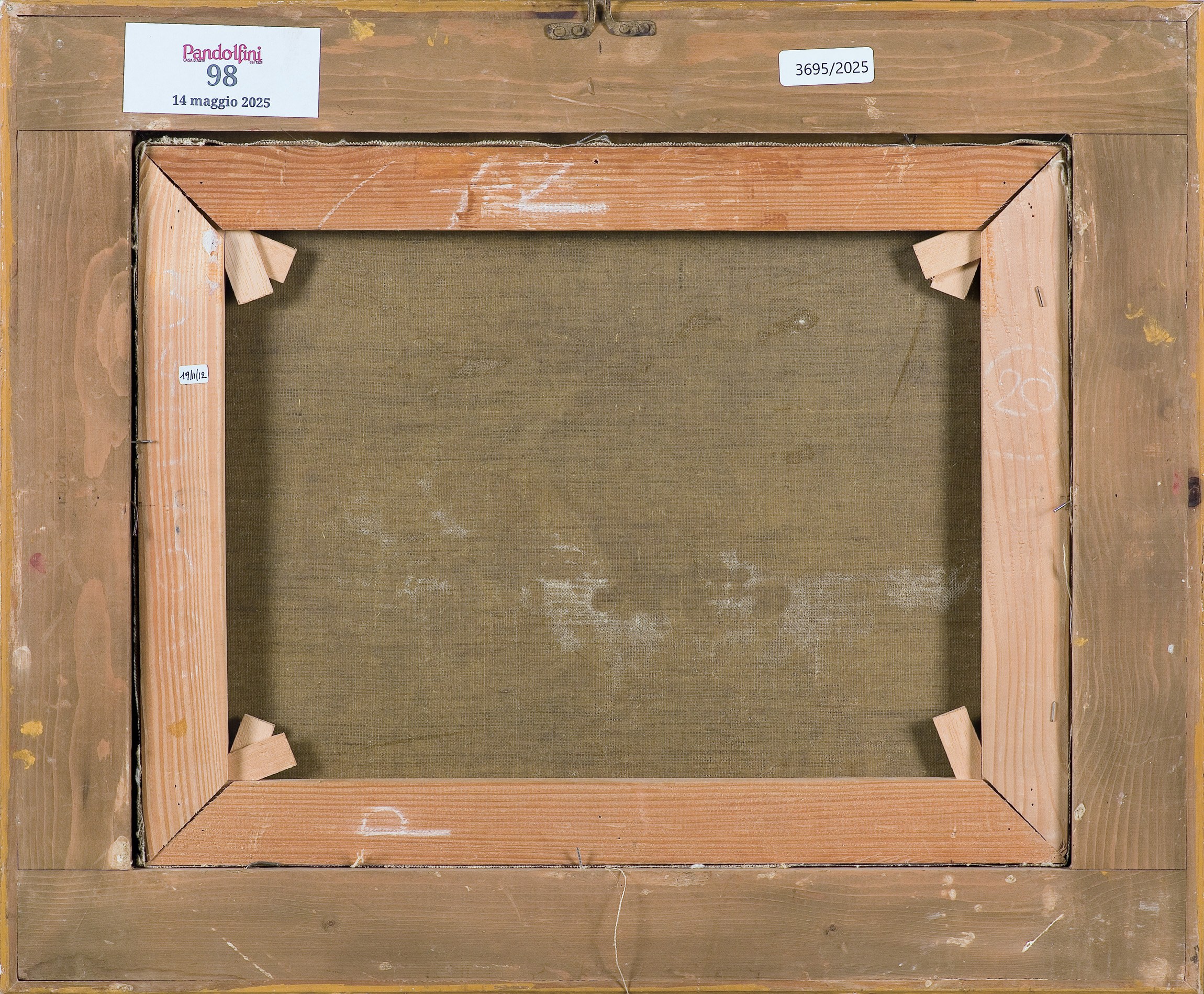
On the reverse, on the frame, stickers of an Italian auction house.
Private collection Warsaw
Private collection Europe (Italy)
Image reproduced in:
-H. P. Bühler, Jäger, Kosaken und polnische Reiter. Josef von Brandt Alfred von Wierusz-Kowalski, Franz Roubaud und der Münchner Polenkreis, Hildesheim - Zürich - New York 1993, il. 7 on p. 18 [as Flotte Fahrt];
- H. P. Bühler, Józef Brandt, Alfred Wierusz-Kowalski and others, Warsaw 1998, il. 7 on p. 16 [as Fast Ride].
- A. Wierusz-Kowalski, Merry Driving (see opposite - Viaje alegre).
Alfred Wierusz-Kowalski became known primarily as a master of dynamic genre scenes, and "merry rides" are among the most recognizable motifs in his work. They usually depict speeding carts or sleighs with amused travelers and horses captured at full gallop. These subjects combine the liveliness of movement, anecdote and moodiness of the surrounding landscape, so that the paintings have a strong effect on the viewer, who has the impression of hearing laughter in a moment.
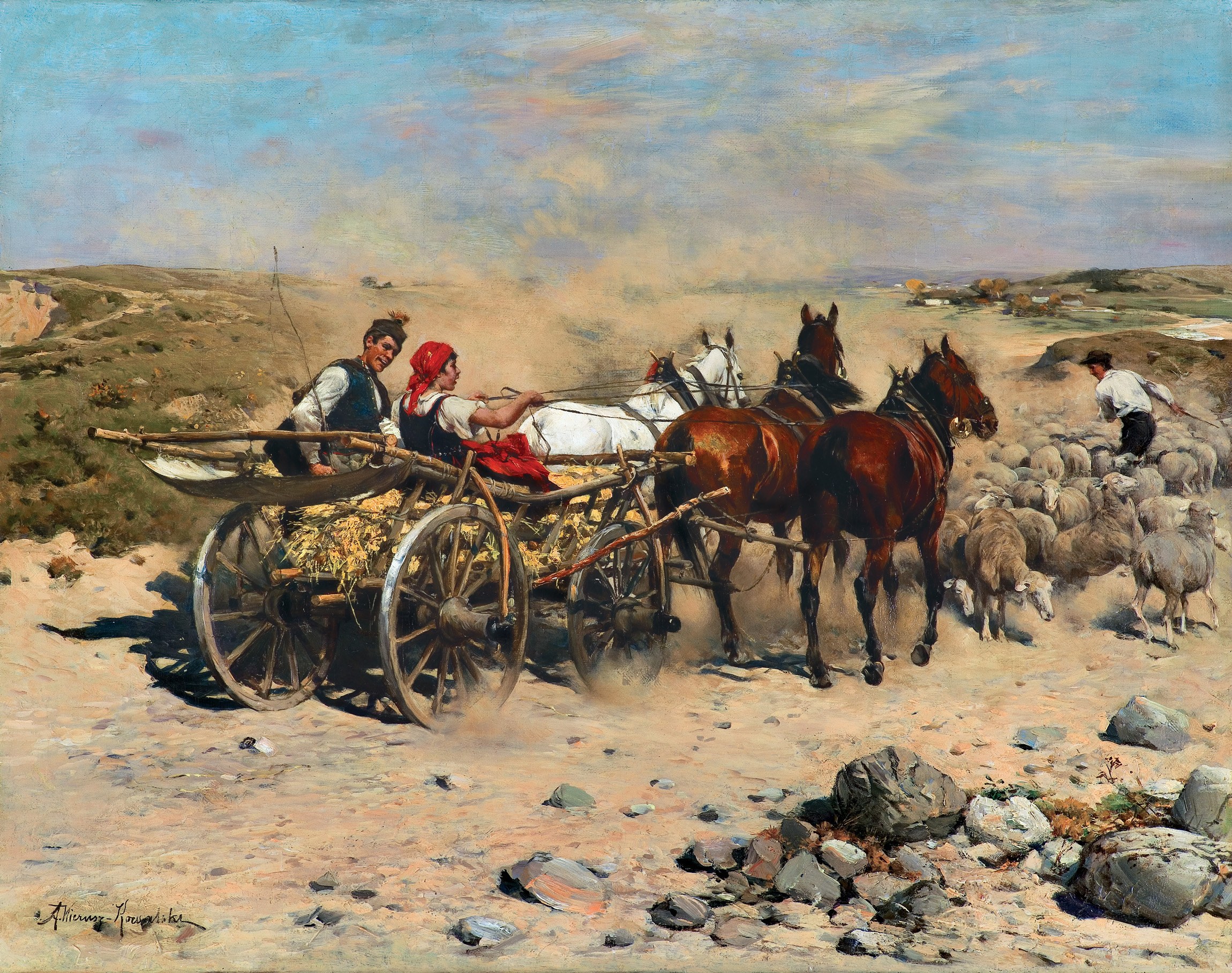
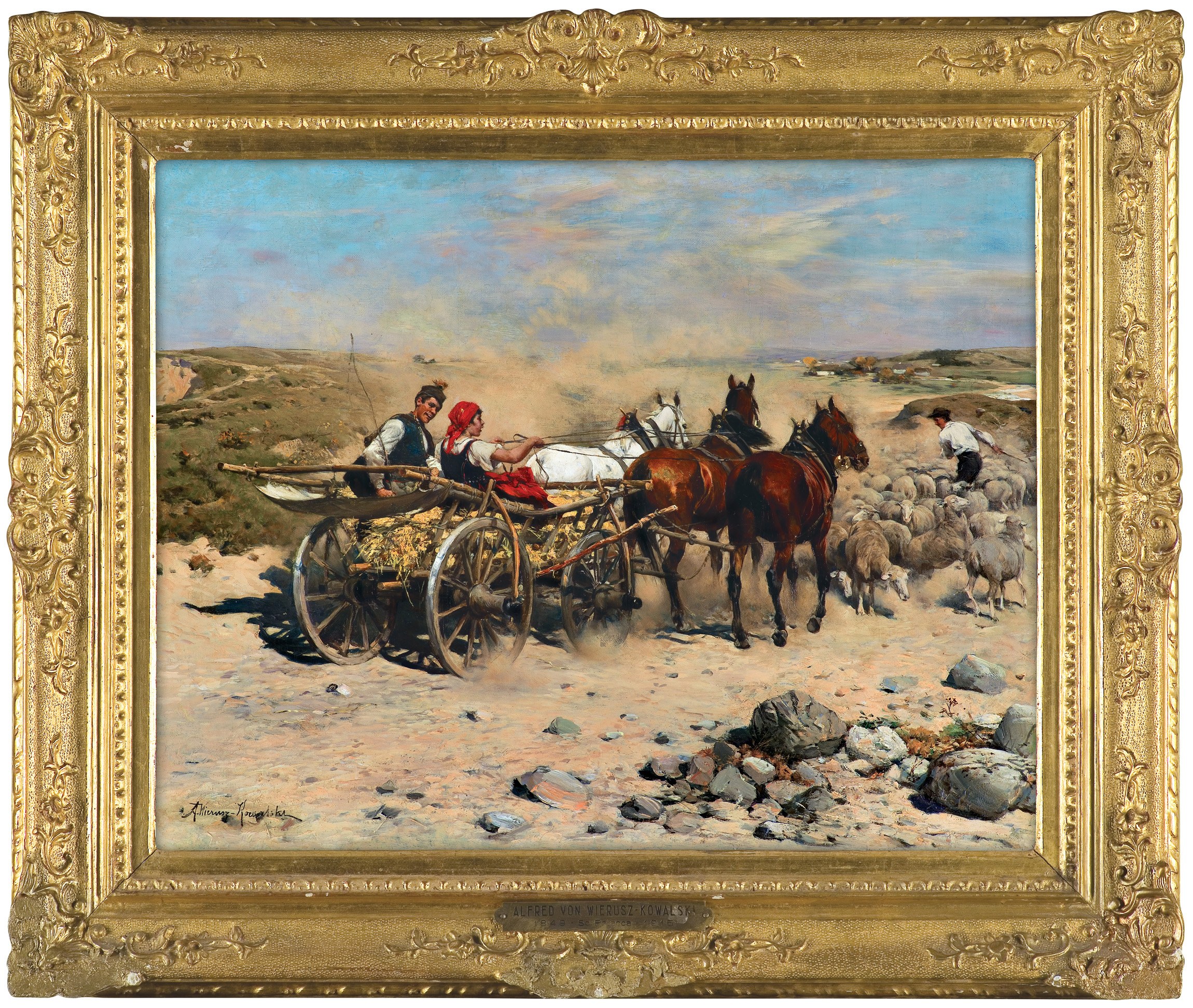
The featured painting depicts a genre scene from rural life. A pair of young villagers, driving a hay-filled carriage harnessed to three horses, come across a flock of sheep blocking their passage. In front of them, the shepherd tries to chase the flock away, but they do not look frightened and stand calmly on the road. From under the horses' hooves and the cart rises dust picked up from the rocky road. The dust creates a light, almost misty veil that softens the contours of the further plan.
Sitting on the carriage, a young woman, dressed in a white blouse, dark corset and red headscarf, confidently holds the reins and deftly halts the harness. The man accompanying her, wearing a light-colored shirt, blue vest and feathered hat, leans toward her with a smile. His gesture and gaze suggest cheerfulness and admiration for the coachman's skill.
A flock of sheep crowding in front of the wagon adds to the impression of momentary confusion. In the background stretches a wide, somewhat dry plain with low hills and distant buildings, bathed in intense summer sunshine.
With great skill and masterful use of painterly means, Alfred Wierusz-Kowalski operates with perspective and light. The vast, slightly dry plain, shows his exquisite sense of perspective. The artist realistically captures the softness of dust, the shiny coat of horses and the texture of sheep's wool. The muted colors of the earth and sky emphasize the warmth of a summer day. Happy Riding is a graceful, harmonious composition and careful execution, a lyrical depiction of everyday life in the countryside.
The featured canvas is one of the early compositions of particular interest. The influence of realism and the Munich school, with which the artist was strongly associated, is evident here. The early compositions are more compact and the narrative is clearer and calmer than in the later, more dynamic scenes. The artist focuses on the relationships between the characters, their gestures and facial expressions, and movement does not yet completely dominate the story.
Over time, the "merry go round" motif evolved into energetic shots with more expression, but it is the first compositions that show how Wierusz-Kowalski built his painterly foundation. Attention to detail, a great sense of horse anatomy and the ability to tell a story with a picture. "Happy Rides" accompanied the painter throughout his creative activity giving us the opportunity to trace the artist's path from realistic observation to the temperamental, dynamic vision that brought him international fame.
Alfred Wierusz-Kowalski (Suwałki 1849 - Munich 1915) - one of the most prominent Polish painters of the so-called Munich School was, along with Jozef Brandt and Władysław Czachórski, also the most popular of the Polish artists settled and permanently active in Munich. He settled there in 1873, having already studied in Warsaw and Dresden. He studied for a year more at Munich's Academy of Fine Arts under Alexander Wagner, before moving to Brandt's private studio. He gained critical and public recognition early on; his paintings, decorated with medals at exhibitions, were coveted by collectors and German dealers. In 1890 he became an honorary professor at the Munich Academy. He painted genre and genre-historical scenes with motifs of horsemen, knights, hunters, horses, wolves and snow. After a trip to Africa in 1903, he also took up oriental themes. Relatively few of the artist's works were found in Polish museum collections - his paintings sold mainly on the German market in greater numbers went to private collections, mainly in Germany and the United States. Present often appear also on the Polish art market, always arousing the interest of collectors.