


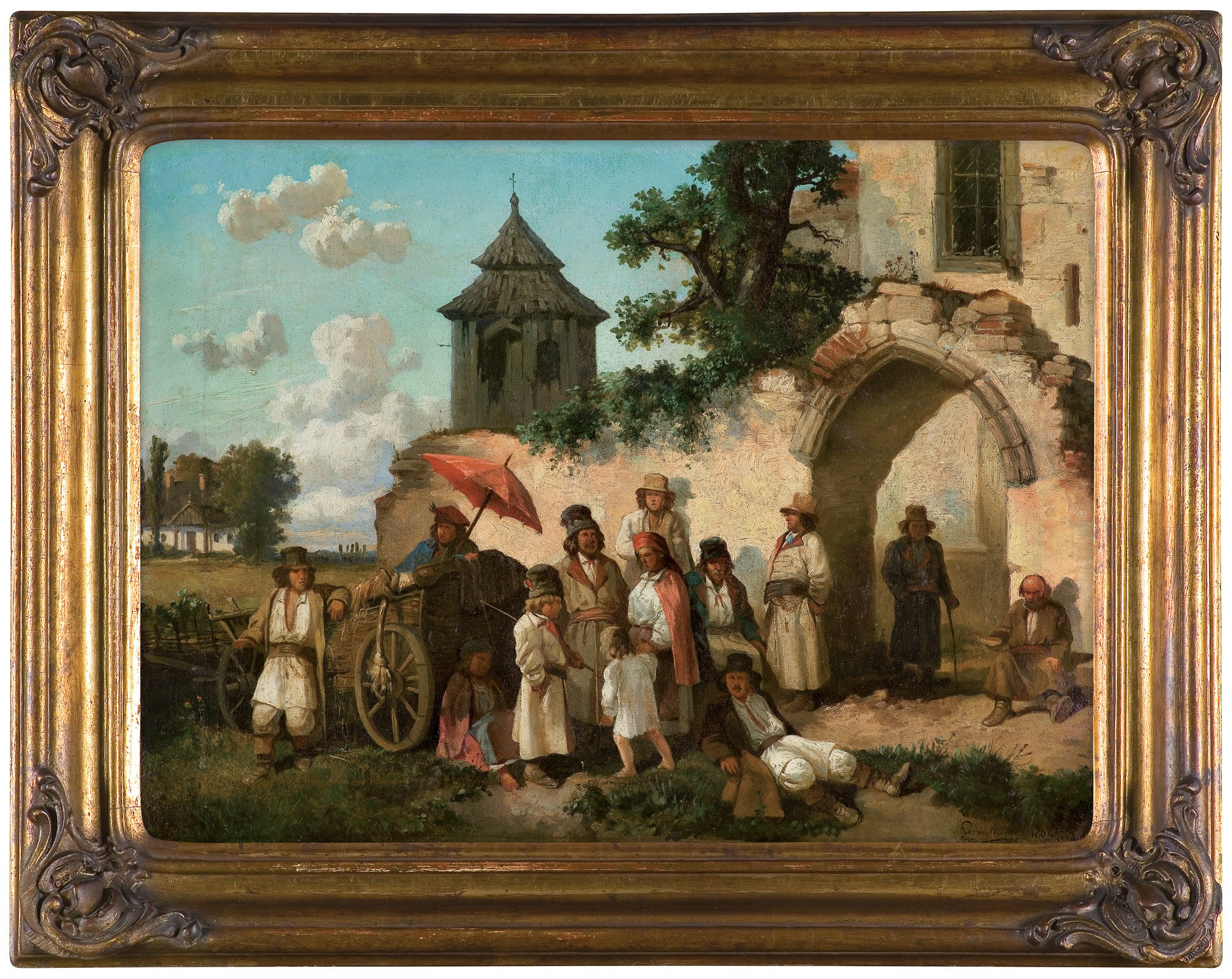

48.7 x 64.0 cm - oil, canvas
Signed p.d.: Szermętowski 1862
In 1860, Jozef Szermentowski, a student at the Warsaw School of Fine Arts, thanks to a government stipend, traveled to France, where - contrary to his original plans - he settled permanently. There, under the influence of contacts with the Barbizon community and inspiration from the paintings of Dutch masters, his mature style was formed. The initial tendency to idealize the landscape, exposing the picturesqueness of motifs and their romantic mood gave way to realistic tendencies. The artist developed a remarkable sensitivity in observing nature and the ability to interpret it in depth.
In the mature period of his work, two main trends can be distinguished. The first includes views of nature inspired by the landscape around Marlotte or Fontainebleau - forested corners and wet meadows, often with a water mirror motif. The second trend, richer and more thematically diverse, is Polish landscapes: views of his native Kielce region, the banks of the Vistula River, motifs from the Tatra or Pieniny Mountains, as well as landscapes with characteristic thatched cottages, country churches or chapels. During his sixteen years in France, Szermentowski painted Polish landscapes from memory, also using photographs. Hence, the same or similar motifs of rural churches and types of figures recur in many of his paintings. The artist also created replicas of his more successful works. The offered painting is an example of this practice. A twin composition, in the same format, dated 1862-1865, was sold at an Agra-Art auction in December 1992.
The works of Jozef Szermentowski, one of the most outstanding Polish landscape painters and precursors of realism in Polish art, are rare on the art market. Hence Before the Church undoubtedly represents a valuable item for collectors.
Józef Szermentowski - painter and watercolorist - was one of the most outstanding Polish landscape painters of the mid-19th century. Supported by Tomasz Zieliński, a Kielce-based collector and patron of artists, he took his first painting lessons from Franciszek Kostrzewski, and further studies at the Warsaw School of Fine Arts from the landscape painter Christian Breslauer and privately from Juliusz Kossak. In 1860 he received a scholarship to go to Paris, where he settled permanently and from where he came to the country twice more. In his early work he referred to the style of Kostrzewski's painting, while in Paris his art matured under the influence of artists from the Barbizon landscape school. The subjects of his paintings were Polish motifs - landscapes from the area of Kielce, Sandomierz or Cracow, recreated from memory and based on photographs, into which he often introduced genre scenes. The artist, who attached great importance to luministic studies, was a co-founder of the modern landscape direction in Polish painting.













最近浏览过的
登录以查看拍品列表
收藏
登录以查看拍品列表