


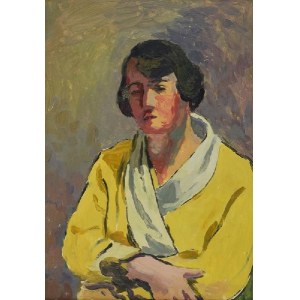
Oil, cardboard; 34 x 24 cm.
From the artist's family collection.
Posthumous Exhibition. Leonard Pękalski 1896 - 1944 March - April 1969 . Union of Polish Artists Warsaw District. In the catalog item 238 as the property of the artist's sister J. Sawicka in Warsaw.
"Pękalski's rich and varied work in the 1930s in the field of both mural and easel painting (...) consistently reached the pinnacle of his own synthesis. In getting to the core of his own being, as well as in the ordering of his creative method, a great help was the artist's sensitivity to all stirrings of vitality in the Polish milieu: friendly contact with Kowarski, as well as with the Kapists, by no means excluded his interest in abstract painting and close observation of the young and youngest talents. Also not indifferent were deeply experienced foreign trips. Thus, for example, from (...) France [Pękalski brought back] the painting ideal par excellence, under whose spell he was to remain for the rest of his life: Chardin's still lifes. As an easel painter, he achieved a high degree of color-composition harmony. Chardin's lessons, combined with those of Cézanne, overlap superbly with the experience previously gained in decorative painting. With his paintings of the second half of the 1930s, especially in the fields of still life, portraiture and landscape, Pękalski proved that he was unfamiliar with all the secrets of intimate painting, that he wielded the subtlest means of color expression in his proper muted range with a predominance of gray-olive and brown-silver tones." (Juliusz Starzynski, Introduction to the exhibition catalog, p. nlb.12).
A pupil and collaborator of E. Trojanowski in 1913-18, he graduated from the Municipal School of Decorative Arts and Painting in Warsaw in 1918. He worked on the conservation of polychromes at the Castle in Lublin. In 1924-1928, he was an assistant to F. Sz. Kowarski at the Academy of Fine Arts in Cracow. At that time, under the direction of A. Szyszko - Bohusz, he worked on the conservation of friezes in the Wawel Castle. He was a member of the Artists' Guild Jednoróg, then of the Pryzmat grouping. He traveled to Italy, France and England. Since 1928 he was an assistant and professor at the Warsaw School of Fine Arts. He presented his works at many group and individual exhibitions. In 1969, a retrospective exhibition of his work was held in Warsaw. He created landscapes, still lifes and portraits in oil, gouache and drawing. His artistic path led from monumental painting - an interest he picked up during his college years - through formalism to colorism.


![Leonard PĘKALSKI (1896-1944), Kobieta w fotelu [Siedząca]](https://img1.one.bid/img/4719/1219013_1w.webp?1752699466)

![Leonard PĘKALSKI (1896-1944), Odpoczynek [Leżąca w szlafroku]](https://img1.one.bid/img/4719/1219014_1w.webp?1752699471)










最近浏览过的
登录以查看拍品列表
收藏
登录以查看拍品列表