


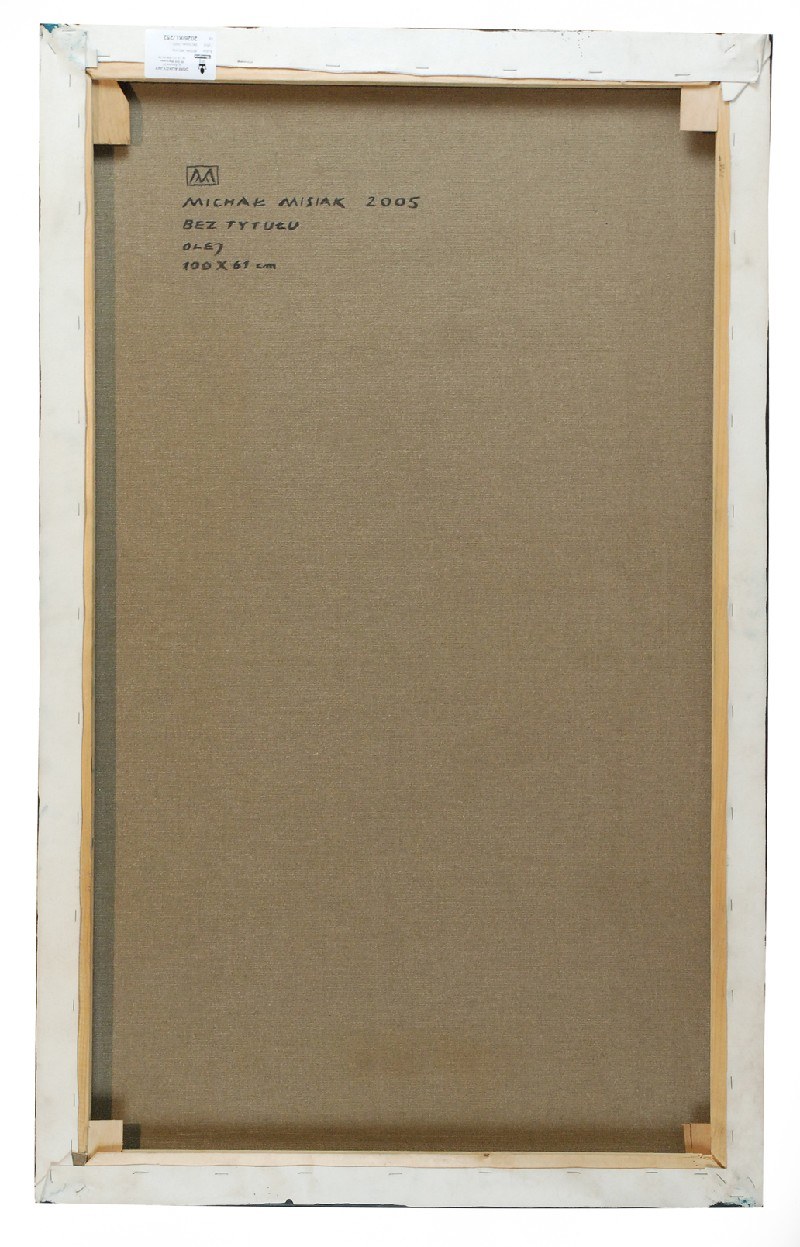
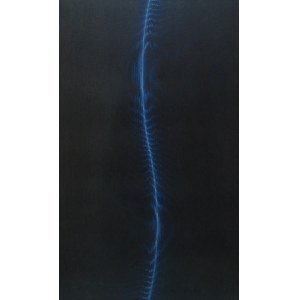
oil, canvas; 100 x 61 cm;
signed, dated and described on the reverse: MM [in rectangle] / MICHAŁ
MISIAK 2005 / WITHOUT TITLE / OLEJ / 100 X 60 cm.
Studied at the Faculty of Painting of the Academy of Fine Arts in Cracow. Obtained his diploma in 1999 with honors in the studio of Prof. Stanislaw Rodzinski with a graphic annex in the woodcut studio of Prof. Zbigniew Lutomski. Currently working as
assistant professor in the drawing and painting studio at the Faculty of Interior Design of the Academy of Fine Arts in Cracow. He cultivates creativity in painting, graphics, drawing and photography. Recently, he has also been creating moving video images. He has received a scholarship from the Ministry of Culture and National Heritage of the Republic of Poland and has won more than a dozen prizes and awards. He is the author of 24 solo exhibitions, and participant in more than 100 group exhibitions. Since 2004, he has been a participant in open-air workshops for artists using the language of geometry by Dr. Bozena Kowalska. His works are in the collections of the Polish Sculpture Center in Orońsko, the Mazovian Center for Contemporary Art Elektrownia in Radom, the Jerke Museum in Recklinghausen, the International Triennial of Graphics in Kra -
ków, the Museum of the Borderlands in Lubaczów, and in private collections in Poland, Germany, the Netherlands, France, Switzerland, Ukraine and the USA.
(source: artemis.art.pl)
"In the most general terms, Michal Misiak's painting is categorized as a geometric trend. The mechanism of his paintings is analogous to that used by the op-art classics: the course of closely spaced parallel or densely intersecting lines sets the
surface into vibration, revealing the relativity of two-dimensions. Spaces that exist not on the basis of the mutual arrangement of objects in perspective are revealed, not "painted on the picture", but directly expressed by the painting. Thus, a painting work does not "represent" or "depict" any object in the visible world, but refers to the arche, to the fundamental principle of the existence of this world. Well, at any rate, basic according to the Pythagorean concept. And this principle was number, and therefore - proportion, and therefore - harmony, and therefore - golden division, and therefore - symmetry."
Andrew Stembarth Sawicki
(Text accompanying the exhibition: Michal Misiak's "Dynamic Structures," SOCATO Gallery, 2013)










最近浏览过的
登录以查看拍品列表
收藏
登录以查看拍品列表