


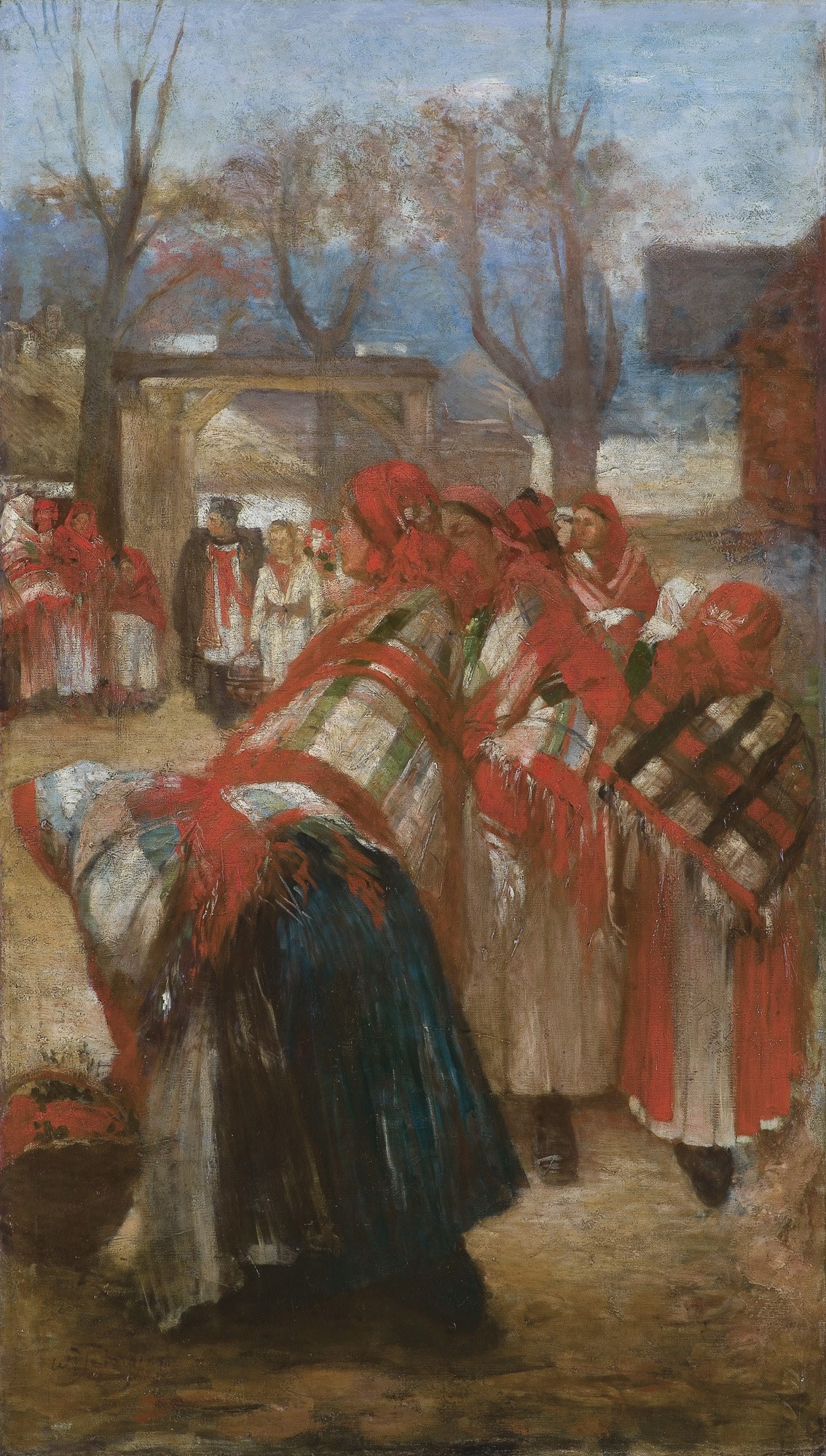
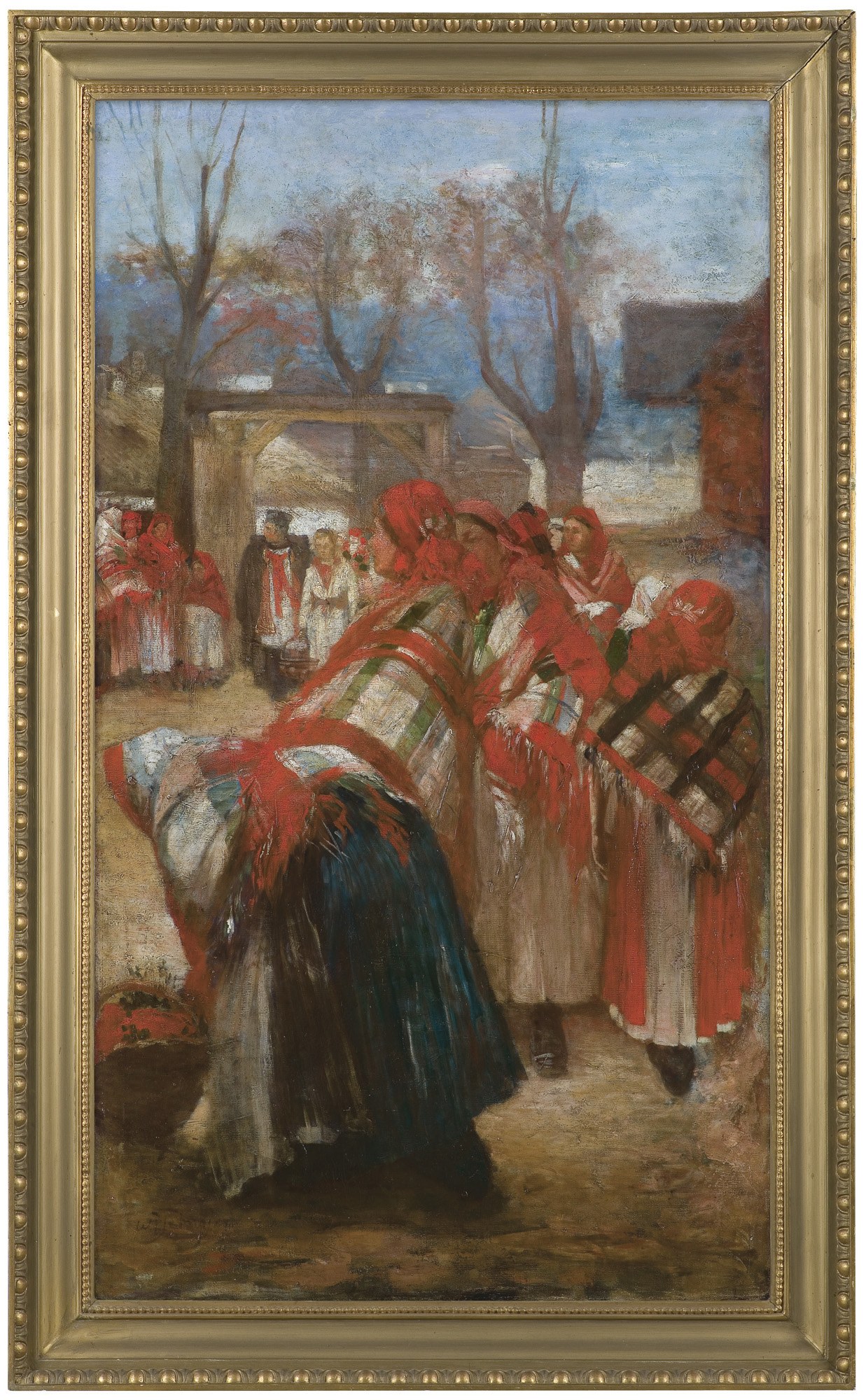
134.5 x 76.5cm - oil, duplicated canvas signed l.d.: Wł. Tetmajer
On the back a trace of a pasted opinion by Kazimierz Buczkowski dated September 1946 (the document is attached to the painting).
Święcone is a subject that appeared very early in Włodzimierz Tetmajer's work. The artist painted his first painting under this title in a Matejko major after returning from Paris. As the anecdote goes, a pupil of Matejko, famous for his apodictic and conservative views on art, was afraid to invite his master for a revision. The latest art trends he encountered in France had a significant impact on the formation of his unique style and were probably already evident in this early work. I was afraid I would be fired from the studio. However, I invited him," he later confided to painter Leon Kowalski. Matejko's opinion, on the other hand, was flattering: "To you belong the air and the sun, while I will stay with the old kings.... Well done ladies! It is good that you went this way, I like the painting, please finish it.... I please, sir," he said in passing, "I can perfectly see who studies nature and has something to say, and who studies other people's paintings..." - was to say the professor (quoted in Włodzimierz Tetmajer. The power of colors and temperament. Exhibition catalog, M. Marek, P. Hapanowicz, Museum of Krakow, Krakow 2023, p. 26).
The distinctive style of Tetmajer's painting, which derives from realism, is founded on the creative absorption of post-impressionism. It is characterized by the handling of synthetic, soft color spots, silhouetted treatment of forms, strong contrasts of light and shadow, a color scheme based on the juxtaposition of white and red, complemented by browns and greens, as well as a peculiar dramaturgy of representations. What his power of expression flows from, however, is the eye of the observer - a member of the local community. Tetmajer, who married the daughter of a Bronowice peasant and settled in a village near Krakow, was fascinated by the culture of peasants and observed their lives and customs both as an ethnographer by avocation and as a man ingrained in the countryside. He was therefore well acquainted with both the customs and traditions, as well as the mentality of Bronowice residents.
Fascinated by folklore, the artist painted scenes from village life until the end of his life, and returned to the motif of blessing food on Holy Saturday several more times, of which the offered work is an excellent example.
Włodzimierz Przerwa-Tetmajer (Harklowa near Ludźmierz in the Podhale region 1862 - Kraków 1923), half-brother of the poet Kazimierz, began studying painting at an early age; as early as 1875 he attended classes at the School of Fine Arts in Kraków, where he continued (with breaks) to study until 1895 - initially with Franciszek Cynk, Leopold Loeffler and Władysław Łuszczkiewicz, and after 1889 with Jan Matejko. At the same time, he studied classical philology at Jagiellonian University. In 1882 he still studied at the Vienna Academy, and in 1886-89 at the Munich Academy under Alexander Wagner. He supplemented his studies at the Académie Colarossi in Paris. An imperial scholarship enabled him to travel to Rome. Upon his return, he lived in Cracow. In 1890 he married Anna Mikołajczykówna, daughter of a farmer from the village of Bronowice near Krakow, where he himself often stayed, and in 1895 settled permanently. In 1901 he founded and then ran a painting school for women for several years. Since 1899 he was a member of the Society of Polish Artists "Art"; in 1901 he was one of the founders of the Society "Polish Applied Art"; in 1908 he co-founded the "Zero" group. He was a prominent representative of the "folklore" trend, a painter of customs, labor and landscapes of the countryside near Krakow. In his earlier period he created in the spirit of academic, Munich realism. Later he developed his own original style - the composition of his paintings was free, he painted with broad brushstrokes and used bright, vivid colors. In 1892-1894 he collaborated with Wojciech Kossak and Jan Styka on Panorama Raclawicka. He designed stained glass windows, did illustration and mural painting, including a polychrome of the Queen Sophia Chapel at Wawel Cathedral in 1902. The artist was the prototype for the character of the Host in S. Wyspiański's drama The Wedding.













最近浏览过的
登录以查看拍品列表
收藏
登录以查看拍品列表