


81 x 65.5 cm - oil on canvas
signed lower right: ADAM | STYKA [in frame]
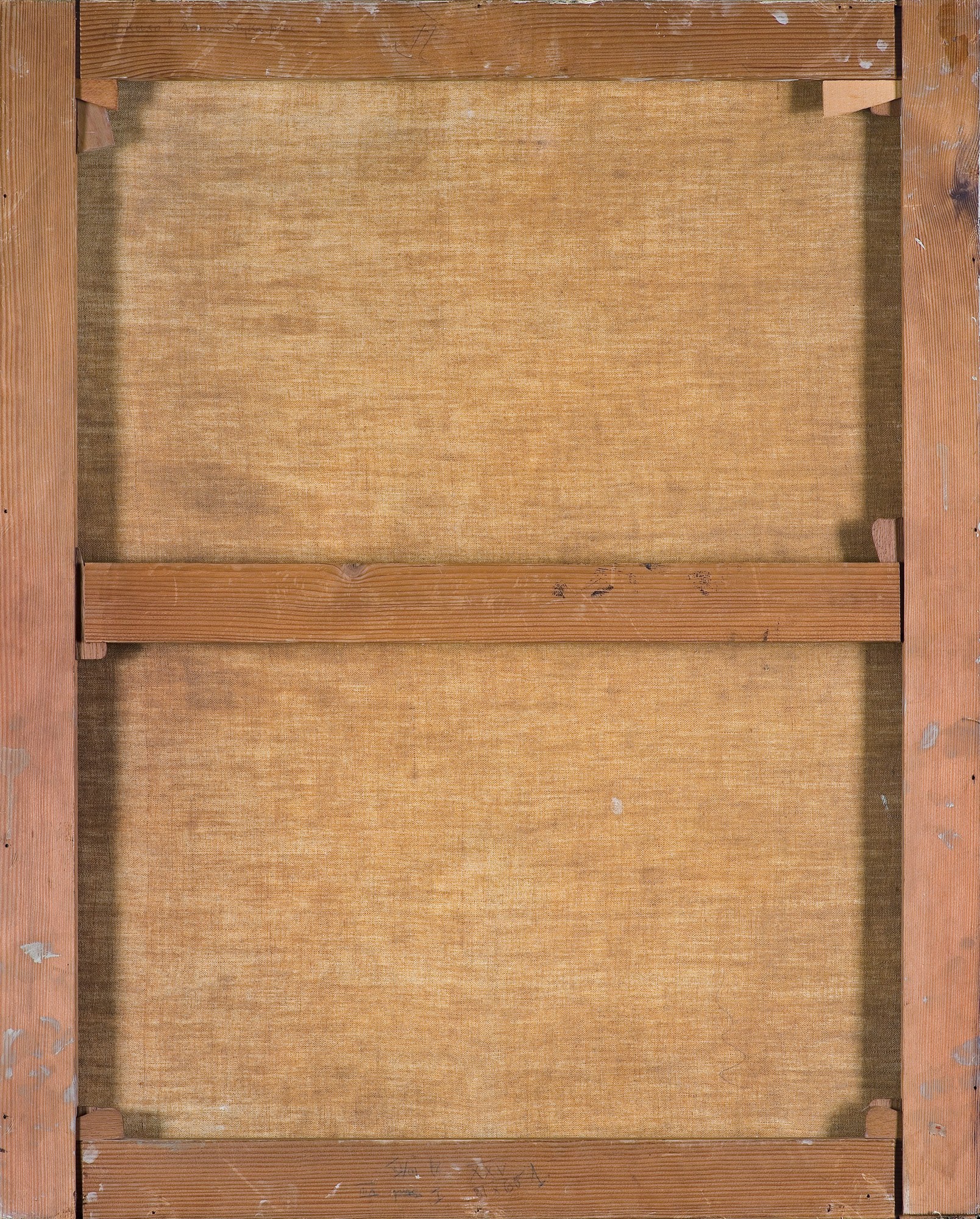
On the top rail of the easel (in pen): “Temptation” Adam Styka pinx. II;
on the bottom: IV / O1 V XXV | VIII [opposite the direction of the composition] [...] I | 81 x 65 1.
The paintings of Adam Styka, an outstanding Polish Orientalist who gained recognition in France and the United States, are a captivating tribute to the exotic and to light. As the artist himself confessed: “Almost from the very beginning of my artistic career, I have been seeking and painting the sun.” We read about the rapidly developing career of this Polish Orientalist and his travels in the press of the time: “He began his independent career in 1909 by exhibiting his first painting, created in Algiers, at the official Salon.” From then on, he devoted himself specifically to Oriental studies, which over the years allowed him to occupy one of the most prominent positions within the Parisian group of painters of the East. At the first Salon of Orientalists, he was allocated an entire room—and subsequently won a bourse de voyage. The Governor of Algiers, Lutcaud, took the young painter under his wing and often facilitated his exploration of Algiers, as well as further trips to Tangier, Morocco, and Tunis. He crossed the entire Sahara with a caravan, reaching Timbuktu. The studies he made there later served as the basis for the paintings he exhibited annually at the Salon des Artistes Français. In 1922, he received a mention honorable. Two years earlier, a group exhibition organized by Adam Styka at the Towarzystwo Zachęty had enjoyed enormous success. ((P.), A Celebration of Polish Art in Łódź. An exhibition of works by the late master Jan Styka and his sons Adam and Tadeusz Styka, “Łódź in Illustrations” (Sunday supplement to “Kurier Łódzki”), 1926, No. 11, p. 3).
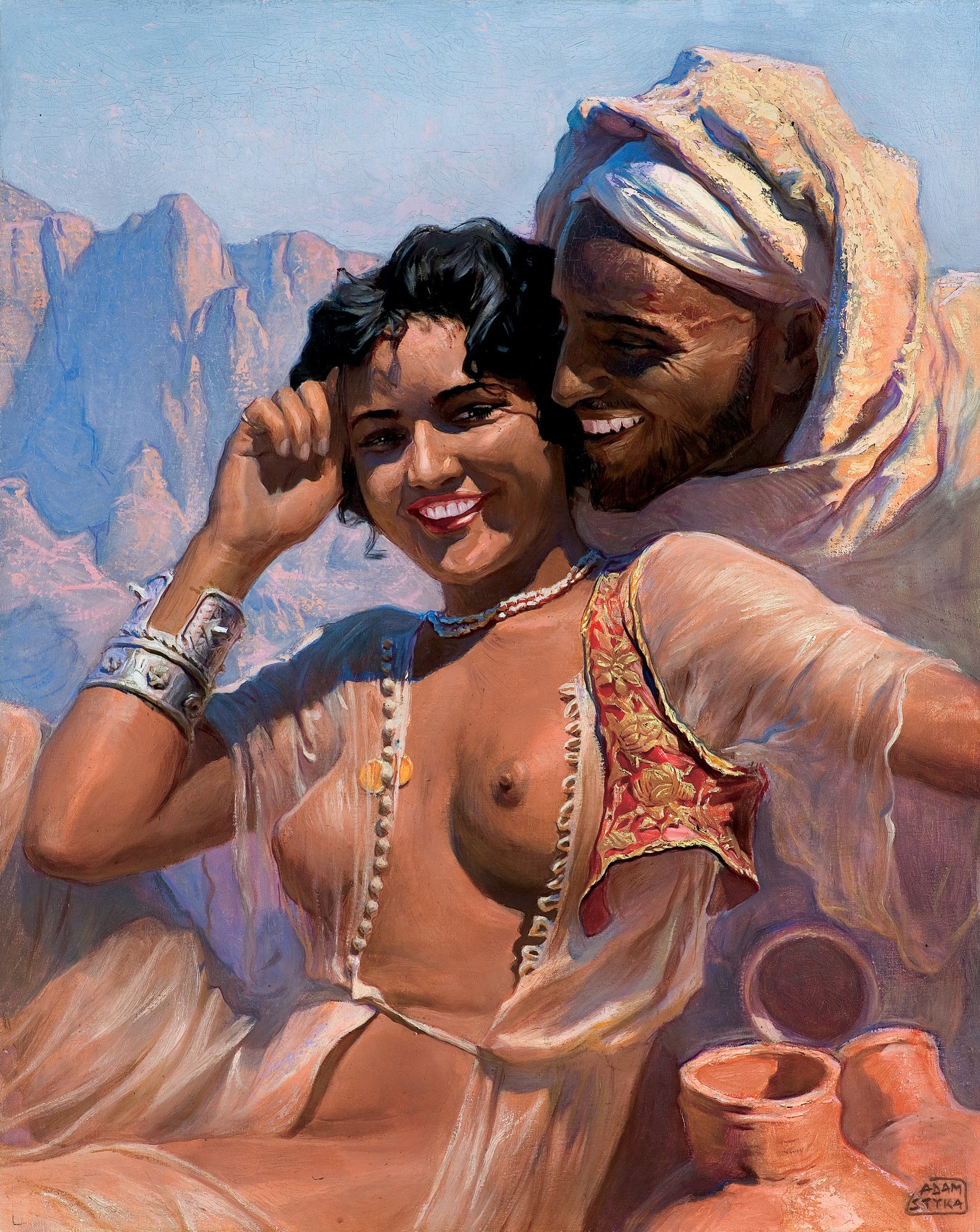
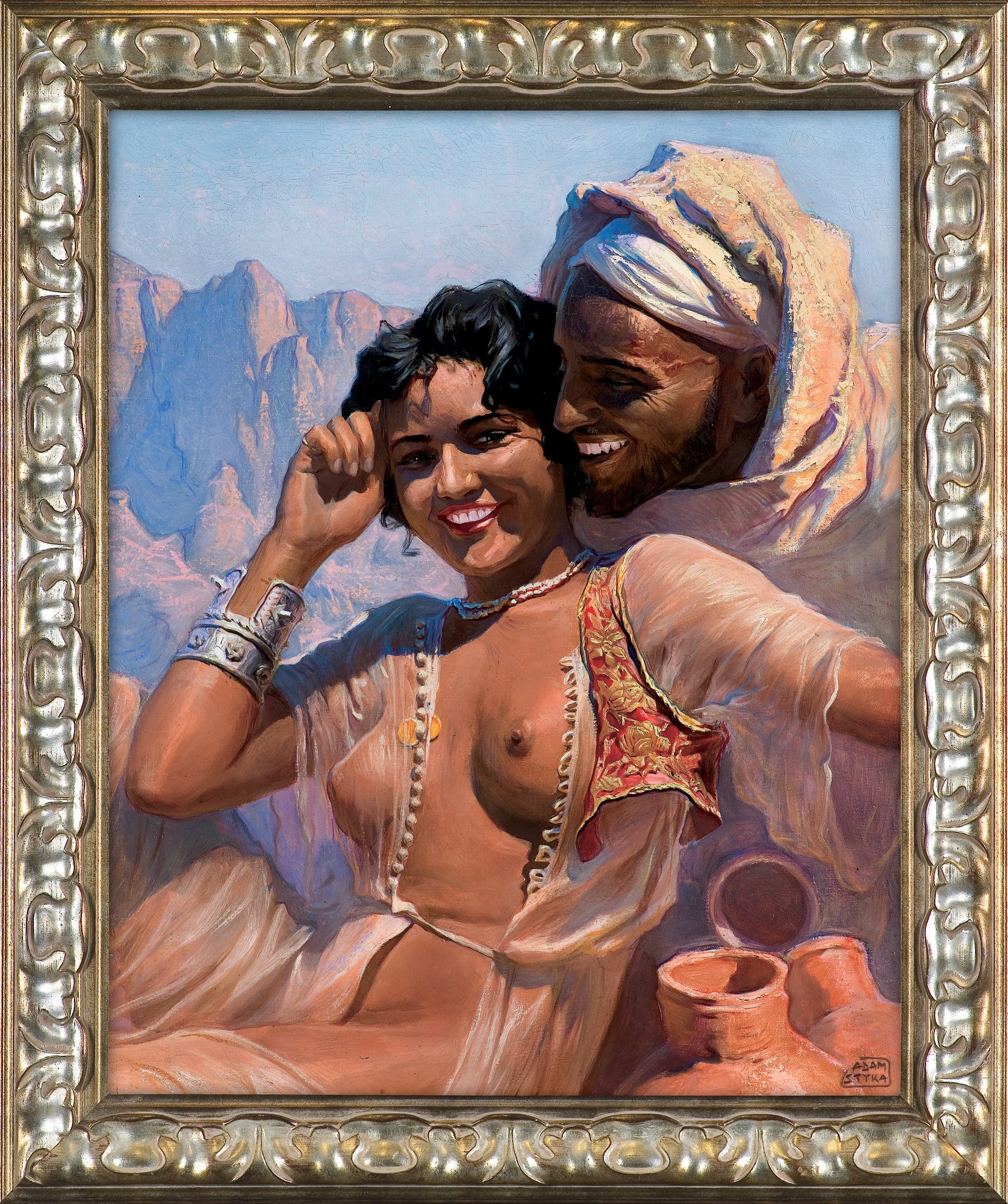
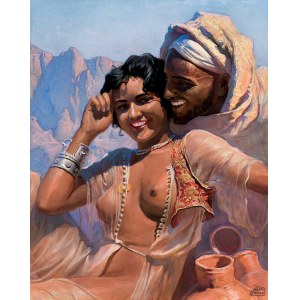
The canvas on display brilliantly showcases Adam Styka’s mastery, depicting a joyful scene of flirtation bathed in southern sunlight against the backdrop of a rugged mountain landscape and a bright blue sky. At the center of the composition stands a smiling woman in a semi-transparent robe and a richly embroidered bolero, adorned with heavy silver jewelry. She is tenderly embraced by a man in a light-colored turban who gazes at her lovingly, while clay amphorae complete the foreground.
The work is a direct result of the artist’s African travels in the 1930s to Egypt, Morocco, and Algiers. It belongs to a series inspired by the colorful life of Marrakesh (including the local Quartier réservé), about which the painter remarked: “It was there that I also found subjects for such paintings of mine as ‘Flirts,’ ‘Moroccan Idyll,’ “Slaves of Love.” This painting, exuding carefree spirit, sensuality, and an intimate atmosphere, embodies the artistic quest of an artist who tirelessly sought to capture on canvas all the painterly impressions evoked by the midday sun.
♣ Droit de suite: ♣ An additional fee will be added to the Purchase Price, arising from the right of the artist and his heirs to receive remuneration in accordance with the Act of February 4, 1994, on Copyright and Related Rights (droit de suite).
Adam Styka (Kielce 1890 – New York 1959)—son of the painter Jan and younger brother of Tadeusz Styka—was an Orientalist painter. He initially studied mathematics and engineering, then began his studies at the École Nationale des Beaux-Arts in Paris (1908–1912). During World War I, he served in General J. Haller’s Blue Army—first in France (where he received a medal for the Battle of Verdun), and later in Poland. As a painter, he began with genre scenes, but after a trip to North Africa, he primarily created paintings with Oriental themes. He found his motifs during his repeated trips to Morocco, Algiers, Tunis, and Egypt. He exhibited his works mainly abroad; during the interwar period, he also held several exhibitions in Poland, including one at the Zachęta in Warsaw. These exhibitions were always hugely popular with the public, and the paintings on display found many eager buyers. Adam Styka also painted religious works (including the well-known painting *Christ the King*; 1944; commissioned by the Pallottine Fathers in Warsaw; destroyed in a fire in 2007) and worked as a book illustrator; among other things, he created illustrations for H. Sienkiewicz’s *In the Desert and the Wilderness*. After World War II, the artist lived and worked in the United States—he painted landscapes and scenes of life in Mexico and Arizona, as well as—in particularly large numbers—religious paintings. He also oversaw the restoration of the “Golgotha” panorama, a work by his father, Jan Styka (unveiled after its restoration in 1951 in Los Angeles).













最近浏览过的
登录以查看拍品列表
收藏
登录以查看拍品列表