


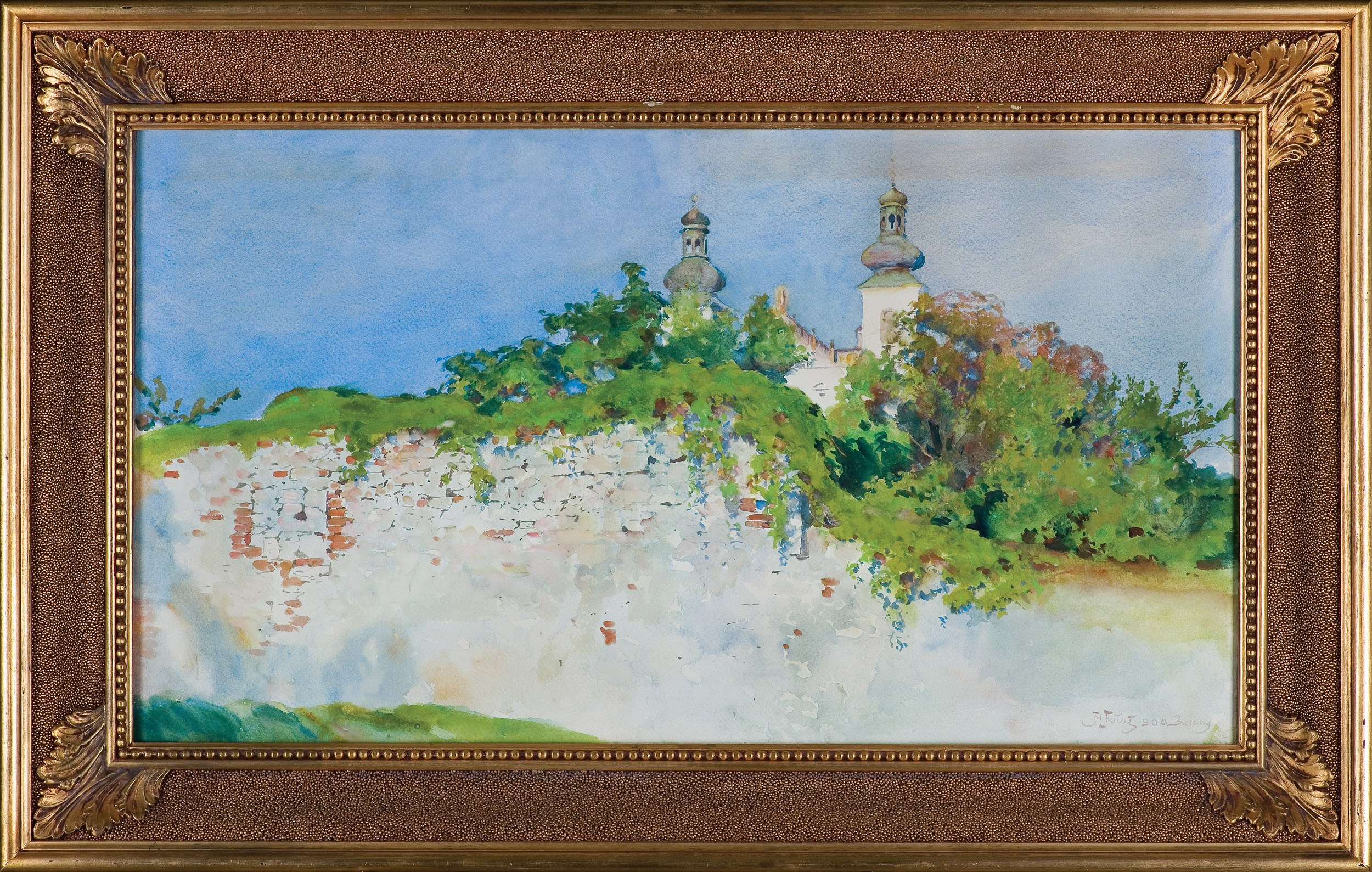

45.0 x 80.0 cm - watercolor, paper
Signed p. d.: Jul Fałat 900 Bielany
On the g. strip of the painting loom a sticker of the Warsaw auction house, next to it a sticker with the number (print): 224.
The presented watercolor is an excellent example of the mature period of Julian Fałat's work, in which the artist achieved technical mastery and exceptional clarity of outlook. Bielany shows his characteristic lightness of brush and his ability to bring out the mood of the landscape using economical but precise means. It is this virtuosity that has caused Fałat's watercolors to be compared to the best European productions of the late 19th century, and the artist himself is considered one of the artists who elevated watercolor to a medium on par with oil painting. Here, large, bright planes of sky and wall contrast with dense, shimmering greens, creating an impression of spaciousness and a free, natural composition. Fałat uses an unusually luminous palette, pastel in places, giving the whole a lightness that is one of his trademarks. The architecture is only gently suggested - the artist consciously avoids its literalness - allowing nature and intense southern light to take the foreground, dominating role, intensifying the atmosphere of a summer day.
Julian Fałat was a master of watercolor, and his landscapes are distinguished by his extraordinary ability to capture fleeting atmospheric phenomena. His landscape painting was not just a faithful reproduction of nature, but a profound study of mood and play of light. Fałat created with extraordinary verve and flair. As an undisputed master of watercolor, proficient in this technique, he boldly poured colors on paper, creating unique works. In the presented landscape, the artist does not imitate nature, but with quick projections of contrasting colors, he gives us a sincere feeling of it.
The Bielany view, saturated with peace, tranquility and devoid of human presence, reveals the transcendent dimension of Nature. Painting a fragment of the landscape, Fałat created a landscape that is universal, timeless and filled with a poetic feeling of light. This work is an excellent example of the painter's paintings presenting high artistic value and perfectly represents the achievements of one of the most important landscape painters of Young Poland.
Julian Fałat (Tuligłowy [Lviv district] 1853 - Bystra near Bielsko 1929) - painter and pedagogue - one of the most outstanding Polish artists of the late 19th and early 20th centuries, member of Polish and European creative associations and the Royal Academy of Fine Arts in Berlin, repeatedly awarded medals at international exhibitions. He studied painting with Władysław Łuszczkiewicz and Leon Dembowski at the School of Fine Arts in Cracow (1868-71 and 1881) and at the Academy of Fine Arts in Munich with Alexander Strähuber and Johan Leonhardt Raab (1877-80). After his studies he spent several months in Rome, in 1884 he was in Paris and Spain, and in 1885 he made a sea voyage around the world. In 1886, while hunting with the Prince Radziwill family in Nesvizh, he met the later German Emperor Wilhelm II - for whom he then worked as a court painter in Berlin in 1886-95. In 1894-96 he collaborated with Wojciech Kossak on the Berezina panorama. In 1895 he was appointed director of the School of Fine Arts in Cracow, where he thoroughly reformed the teaching system, transforming the school into a modern Academy of Fine Arts (r.1900). He was rector of the Academy until 1910; after retiring, he settled in Bystra near Bielsko. An excellent watercolorist, he also painted in oils. In his earlier period he worked in the realist convention, with time he lightened and enriched his palette, and in watercolors he introduced an overflowing color patch. He became famous as a painter of hunting scenes usually set in winter scenery; he also painted landscapes, rural genre scenes, portraits and urban views.











最近浏览过的
登录以查看拍品列表
收藏
登录以查看拍品列表