


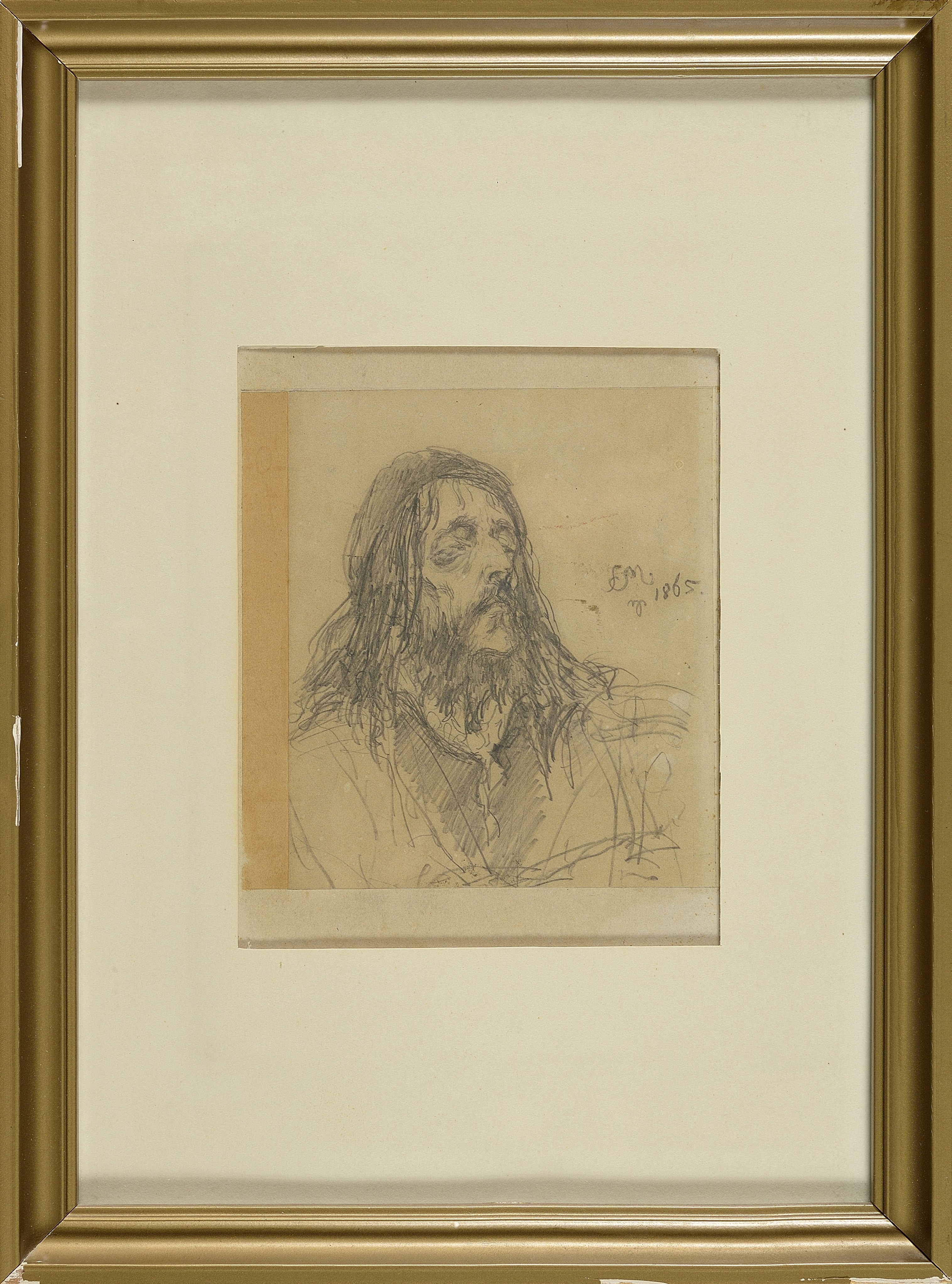
Pencil, paper pasted on cardboard, 13.8 x 11.9 cm,
Signed (secondarily?) p.r.: JM rp 1865.
Prof. A. Ryszkiewicz, in an opinion dated 4 II 1996, identifies the figure as Sigismund Augustus in the garden of Vilnius, whose features are a transformation of the physiognomy of Piotr Skarga.
Jan MATEJKO (1838-1893)
From 1852 to 1858 he studied at the Academy of Fine Arts in Cracow under W.K. Stattler and W. Luszczkiewicz. He continued his studies in Munich from 1859-1860 with H. Anschütz and at the Academy in Vienna with C. Ruben (1860). From 1873 he was director of the Academy of Fine Arts in Cracow, and in 1887 became associate professor h.c. Jagiellonian University. He received many awards and honors, including a gold medal in Paris in 1865 and a first-class gold medal at the World Exhibition in Vienna in 1867, and a scepter presented to him by the Cracow authorities in 1878 as a sign of his reign in the arts. He traveled extensively, including to Paris, Vienna, Turkey, Hungary and Italy. Since the mid-1850s, he mainly created paintings of his native history, preceded by thorough historical and monumental studies. His paintings are mostly huge compositions of great expressive power, characterized by a combination of realistic observation and documentary accuracy of details with exaggerated gestures and dynamic compositional arrangements of the whole picture. His paintings imbued with deep patriotism, showed the Polish public visions of the past and played a major role in strengthening national consciousness. Matejko produced one of the greatest works of Polish monumental painting - the polychrome in the St. Mary's Church in Krakow, as well as a series of drawings "Poczet królów i książąt polskich". Today his works are in the collections of the National Museums in Krakow and Warsaw.










最近浏览过的
登录以查看拍品列表
收藏
登录以查看拍品列表