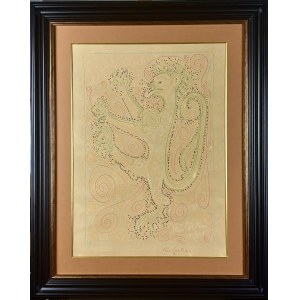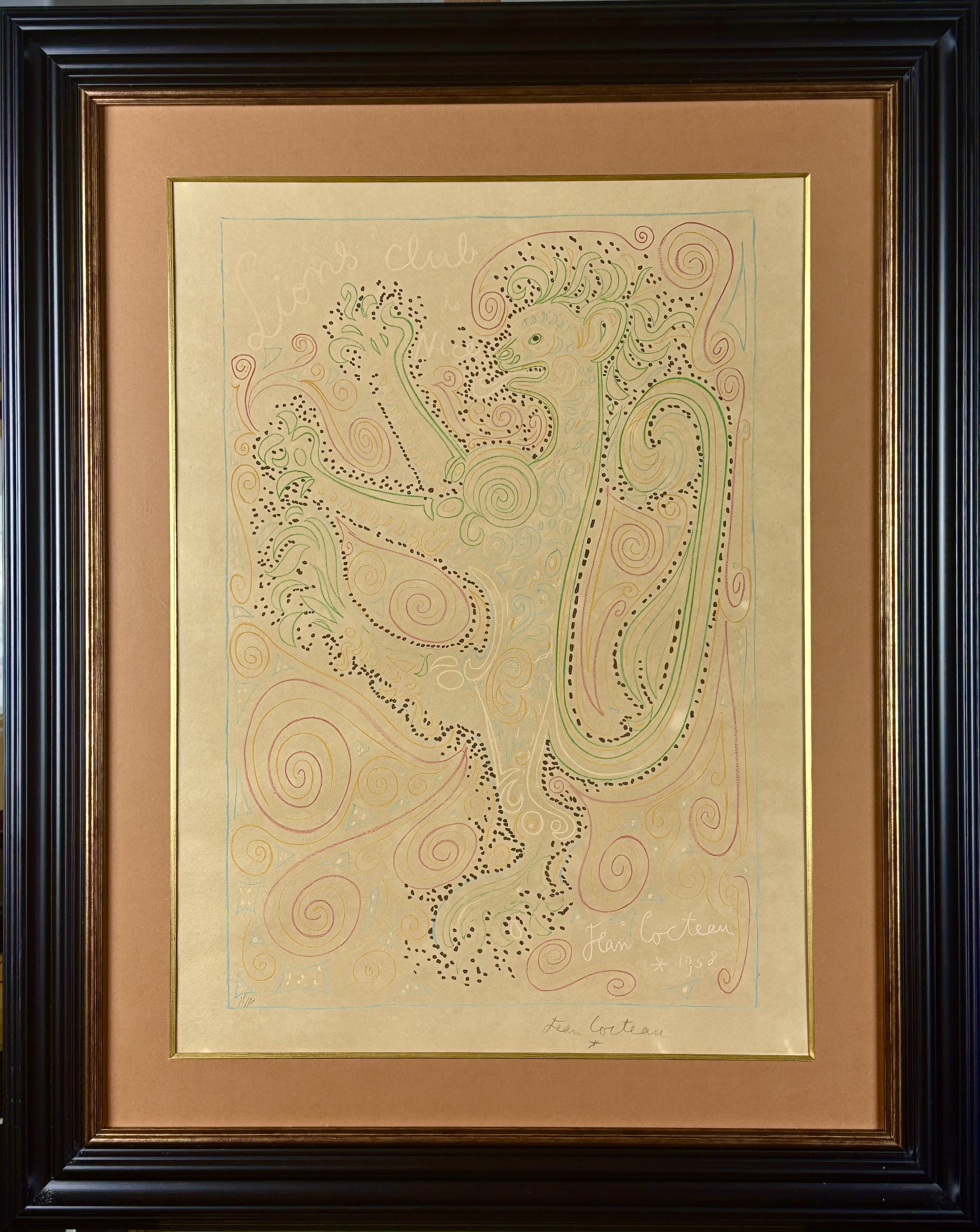
Collector's lithograph on handmade Arches paper, 64 x 45 cm (inside the mat), framed in a frame measuring 87 x 70 cm;
The work was commissioned in 1958 as a limited edition of 150 pieces, created specifically for members and donors of the Lions Club; Piece No. 15/150, hand-numbered by the artist;
Double-signed: on the board and hand-signed in pencil with a distinctive star motif;
Publisher: Lions Club Nice,
The lithograph was produced by Imprimerie Mourlot (Atelier Mourlot) in Paris—the most renowned Parisian lithographic studio of the 20th century.
Cocteau was a magnetic figure in Parisian and Mediterranean bohemian circles. He was friends with the greatest minds of his era— Pablo Picasso, Amedeo Modigliani, and Coco Chanel. was one of the most colorful and versatile figures of the 20th-century French avant-garde. He was called an “artist-orchestra” because he could transform literally everything he touched into art
His work was steeped in mythology, dreams, the motif of mirrors, and the transcendence of death’s boundaries. Alongside his traditional signature, he placed a distinctive drawing of a star (étoile) on his works, which became his personal symbol.
A famous quote by Cocteau:
“They didn’t know it was impossible, so they did it.”
This lithograph from 1958 was created by Jean Cocteau just four years after the first Lions Club was founded in Nice. The artist, who was spending a great deal of time on the French Riviera at the time, designed this lithograph specifically for the Lions Club in Nice to support its philanthropic and charitable activities.
It depicts a stylized, metaphorical figure of a lion—the symbol of the Lions Club—with the poetic and mythical features characteristic of Cocteau (the profile resembles the classical Greek/mythical faces that the artist often depicted in his works). The drawing is executed with a fluid, continuous line and stippling, using colored crayons and pastels (greens, pastels, shades of pink, and orange). This style is extremely characteristic of Cocteau’s mature period in the 1950s (the so-called “Villefranche-sur-Mer / Côte d’Azur” ceramics and lithography style).