


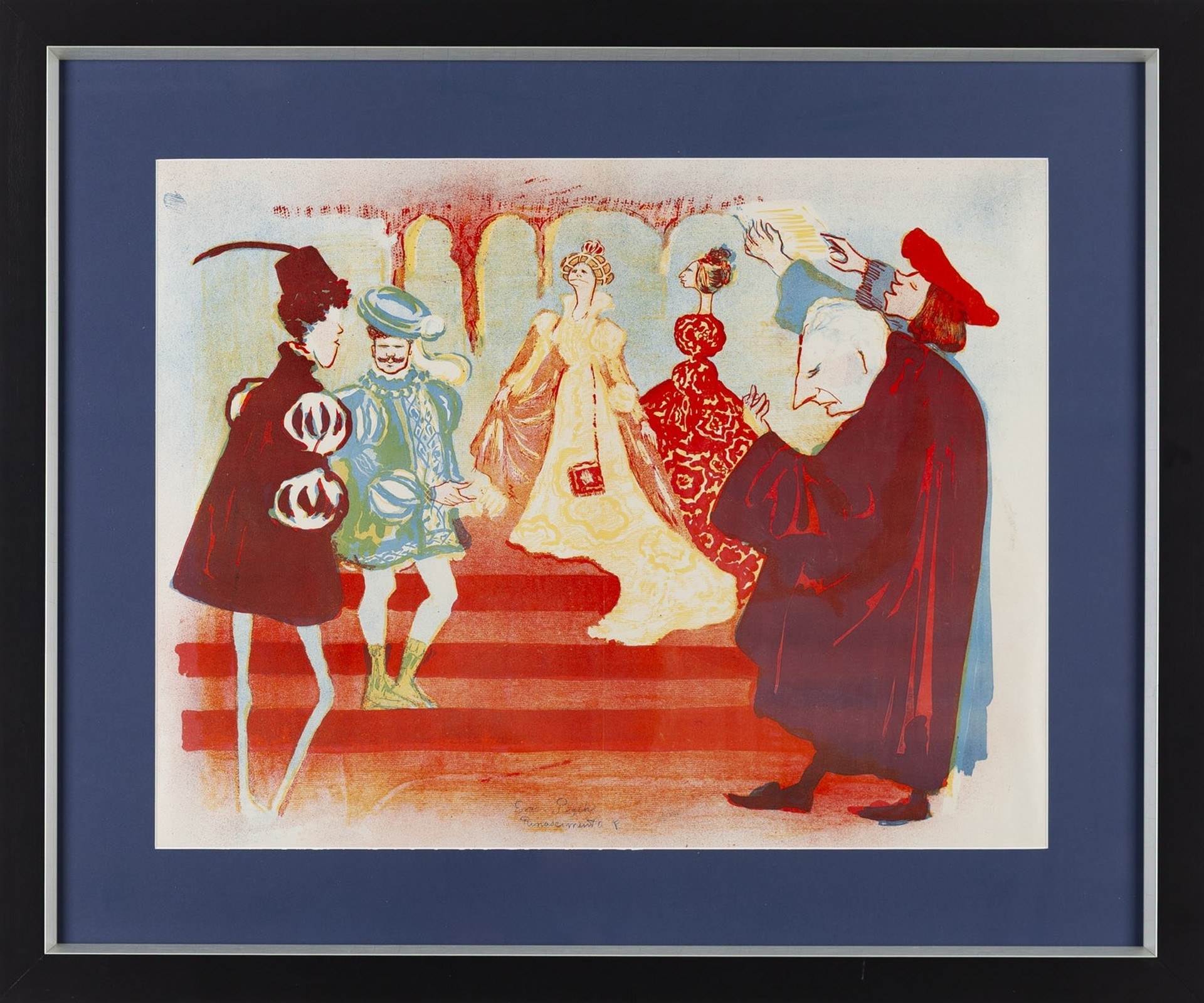
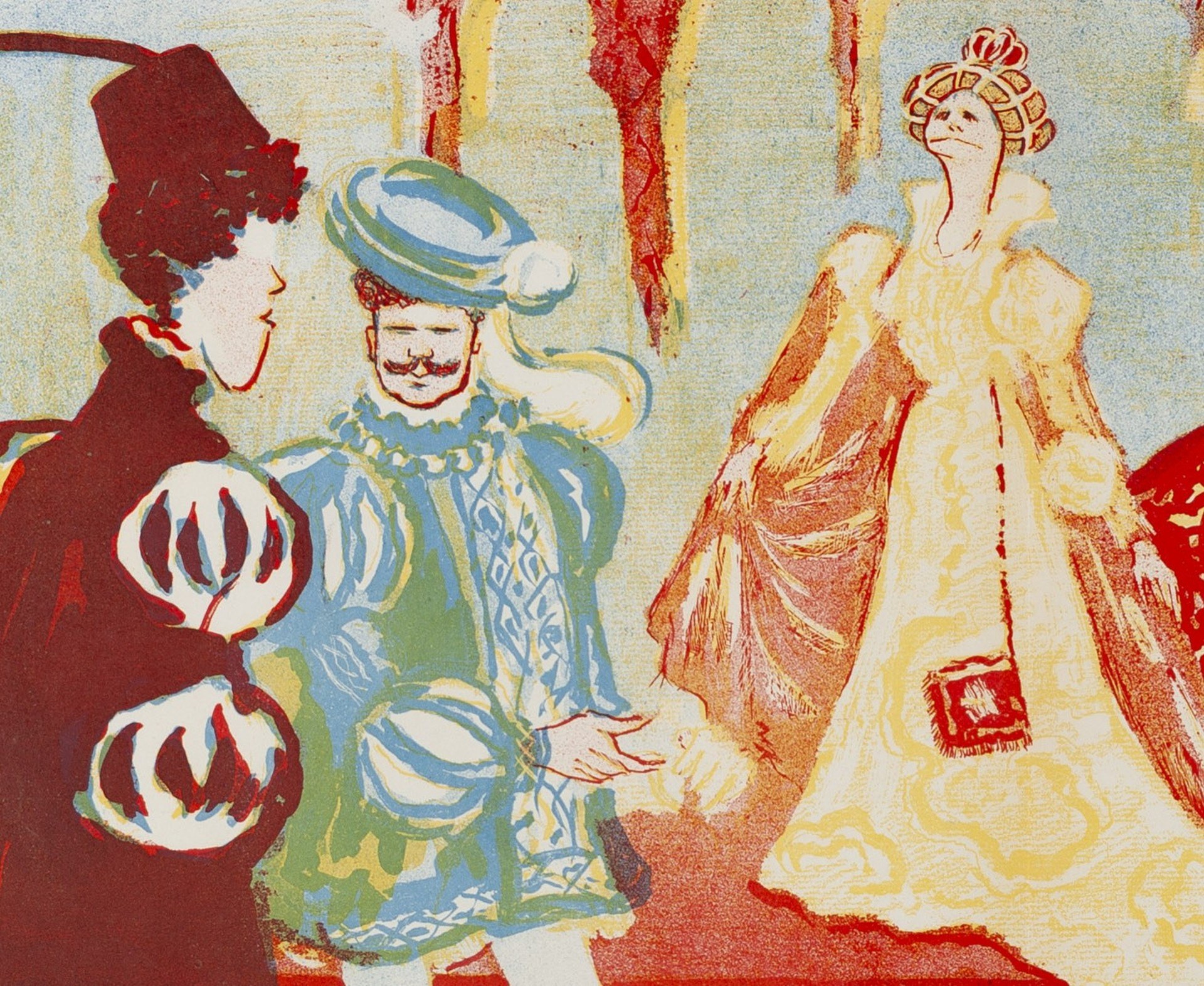
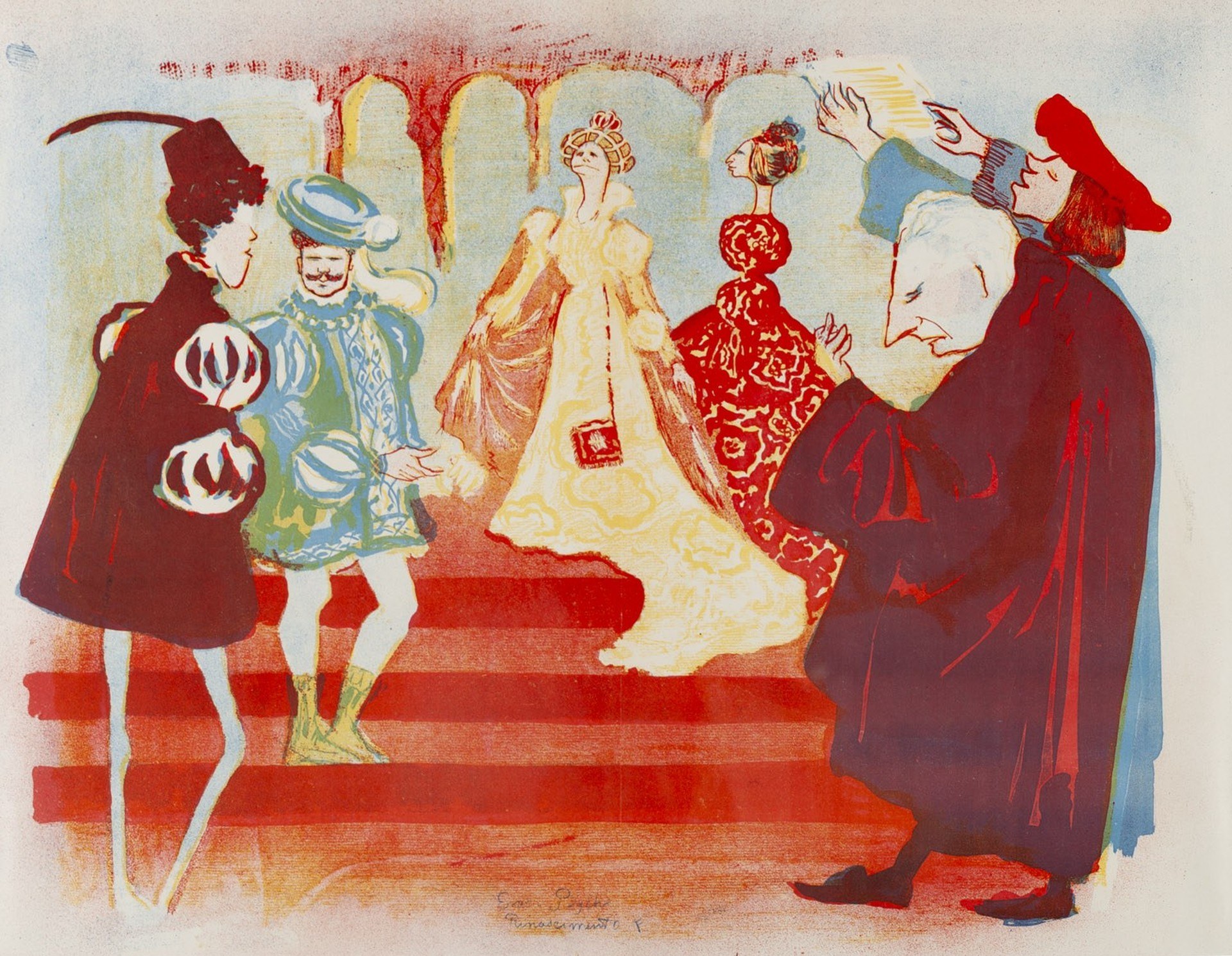
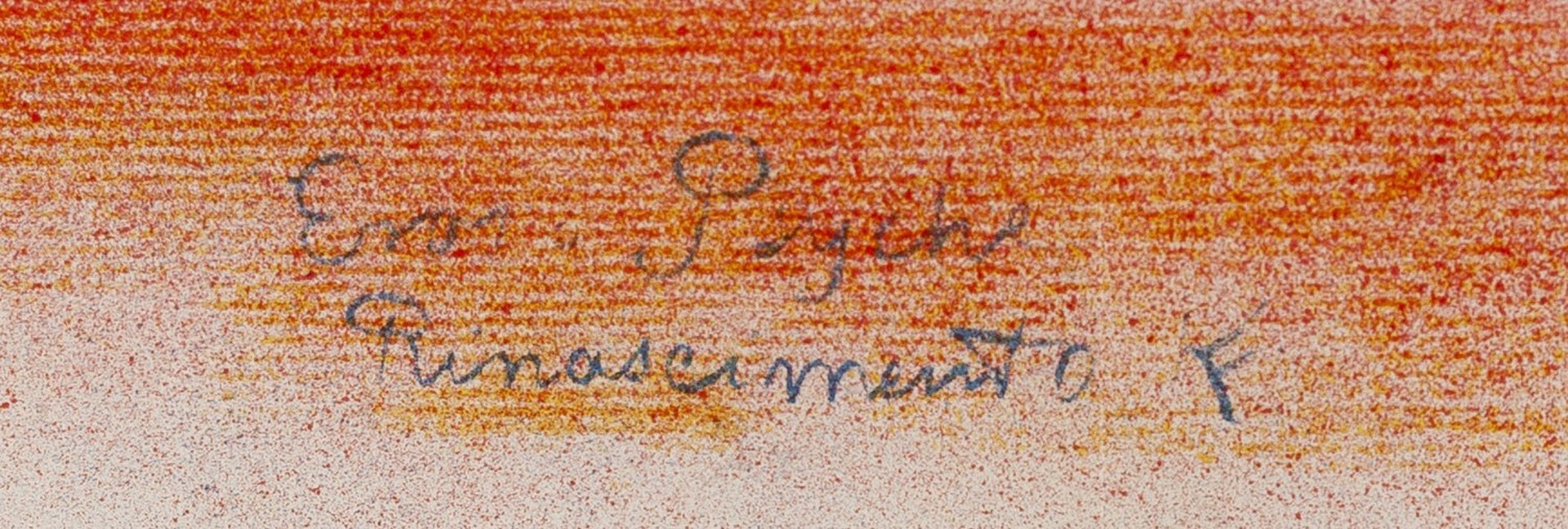
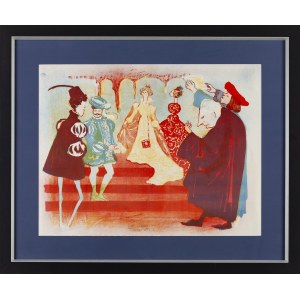
Autolithograph on paper, 44 x 57 cm, within the inner dimensions of the mat, framed in a frame measuring 77 x 65 cm. Signed on the stone with the letter “F” and inscribed by the artist as “Eros and Psyche. Rinascimento.”
Krakow’s social and artistic life at the turn of the 19th and 20th centuries flourished, centered both in salons and at the tables of fashionable cafés. Kazimierz Sichulski, alongside Karol Frycz, Stanisław Kuczborski, Stanisław Rzecki, and Wojciech Wojtkiewicz, joined the circle of Kraków’s satirists, who, sitting at a table in Jan Apolinary Michalik’s “Cukiernia Lwowska” café, came up with the idea of creating a lithographic portfolio of caricatures of actresses and actors in the roles they were playing in plays of the time—“The Wedding,” *Eros and Psyche*, *Waniusz’s Children*, *The Twin Sisters*, *The Marriage of Figaro*, *Kościuszko at Racławice*, *Anastasia*, “The Merchant of Venice,” “The Half-Virgins,” and “Maiden Vows.”
And so, under Rzecki’s direction, the famous “Melpomene Portfolio” was created in 1904, printed free of charge by Zenon Pruszyński at his Artistic Lithography Workshops—a friend of the artists and a faithful ally in their creative pursuits. The “Portfolio” comprised 38 autolithographs created by outstanding artists of the Young Poland period.
Through the distorting mirror of caricature and humor, with fluid lines and flat washes of color and black—sometimes against a starry background of splattered paint— —we see the heads and figures of actresses and actors, as well as group scenes, including the “Enchanted Dance” by Chochoł."
Among the popular and beloved actors featured here are: Jadwiga Mrozowska, Helena Sulima, Stanisława Wysocka, Jerzy and Bolesław Leszczyński, Marian Jednowski, Michał Przybyłowicz, and Aleksander Zelwerowicz.
“Melpomene’s Portfolio” entertained, caused a bit of a stir, but enjoyed great popularity, and its fame has endured to this day. Lithographs from this portfolio were exhibited in 1905 at the Krywult Salon in Warsaw; many of them found their way into collectors’ portfolios, while others adorned the walls of the living rooms and bedrooms of enthusiasts of graphic art, Art Nouveau, theater, and good fun. They also adorned the walls of the Lwowska Confectionery, where the idea for the portfolio was conceived and where, in 1905, the artistic cabaret Zielony Balonik was founded; the confectionery came to be known as “Jama Michalikowa,” a name it retains to this day. Aureliusz Pruszyński (1847, Kasinka Mała, Limanowa County—1904, Kraków), a Kraków-based lithographer and owner of the renowned Aureliusz Pruszyński Artistic Lithography Workshop in Kraków, founded in 1873 at ul. Pijarska Street; from around 1902, the studio was owned by his son, Zenon Pruszyński (see SAP, vol. 8, pp. 92–93). At A. Pruszyński’s studio, starting in the late 19th century, leading Kraków artists had their graphic works (including posters) printed using the lithography technique, such as the famous “Melpomene Portfolio.”
Autolithography—a lithograph drawn by the artist directly onto the lithographic stone.
Lit.: M. Grońska, Grafika w książce, tece i albumie, Wrocław 1994, item 7.










最近浏览过的
登录以查看拍品列表
收藏
登录以查看拍品列表