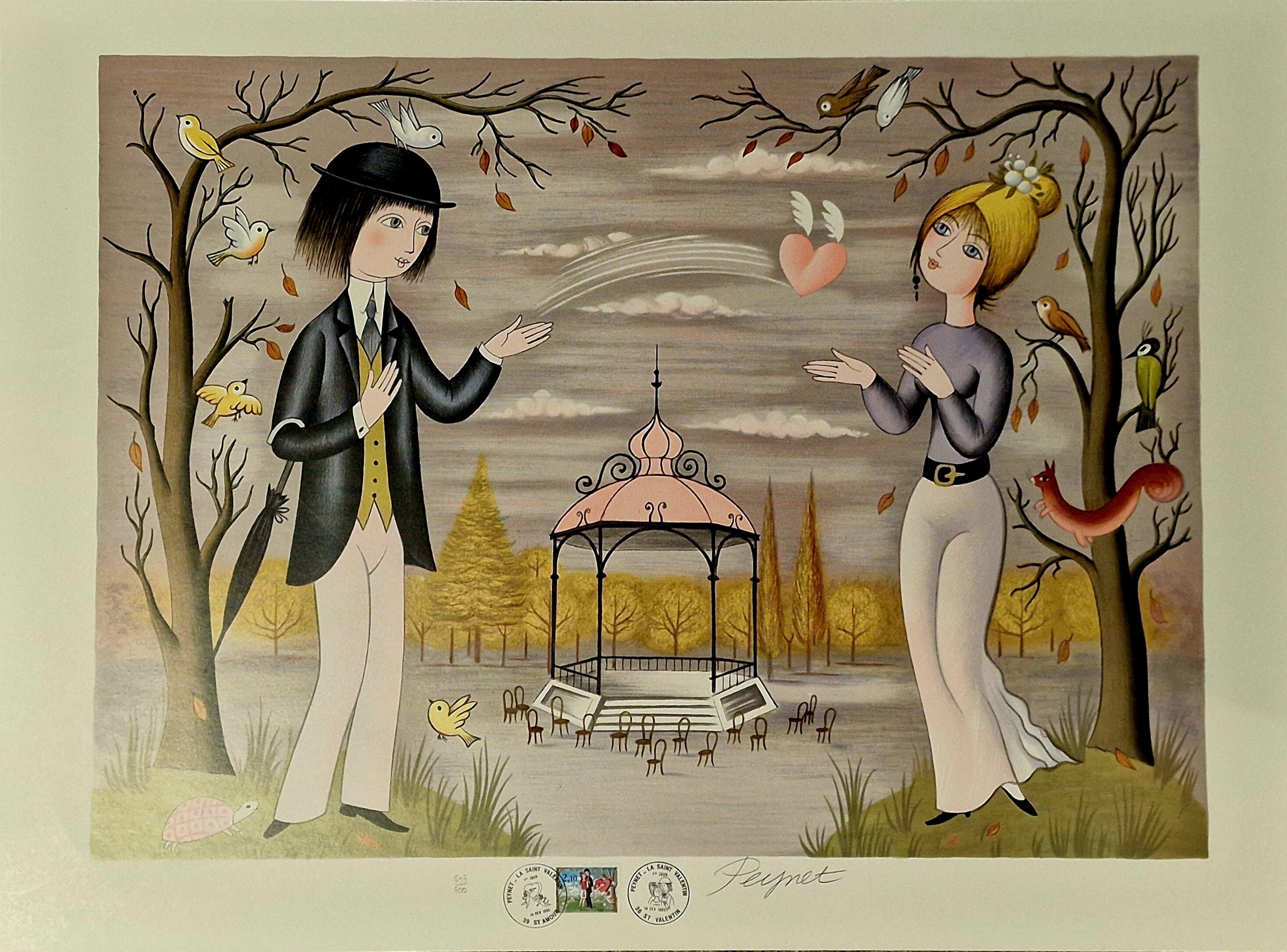
Color lithograph, satin paper, 74 x 50 cm
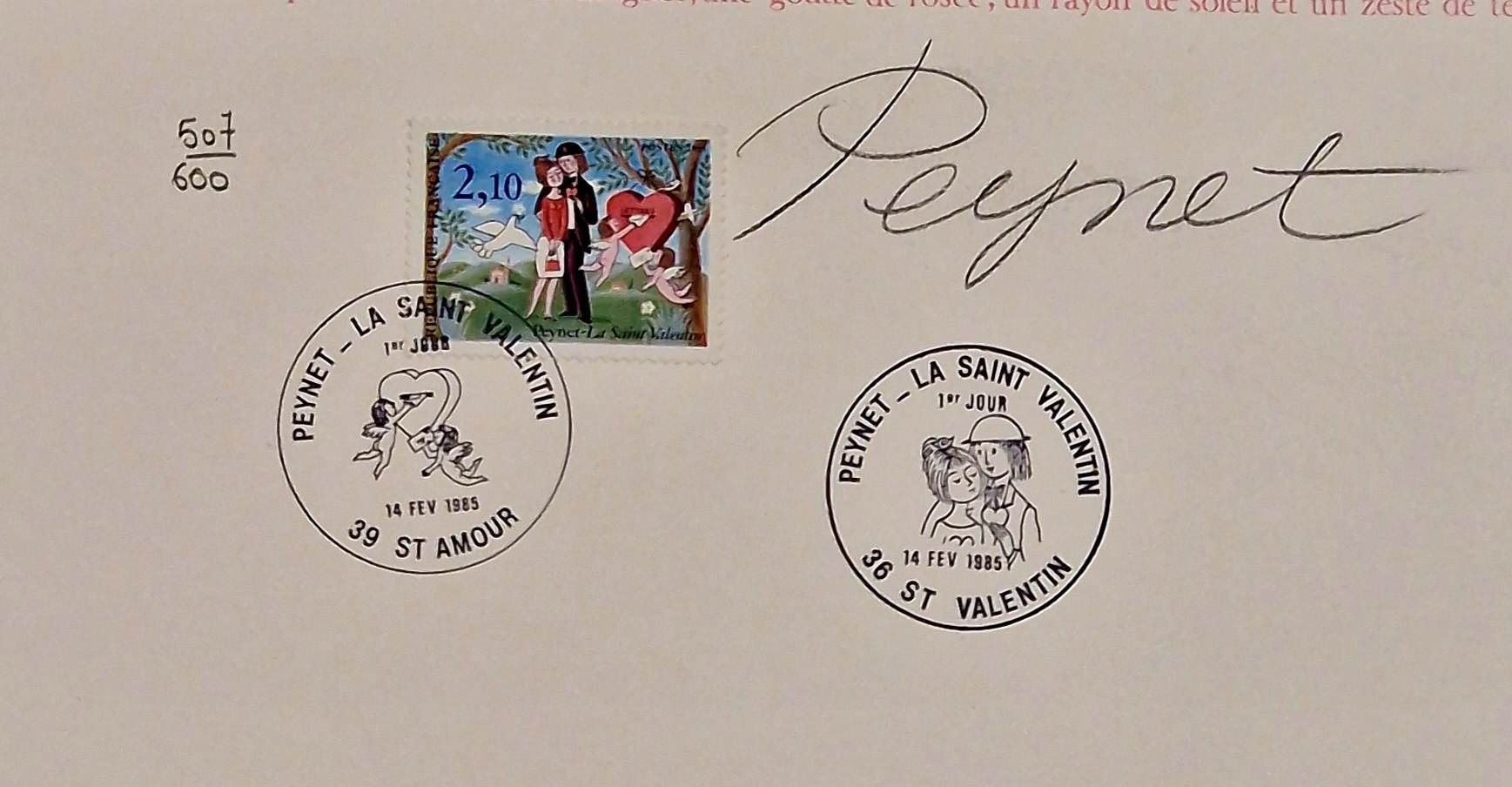
Signed in pencil by the author "Peynet" medr. d., limited edition, numbered in pencil 507/600.
Publisher: Mure Bublisher Nice; Artistic marketing: Edition du Cercle Montpellier.
Stickered under the composition is an original Republic of France postage stamp designed by Peynet, issued on the occasion of Valentine's Day in 1985, and two commemorative postage stamps dated February 14, 1985 from the towns of Saint-Valentin and Saint-Amour, whose names clearly refer to the Feast of Lovers.
Raymond Peynet was a world-famous French artist whose charming, romantic figures became an icon of love and happiness around the world. He is best known for his series of drawings depicting a pair of lovers commonly known as Les Amoureux de Peynet (Peynet's Lovers). Peynet himself was called the "Painter of Love."
The idea to create a pair of lovers was born in 1942 in Valence. Peynet was sitting on a park bench and, inspired by the gazebo where orchestras usually played, drew two characters - a slender poet and a delicate, long-haired girl - on a napkin. The drawing quickly gained popularity, and their images appeared on countless products. In the 1950s and 1960s, the "Lovers" became a symbol of France from another era.
Peynet's figures appeared on: porcelain and crystal (e.g. in the Limoges and Daum manufactories), jewelry, vinyl records, scarves, postage stamps, figurines,etc. The couple in love is always accompanied by small animals, birds, ladybugs symbolizing the world of love and harmony.
Peynet collaborated with many artists, including Georges Brassens, who wrote the song "Les amoureux des bancs publics" (Lovers from the public benches ) inspired by his work.
Peynet created a total of 6,000 drawings dedicated to "Lovers." The French Post Office issued a Valentine's Day stamp in 1985 with a drawing by Peynet, the original of which is glued to this lithograph. In 2000, a 3 franc (€0.46) stamp was issued in memory of the late artist with a drawing of Lovers under Peynet's gazebo. In France, three museums have been dedicated to Peynet's work: in Valence, in Antibes on the Côte d'Azur and in Brassac-les-Mines, his mother's hometown, and in Japan two: in Karuizawa and in Sakuto. A volume of Peynet's drawings was published in Poland in 1958.