


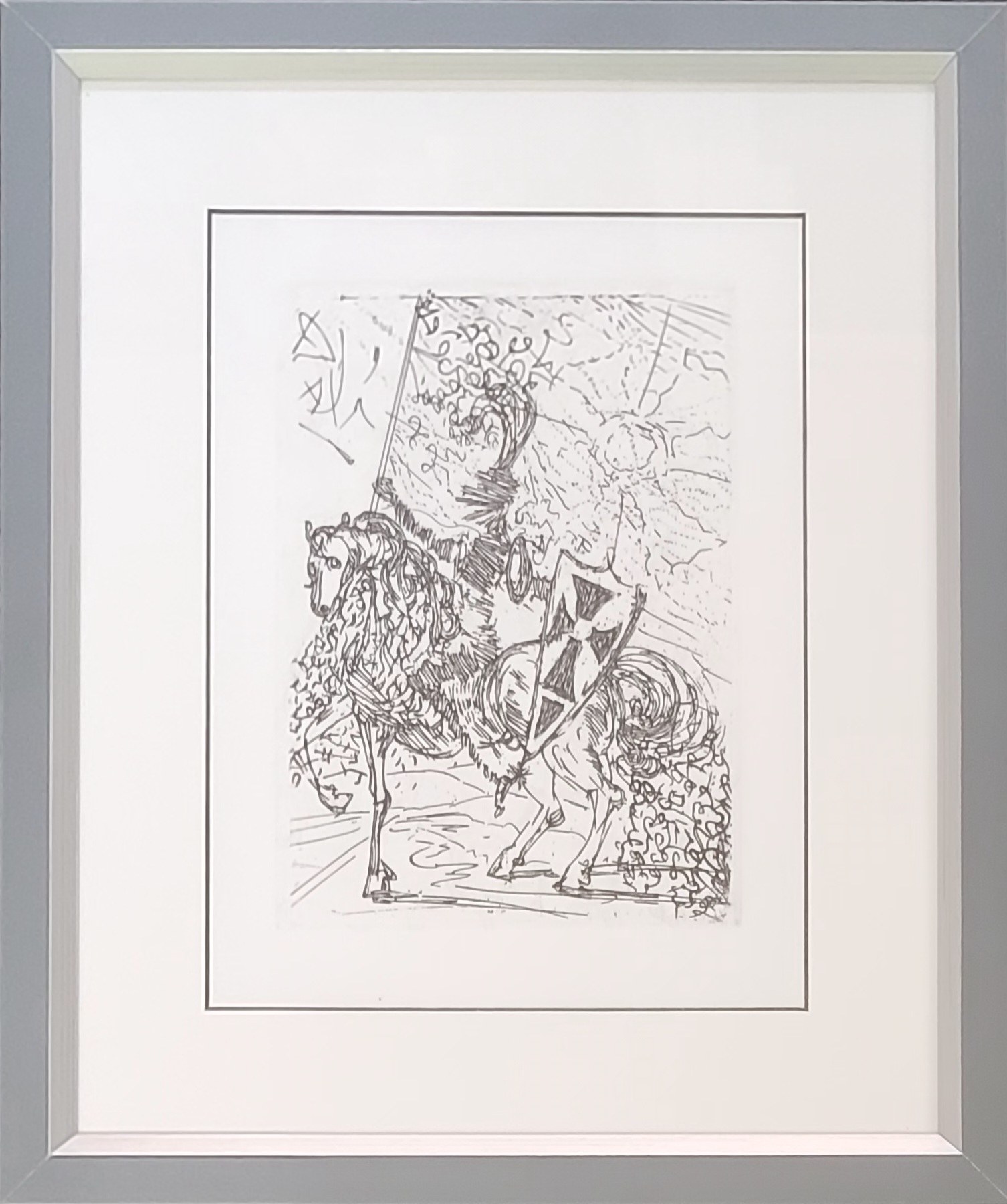
Etching, heavy vellum paper, 17.5 x 12.5 cm (plate print), 38 x 29 cm (sheet)
Signed on the plate l.g.
Salvador Dalí, one of the most famous Surrealists, created many works inspired by literature and culture, including the compositions "El Cid Campeador" or "Don Quichotte."
Salvador Dalí's work titled "El Cid Campeador" is an original engraving on paper, created by the artist in 1968. It depicts a portrait of Rodrigo Díaz de Vivar, known as El Cid or El Campeador, who was a medieval knight andruler in Spain. El Cidbecamefamousfor hisservicein the armies ofbothChristianandMuslimrulers. After his death,hebecame Spain's best-known national hero andthe main character of Spain's mostimportant medievalepic, "El Cantar de mio Cid."
The characteristic features of Dalí's style thatcan beseen in this engraving are the playful lines andvariedthicknessofthe lines,whichbringthefigureto life anddistinguishthe background from the foreground. The lines of the drawing are dynamic, suggesting movement andenergy, in keeping with El Cid'sadventurousnature.
Dali often used surrealistic symbols and motifs that canbe interpreted in manyways,depending on the viewer's perspective. The symbolism associated with El Cid refers to his role as a national hero, a master of the battlefield and a figure who transcended the cultural and religious boundaries of his time. Hisfigurehas been repeatedly depicted in literature, music, video games and films, attesting tothe lastinginfluence of his legend onSpanish and worldculture.
The work reproduced and described in themost importantcatalog of Salvador Dali's prints - Albert Field "The Official Catalog of the Graphic Works of Salvador Dali" 1996, item 65-7 A










