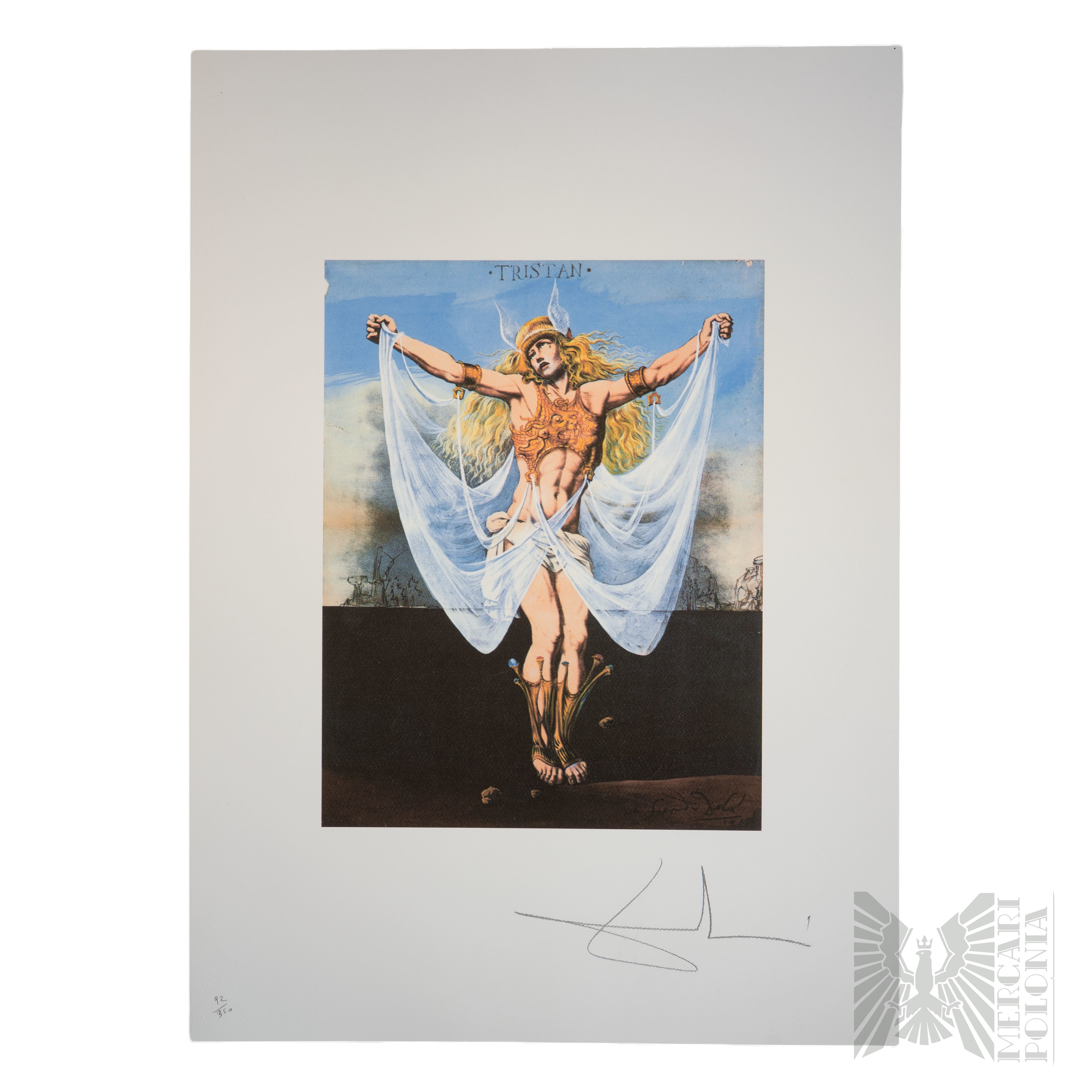
Salvadore Dali (1904-1989) - Tristan
Lithograph, limited edition of 350 pieces, Arches velin paper, 70 x 50 cm (sheet),40 x 30 cm (composition)
Numbered in pencil l.d.: 92/350 and hand-signed under the composition. At the bottom dry stamp-Certified Dali Dalart NV, Copyright 1981.
"Tristan as Christ "is an iconic and enigmatic work by Salvador Dalí that has captivated viewers since its creation in 1951. At first glance, the painting depicts the suspended figure of Jesus Christ, seen from above against a dark sea and sky. The dramatic color contrast, careful rendering of detail and unique perspective make this painting instantly recognizable as a Dalí masterpiece.
In a simple reading, the painting is a representation of the cross of Christ. What sets this painting apart is Dalí's innovative approach to capturing this sacred moment. The artist chose a bird's-eye perspective, an unusual viewpoint that adds drama and power to the composition. The dark sea and sky, which almost blend together, create a supernatural atmosphere, emphasizing the divine and supernatural nature of the subject. Unlike traditional crucifixes, where Jesus is usually depicted as suffering and in pain, Dalí shows Christ as calm. The elongation of the legs gives the impression of weightlessness, as if Christ is lifted, transcending the physical realm. This interpretation resonates with St. John of the Cross' concept of the Dark Night of the Soul, a spiritual state in which one experiences deep union with God beyond the senses. However, the unexpected interpretation adds another layer of intrigue to Dalí's masterpiece.
Some art critics suggest that Tristan as Christ "is not only a representation of the Crucifixion, but also a metaphorical representation of the atomic bomb dropped on Hiroshima. Elements of the painting can be linked to this unexpected theme. The suspended figure of Christ may be a symbolic representation of the bomb, hovering menacingly over the sea and sky, just as the atomic bomb hovered in the air before the explosion. The dark sea and sky can symbolize the destruction caused by the bomb, the effects of the explosion. In addition, the calmness seen on Christ's face can be seen as a contrast to the horror and chaos of the Hiroshima bombing, suggesting a divine presence in the midst of the tragedy.
Although Dalí has never confirmed this interpretation, the presence of implicit political and social themes in his work makes it plausible. Dalí was deeply disturbed by the bombing of Hiroshima and Nagasaki during World War II and was known for incorporating political commentary into his art. In conclusion,Tristan as Christusto a fascinating and thought-provoking painting that can be interpreted in many ways.
Salvador Dali (1904-1989) - Spanish painter, printmaker, decorator, illustrator and painting theorist. He was a leading representative of Surrealism. From 1921 to 1926 he attended the San Fernando Academy in Madrid. In 1926 he went to Paris,where he met, among others, P. Picasso and T. Tzara. He was associated with G. Eluard, who was his muse. He became friends with F. G. Lorca, L. Bunuel and R. Albertini. He spent several years in America. Since 1982, after the death of his life partner, he led a life of water seclusion. Thanks to his individual creative method (paranoiac-critical), he introduced an atmosphere of the unusual and fantastic into his work. He introduced a virtuoso technique bordering on illusionism.
The state of preservation can be seen in the photos.