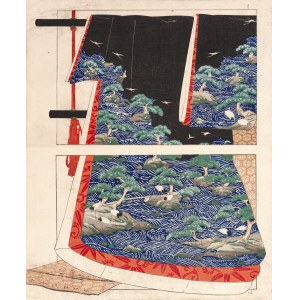
Japanese woodcut, ink, paper, 30x24 cm (diptych paper size)
The plastic effect on the woodcut is enhanced by the use of the karazuri technique, for which a wooden plate without ink was used, pressed by hand onto the paper. The use of karazuri and the use of metallic silver pigments is a major asset of these woodcuts.
The woodcut is from "Isho Sekai (World of Design)" magazine, No. 1. Published in Tokyo in 1901 (Meiji 34), an analogous piece is in the collection of the Harvard Library.
Issue one of "Isho Sekai" magazine was illustrated entirely by an artist named Sawa Kyukou, the woodcuts were cut by Watanabe Takijirō, and the publisher was "Seibikai" (Exquisite Beauty Association). "Seibikai" was founded in Tokyo in 1900 by Shobei Kitajima. The epilogue of the "Isho Sekai" magazine explained that the periodical is published monthly, on the fifth day of the month, providing designers with the latest developments in kimono design, fabric dyeing and pattern weaving. Many post-1900 designs filtered the then-Western Art Nouveau aesthetic and adapted it to traditional Japanese forms.
The design of a kimono has always been extremely important, as it defines not only the garment itself, but also the region or artisan who created it. The decorations of kimonos often have complex levels of meaning, presenting an inexhaustible wealth of patterns alluding to the natural world, the changing seasons, customs or trends in art. In addition to their aesthetic value, these patterns are associated with faith and the desire for a long, prosperous life. The color scheme of the kimono itself can have significant metaphorical and cultural significance. The color purple is a metaphor for undying love, while red signifies youthful charm and allure. The patterns found on kimonos also had their own symbolism. Cranes most often appeared on wedding kimonos, as these birds were believed to be able to live for more than a thousand years - a fact that was supposed to reflect a long, happy marriage. The pine tree motif, on the other hand, is associated with the new year period and was most often worn in winter. The depiction of cherry trees was most popular in spring, when hanami - the cherry blossom festival - is held en masse across the country.