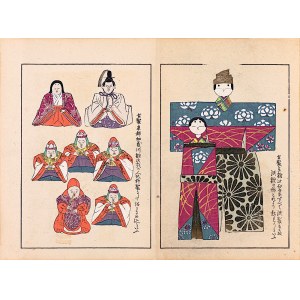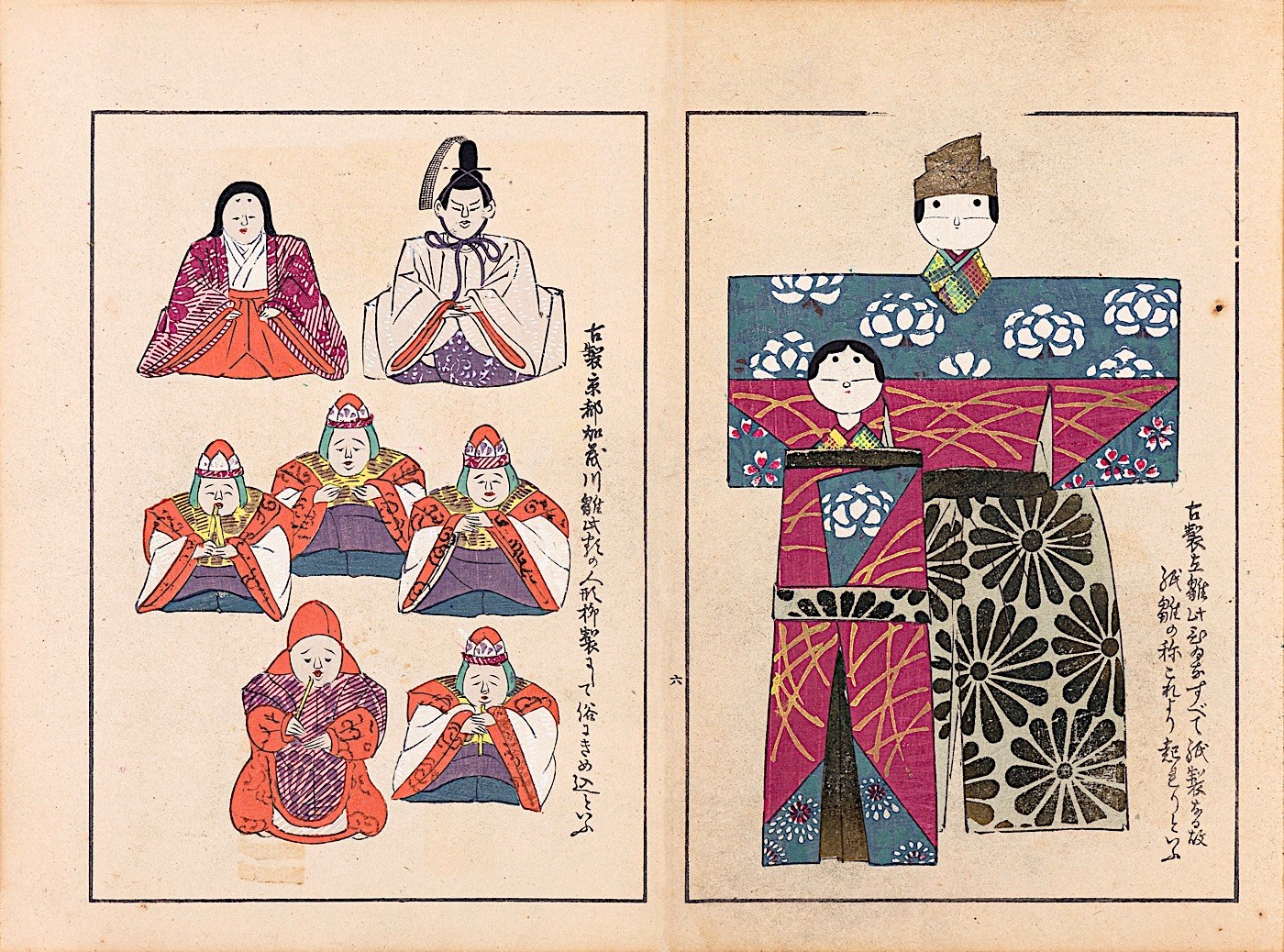
color woodcut, paper, 25x33 cm (size of diptych paper), inscriptions in Japanese
The woodcut is from the second volume of the ten-volume series "Unai-no Tomo" (Friends of the Child) by Seifu Shimizu, published by Unsodo in Kyoto (first edition) in 1911. An analogous piece of this volume can be found at the Brooklyn Museum, where games and toys were handled by the famous curator-ethnographer Stewart Culin, among others. The publication is registered at Japan's National Diet Library under the number 400724478.
Some of the woodcuts in this publication are richly decorated with metallic pigments in gold and silver. "Unai-no Tomo" is a work of great artistic and ethnographic importance, and is widely regarded as the most important early illustrated Japanese work on "omocha," toys made by hand from common materials. Many of these originally derived from amulets and talismans rooted in Shinto and traditional Japanese folklore.
Shimizu Seifu (1851-1913) was a director of a large Tokyo shipping company, as well as an avid collector of Japanese folk toys, author, artist and calligrapher, studying under Hiroshige III. His personal interest in Japanese toys led to the creation of the 10-volume Unai-no Tomo series. The first six volumes, published between 1891 and 1913, were based on his own drawings. After Shimizu's death in 1913, the next four volumes were completed by his friend Tekiho Nishizawa. The series is considered a valuable and important source of information on Japanese folk toys.