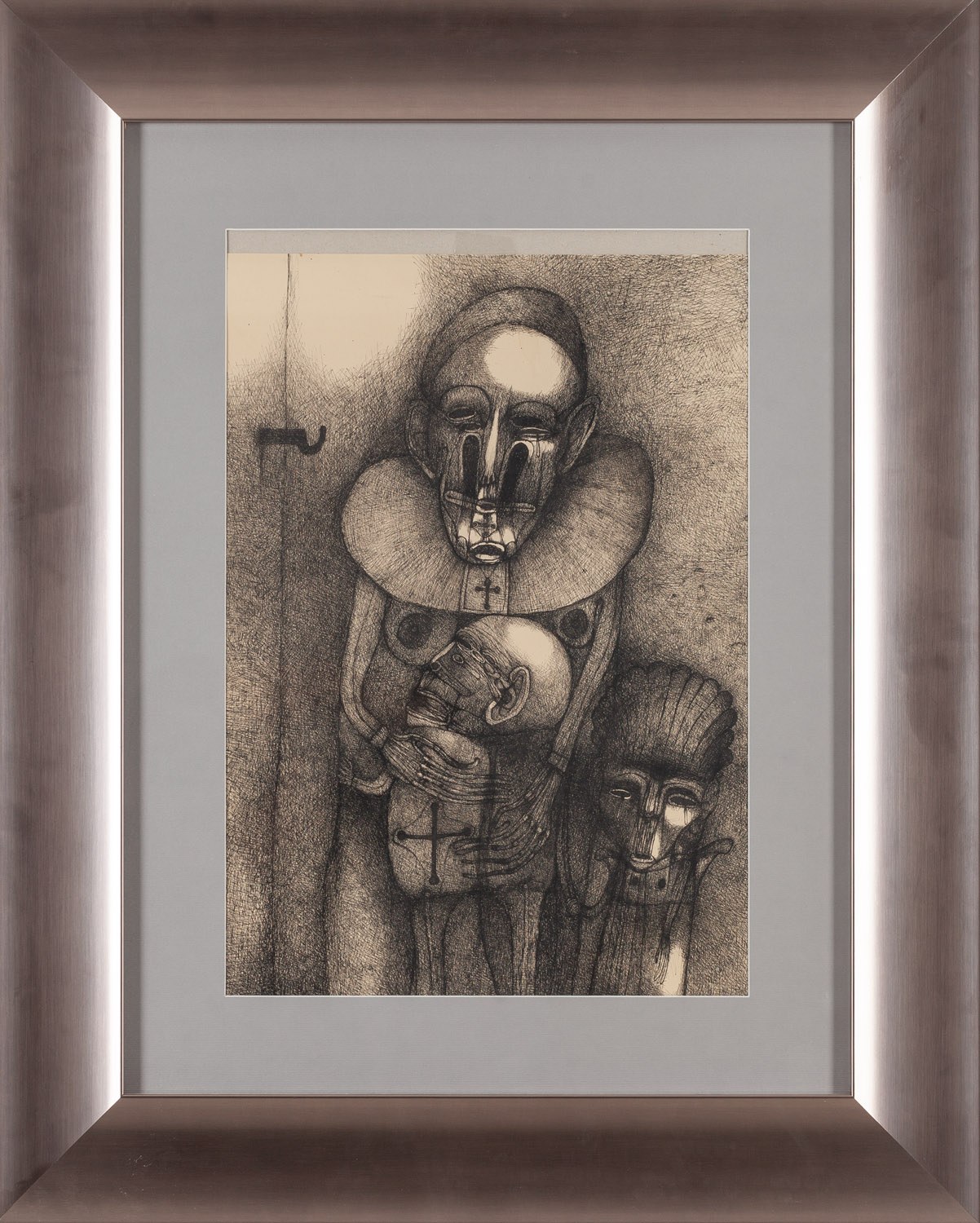

Dimensions: 47 x 32 cm (in light passe-partout)
Origin
Uppsala Auktionskammare, Uppsala, December 2014
private collection, Poland
Comment
"It's probably a good thing that we die in my family in this order. If I had passed away first, and now Tomek died, it would have been an incomparably harder experience for Zosia than for me. You can't even imagine her suffering and loss. If we had both died, in any order, I don't think Tomek himself would have been able to cope with his life and the real world. As it happened, it happened most justly, and you can't think that God picked on us. I have the thickest skin and I was left in the dessert."
Zdzislaw Beksinski
He wrote this in his diaries, about the suicide death of his son Tomasz. First he lost his wife, then several months later his son died. And a few years later he himself was murdered in his apartment. On the night of February 21-22, 2005, just days before his 76th birthday. Most shockingly, the charming man and accomplished painter was killed by his friend's son.
Although Beksinski was regarded as a rather cheerful person with a sense of humor, at the same time many of his works center around the theme of dying and death. The mainstay of his life was his beloved wife Sophia, a Romanist by training. They met while he was still a student. Sophie was seen as an equally colorful, though not as charismatic or well-known, figure as her husband and son. She was the only one who knew how to reach into the closed world of the eccentric twosome and maintain order in the household. The peace of the Beksinski family was shaken on several occasions, but the real drama in the family turned out to be Sophie's devastating diagnosis, she was diagnosed with an aortic aneurysm. She devoted the last months of her life to preparing her husband for independent living. Reportedly, the painter meticulously noted all the advice and recommendations of his beloved wife. On September 22, 1998, their love, which lasted nearly 47 years, was interrupted by Sophie's death. Understandably, the passing of his beloved wife was an incredible blow to the artist. "It's silly, but I constantly have this feeling that we will see each other again and talk. We have been together too long. She is an indelible part of myself," the artist wrote in his diary. (Quoted in "Beksinski. Day by day of an ending life").Unfortunately, Zdzislaw Beksinski's drama did not end there. His only son-Tomasz-had always been fascinated by the motif of death. While still in his hometown of Sanok, at the age of just 16, he attempted suicide for the first time, by poisoning himself with gas and overdosing on sleeping pills. Two years later, moments before moving to Warsaw, Tomasz Beksinski came up with another macabre idea. He posted hourglasses around the city announcing his own death.
In high school he ran the school radio station and played at discos. In the late 1970s, he began his career as a music journalist. He was an outstanding music expert and a one-of-a-kind presenter whose broadcasts quickly became the country's most sought-after radio dramas. Listeners appreciated his frankness and uncompromising nature.
He was a very ambiguous man. On the one hand, he wished for death and spoke loudly about his desire to leave this world, on the other hand, when he survived a plane crash in 1982, he never got on a plane again. Tomasz Beksinski committed suicide in 1999 on Christmas Eve. He had taken a large amount of medication. He had previously announced his passing in a radio column. The broadcast can be listened to online. For many listeners, it was only a symbolic farewell. The end of the millennium was approaching, and it hardly occurred to anyone that they were hearing Tomasz Beksinski for the last time,. The sad truth was guessed by Beksinski's friend Anja Orthodox.
Undoubtedly, the family history of the Beksinskis is extremely dramatic, although it should not be forgotten that, above all, they were a loving, supportive family with more than average skills. To date, many photos of the family together have been preserved, on which three figures can be seen: Zdzislaw, Sophia and Thomas. On the Internet you can even see short films and from their private lives. On which they jokingly prepare meals, in their Warsaw apartment. Watching these videos, one gets the impression that Sophia's calmness and composure, had a soothing effect on the two men closest to her heart.
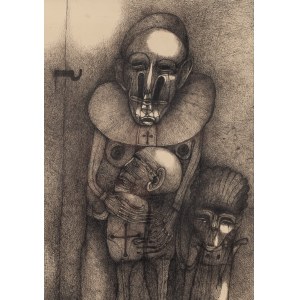
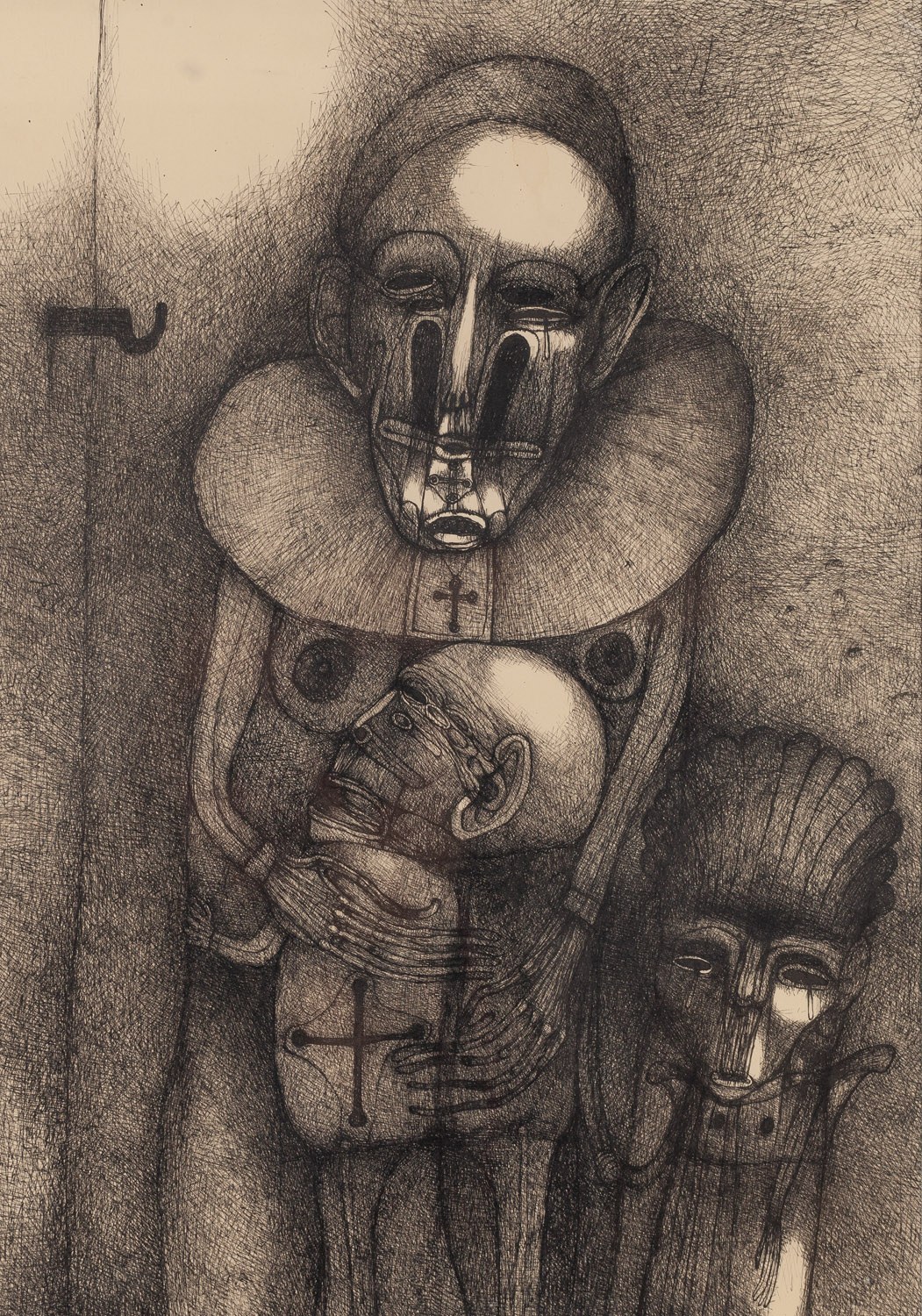
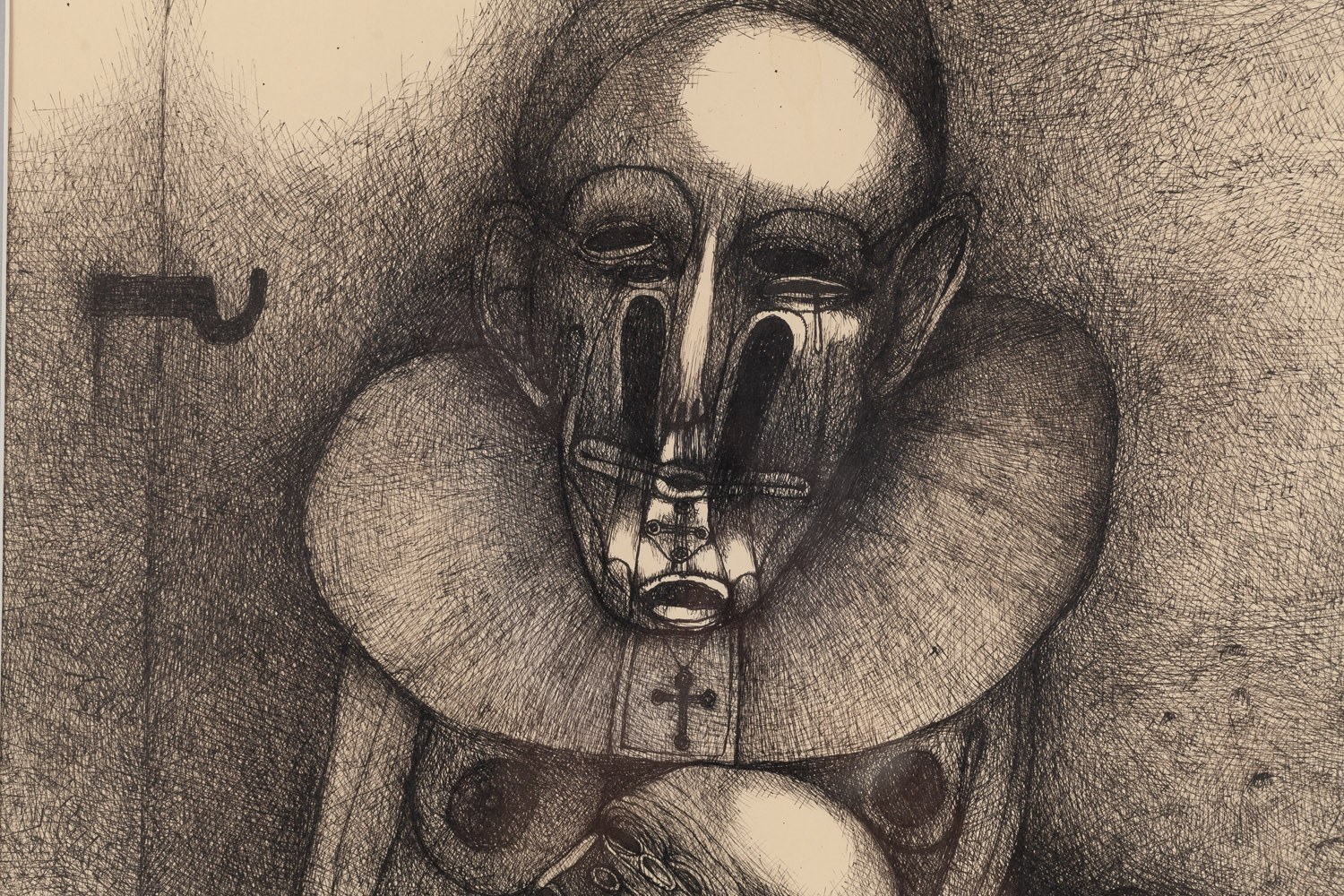
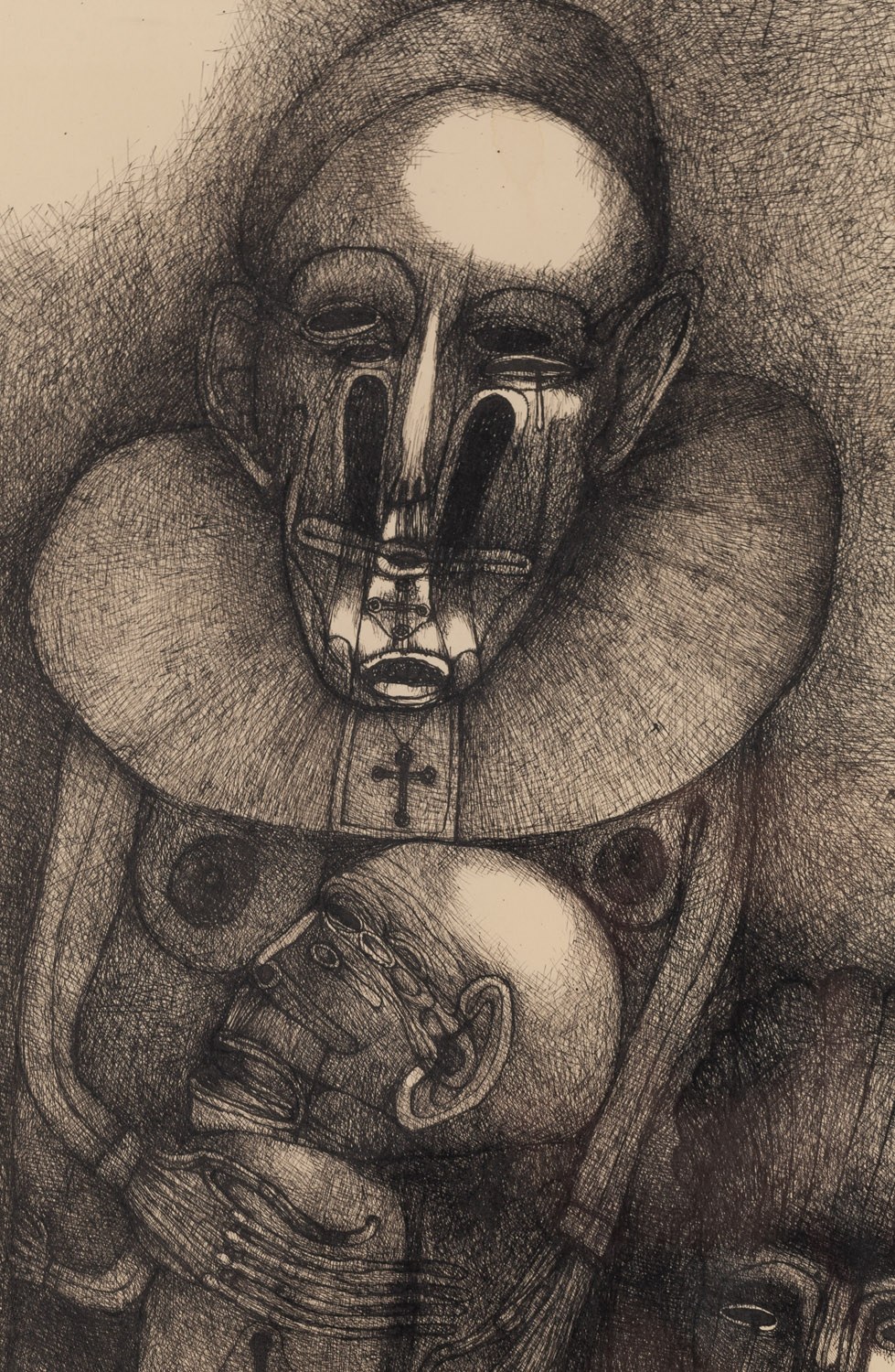
Although it is unclear what inspired the work presented at the auction , it is worth noting the three figures there. The largest is a woman, the other two are smaller. One is huddled with the woman, the other is standing next to her. The work looks like a family portrait, perhaps the master paid homage to his wife in this way?
Biography
Born in 1929 in Sanok, photographer, graphic artist, illustrator and painter. He studied at the Faculty of Architecture at the Cracow University of Technology. In the late 1950s he worked as a stylist-artist in the Department of the Chief Constructor of the "Autosan" Factory. He began his artistic activity as a photographer. In 1957 formed an informal group: Beksinski, Lewczynski, Schlabs, which was active until 1959. The last exhibition of the artists took place at the Deutsche Gesselschaft für Photografie in Cologne organized by Otto Steinert.
From 1957 to 1963, Beksinski was a member of the Union of Polish Artists and the Union of Polish Artists Photographers. In the late 1950s and early 1960s he referred to Reiner Maria Rilke's poetry and existential content. The artist's photographic oeuvre has been preserved in the National Museum in Wroclaw and plays a role representative of 20th century Polish photography. The artist's main model was his wife Zofia Beksinska. Initial depictions of female beauty began to turn into experimental photography using bandages or string, as in "The Sadist's Corset."
In the mid-1960s, he broke with popular avant-garde thought and largely began to devote himself to painting. He claimed that modern art was receding into the background, and that attention was being drawn to the search for synthesis in contradictory directions. This led to the seeds of postmodern thought. He also created sculptures from plaster and metal, referring to the work of Henry Moore. Beksinski's work was popularized by an exhibition organized by Janusz Bogucki in 1964, at the Old Orangery in Warsaw. The exhibition was guided by the idea of Beksinski's contradictions and the juxtaposition of innovation and traditionalism. From the late 1960s to the early 1970s, Far Eastern motifs appeared in his work. Works from the 1980s are characterized by the interweaving of Baroque and 19th-century motifs with a strong erotic accent. They were referred to as "dream photography." In the 1990s, he began to introduce computer graphics applied to works based on a private collection of photographs.
The artist, who died tragically in 2005, is highly regarded outside Poland in South Korea, Japan and the United States. His works are in numerous museums and galleries in Poland, including Sanok (the richest collection of the artist's works), Warsaw, Krakow, Czestochowa and Wroclaw. He is the only Polish artist whose works have been exhibited at the Japanese Art Museum in Osaka.
The artist was associated with Piotr Dmochowski-an enthusiast of Beksinski's art and his art dealer. The first exhibition organized within the framework of the cooperation took place at the Valmay Gallery in Paris, in the fall of 1985. The exhibition gained significant publicity. Then in 1989-96 Piotr Dmochowski opened an art gallery in France dedicated to the artist's works. Marszand speaks of the artist's art as amazement and love at first sight when he and his wife visited the Warsaw Art Exhibition Office.
The life and art of Zdzislaw Beksinski is a phenomenon that far exceeds the circles of art lovers - it can be considered part of pop culture. The artist and his family inspired the creation of many excellent books, monographs, catalogs, etc. In 1964, the first film dedicated to the artist "Photoplasticon" was made, directed by Pyotr Andreev. In 2016, a film directed by Jan Matuszyński "The Last Family" was made, which won many awards, including the Silver Leopard for best actor - Andrzej Seweryn. In 2017 the documentary "Beksinskis. A Videophone Album" directed by Marcin Borchardt and a short film "Pars Pro Toto" by Katarzyna Lelecka. In addition, there was a performance directed by Jerzy Satanowski "Beksinski. Untitled Image", as well as a dance and music show directed by Agnieszka Glinska - Art Color Ballet "KRYPTONIM 27". Beksinski's influence extends even to the fashion world. In 2017, English Vogue published photos from the fall/winter show at London Fashion Week. It featured designs by award-winning Polish designer Joanna Berling, whose show was inspired by Beksinski's work. In 2021, the Bytom brand created a collection in cooperation with the Historical Museum in Sanok. The artist's works appeared on blouses and jackets. Japanese designer Yoji Yamamoto became interested in Beksinski's paintings and created collections for the autumn-winter 2022/2023 season. The Beksinski Foundation, established in 2006, is also active. The foundation's goal is to promote the artist's work, and the Historical Museum in Sanok with the largest collection of the artist.