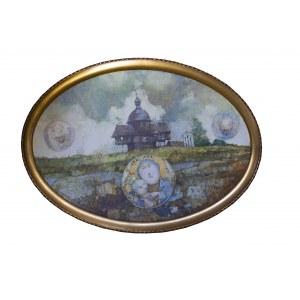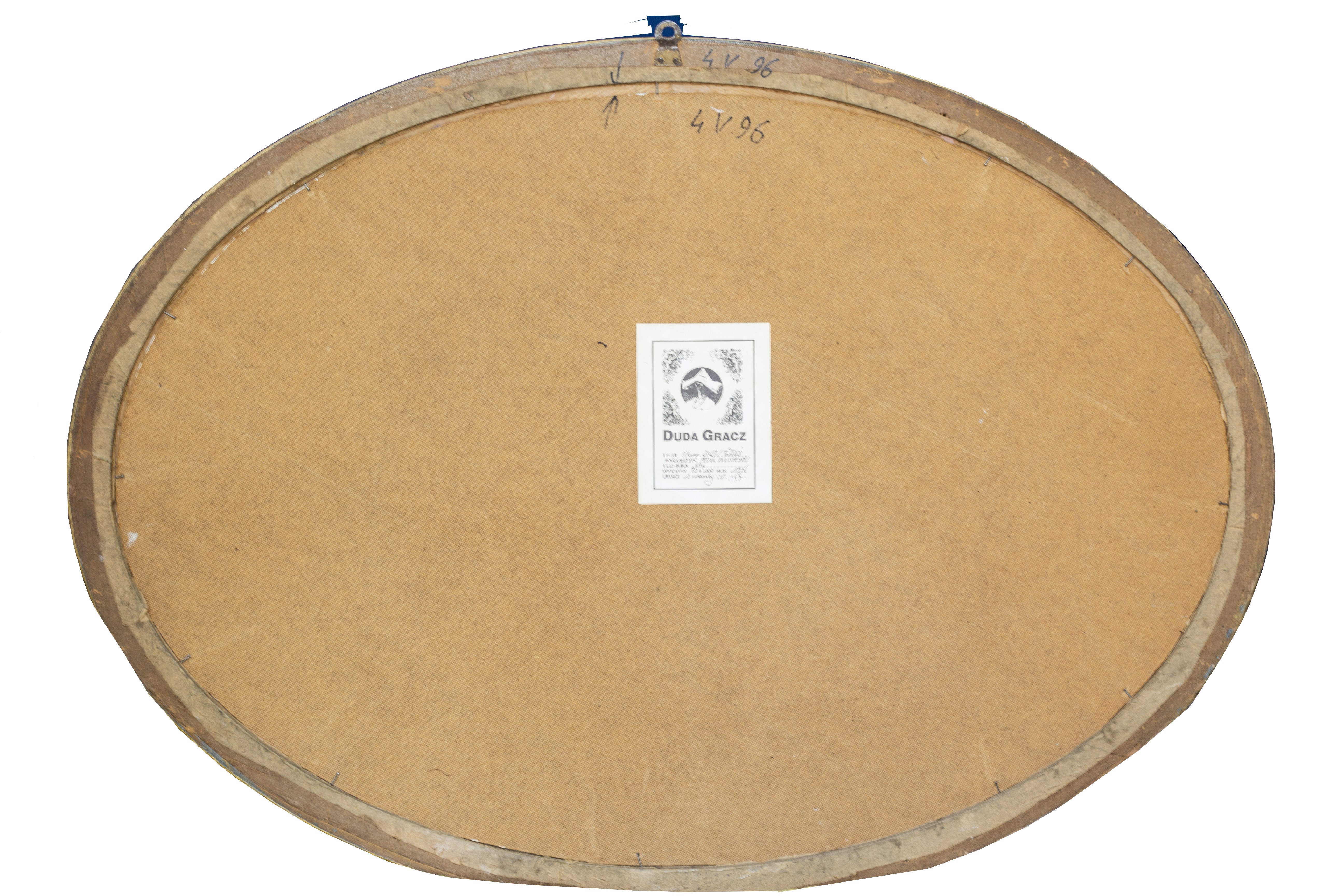

Oil on panel, 70 x 100 cm, signed lower edge left 'Duda Gracz 2027/96', back: author's label
The work comes with a certificate of authenticity signed by the artist's daughter, Agata Duda-Gracz.
Painted in the center of the painting, the unusual Orthodox church is a unique wooden temple located in the village of Kościaszyn. One of its treasures was the Icon of Our Lady of Eleusis, very important to the local faithful. Shortly before Jerzy Duda-Gracz visited this village, the icon was lost. The grief over its loss was palpable in Kościaszyn. As a result, the artist decided to paint a new Bogurodzica "as a consolation" and offer it to the residents of Koscieszyn. Unfortunately, it probably did not like it. The recipients accepted the painting with gratitude, but did not hang it in the church. The eleusa featured in the center of the painting "Village of Koscieszyn - Landscape of Death" is a mirror-painted variation on the theme of this unwanted painting. So are two rainy tondos with adoring angels.
Jerzy Duda-Gracz was born in 1941 in Czestochowa, and died in 2004 in Lagow. He was a painter, illustrator, stage designer and educator. He graduated from the Department of Graphics at the Academy of Fine Arts in Katowice. From 1976 to 82 he was a lecturer at this university and then a professor at the University of Silesia in Katowice. He also taught at the European Academy of Arts in Warsaw (1992-2001). What distinguishes his paintings is not only his excellent technique, but also his attention to detail. Duda - Gracz's entire artistic output includes more than 180 solo exhibitions at home and abroad (including Berlin, London, Paris, Moscow, Rome, Vienna, Florence, Düsseldorf, Chicago, New Delhi, Munich, New York and others). He also participated in about 300 national exhibitions and international presentations of Polish art. Among others, he represented Poland at the XLI Art Biennale in Venice in 1984, at the XX and XXI World Art Fairs in Cologne in 1986 and 1987, and at EXPO '92 in Seville. His paintings are in the collections of the National Museum in Warsaw, Krakow, Poznan, Wroclaw and Gdansk, the Jagiellonian University Museum in Collegium Maius in Krakow, the Museum of the Earth of the Polish Academy of Sciences in Warsaw, the art collection at Jasna Gora in Czestochowa and other district and city museums, and in private collections, including those of W. Ochman and W. Fibak; abroad - in the collections of the Uffizi in Florence, the Pushkin Museum in Moscow, the Ghent City Museum, the "BAWAG" Foundation in Vienna and the Vatican Collection, as well as in galleries and collections in Austria, Belgium, the Czech Republic, Denmark, France, the Netherlands, Israel, Japan, Canada, Mexico, Norway, Russia, Sweden, Switzerland, the USA, Venezuela, the UK, Italy and Hungary.