


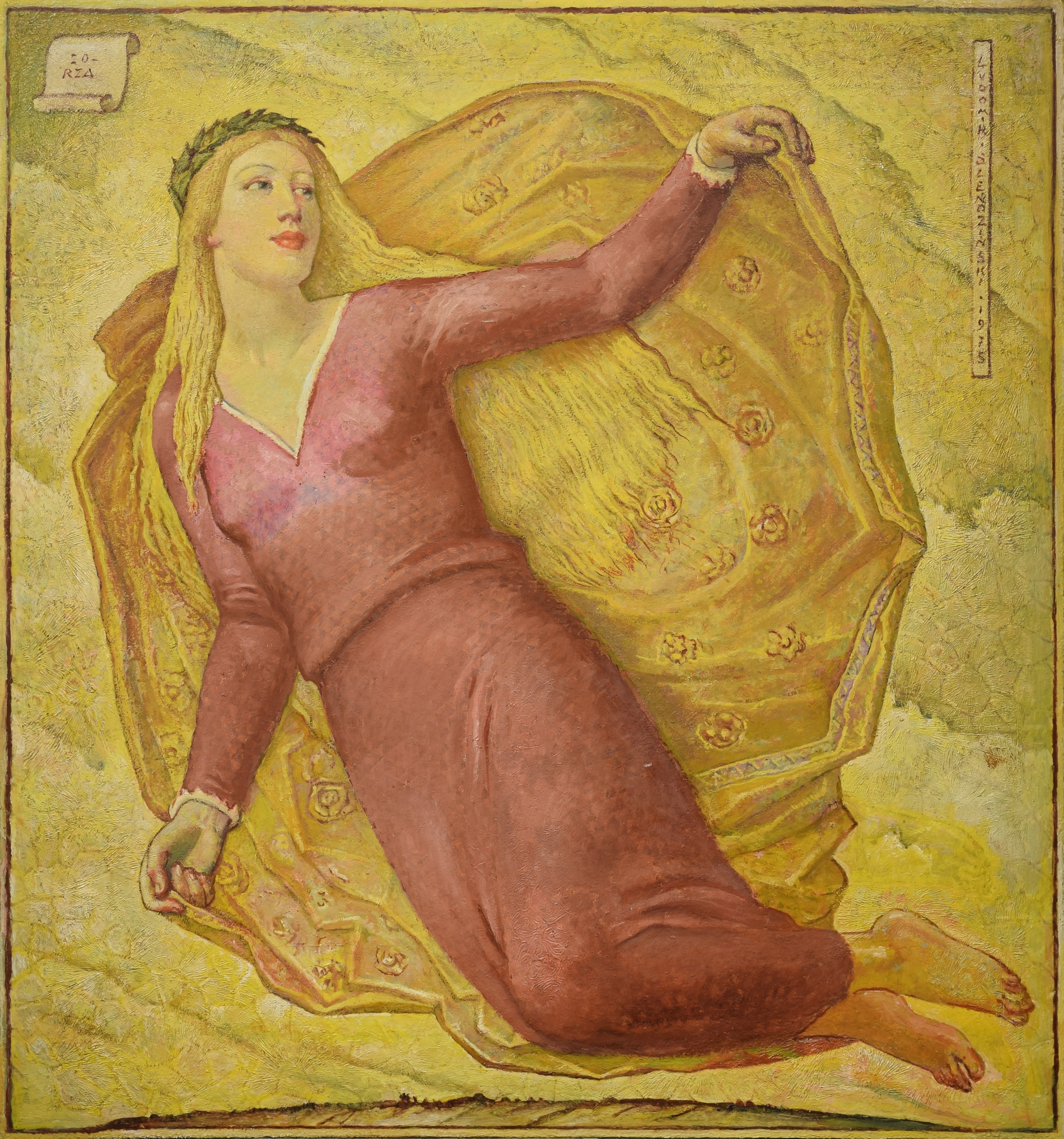
oil, canvas pasted on plywood; 130 x 122 cm;
Signed and dated p. g. vertically: LVDOMIR SLEŃDZIŃSKI 1975,
l. g. inscription: ZO - / RZA;
On the back numerous paper stickers with handwritten inscriptions - address data and concerning other paintings by the artist:
1. Handwritten address sticker: Ludomir Sleńdziński / Kraków / Wybickiego ... (faintly legible);
2. paper on tack with handwritten inscription: Ludomir Sleńdziński "Torn Globe" / Kraków Wybickiego 6 m 8 (in pen, the sticker refers to one of the artist's few abstract paintings presented in 1960 at Warsaw's CBWA Zachęta);
3. paper sticker: INSTITUTE OF ART PROPOAGANDA with handwritten description: Ludomir Sleńdziński / ... / tempera painting / paka N. (in pen, sticker of an institute promoting modern art, founded in Warsaw and active from 1930-1939);
4. papers sticker with inscription: Ludomir Sleńdziński / N 5 Portrait of Teresa S / oil / Cracow Wybickiego 6/8 (in pen). Canvas probably pasted on the wall of a shipping crate, hence the handwritten inscriptions: paka N 4 and 8 paka and stickers unrelated to the presented painting.
Provenance:
- Until the 1980s, the painting was owned by the artist and then by his daughter Julitta;
- private collection, Poland
Image included in the supplement to the catalog of the artist's works from the 1973 exhibition at the National Museum in Warsaw:
- Helena Dobrowolskia, "Works of Ludomir Sleńdziński, supplement to the catalog of the artist's works published in the Yearbook of the National Museum, XVI, 1972", in Ludomir Sleńdziński, Memoirs of an Exhibition, ed. by Irena Koloszyńska, Warsaw 1977, p. 96, cat. no. 55 [here as: Aurora poranna, marked as the property of the artist].
Ludomir Sleńdziński's paintings are distinguished by their classical form, Renaissance elegance and sublime colors, and above all by their excellent drawing, also visible in oil works, and stylistic consistency. Therefore, it is not surprising that in the artist's hometown the so-called Vilnius School was formed in his circle. Sleńdzinski studied at the St. Petersburg Academy of Fine Arts, In 1920 he became a founding member of the Vilnius Society of Artists. He was a member of the Warsaw Association of Polish Artists RYTM and the program council of the Art Propaganda Institute. He was also engaged in teaching work, initially as a teacher of drawing, to later take up the chair of monumental painting at the Faculty of Fine Arts of Stefan Batory University in Vilnius, where he received the title of full professor in 1938, and from 1945 the chair of drawing and sculpture at the Faculty of Architecture.
The painter traveled extensively, the most significant that influenced his art seem to be those to Italy, where he found monumental frescoes and characteristic portraits. In 1923, he first visited the Italian cities of Venice, Florence, Rome, Orvieto and Ferrara. Also that year, he received his first commission for a plafond at the Presidium of the Council of Ministers in Warsaw. In 1928, the artist participated in the polychrome decoration of tenements in Warsaw's Old Town Square. His work also includes mural paintings in the building of the Postal Savings Bank and the Bank Gospodarstwa Krajowego in Vilnius, as well as designs for the decoration of the Sejm Meeting Room and the plafond for the ballroom at the Ministry of Foreign Affairs.
Sleńdzinski's fondness for monumental painting and classical Italian painting is also evident in his oil works. Sometimes the painter's paintings have a characteristic rough texture - this is also the case with the presented canvas "Morning Aurora" and a characteristic, gently bleached pastel color scheme. In the work "Morning Aurora" also the way of showing the figure of a young woman in a cloak, rising slightly against a golden background, refers to the tradition of early Renaissance art - placing saints in mandorla, or throning Madonnas against a golden background, and later fragments of Michelangelo's monumental work from the Sistine Chapel, where, for example, surrounded by a red cloak, God the Father gives life to Adam.
Ludomir Sleńdzinski's painting style is perfectly summed up by Katarzyna Nowakowska-Sito in the National Museum catalog of the Association of Polish Artists' exhibition RYTM, "From the beginning, Sleńdzinski's work, while arousing a lively resonance, evoked contradictory reactions. It represents the most consistent manifestation in Polish art of the interwar years of the new classicism, referring to the patterns of the early Renaissance and the quattrocento, although at times it also uses the patterns of medieval and Mannerist art. This classicism primarily dominated the Vilnius milieu, which was strongly influenced by Sleńdzinski's personality, where the reference to local tradition (early 19th century classicism) intersected with the atmosphere brought from the St. Petersburg Academy, where a significant number of members of the WTAP [Vilnius Society of Visual Artists] studied. The classicizing attitude found expression in the Society's magazine "South" (1920-25): its program became, "pietism for tradition, continuation of tradition, cultivation of the mastery of ancient art in the pursuit of style and monumentality."
(compiled. based on: Ludomir Sleńdziński, Memoirs of an Exhibition, ed. by Irena Kołoszyńska, Warsaw 1977; Exhibition of the Association of Polish Artists RYTM 1922-1932, concept: Katarzyna Nowakowska-Sito, Warsaw 2001, pp. 236-247; https://zacheta.art.pl/pl/wystawy/ludomir-slendzinski)










最近浏览过的
登录以查看拍品列表
收藏
登录以查看拍品列表