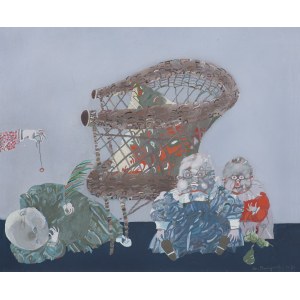
Signed p.d.: Zb. Maciejewski IV 84
A separate chapter of Maciejewski's work is representations of children. Children's games, appeals, processions. In this peculiar theater of one actor, the child (Princess, Girl with a Ball, Sisyphus' Daughter, Strong Sister, Prince, Maharaja, Emperor) inserted most often into the unfamiliar context of the painting scene, is the protagonist, plays the role of an intriguing medium, communicates issues that are not always his own, speaks adult truths and struggles to exist.
Czesław Rzońca, Art is a burnt offering [in:] Zbysław Marek Maciejewski, exhibition catalog, Opera Gallery, Warsaw, 25 I - 30 III 2018, p. nlb.
♣ a fee will be added to the auctioned price, in addition to other costs, based on the right of the artist and his heirs to receive remuneration in accordance with the Act of February 4, 1994 - on Copyright and Related Rights (droit de suite)
Zbysław Marek Maciejewski studied at the Faculty of Painting of the Academy of Fine Arts in Cracow from 1963 to 1969, receiving his diploma in the studio of Waclaw Taranczewski. Shortly after graduation, in addition to painting, he was gainfully engaged in stage design and historic preservation. In 1973 he began teaching at the Graphic Arts Department of his alma mater, where he taught painting until his death, from 1989 as a professor. In the 1990s he was also a professor at the European Academy of Arts in Warsaw. From the early stages of his career, i.e. from the 1970s, he was a prominent personality among painters of his generation. In the 1970s, he focused his attention on man and the human figure, creating portraits, self-portraits, erotica ("Mandragora"), also mythological, religious, symbolic, allegorical depictions, often verging on the grotesque. In his paintings a special place was occupied by images of children, reminiscent of Wojtkiewicz's paintings. Since the 1980s, he painted more often in the open air. He traveled extensively, especially to southern Europe, where he was inspired by mysterious gardens, exotic vegetation, "foreign" light and architecture. An erudite and aesthete, a lover of the old workshop, he considered himself and can be considered a continuator of Polish modernism. In 1998, he was the winner (second in a row) of the Witold Wojtkiewicz Prize, awarded by the Cracow branch of ZPAP.