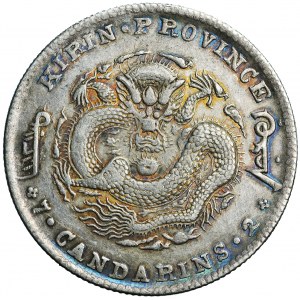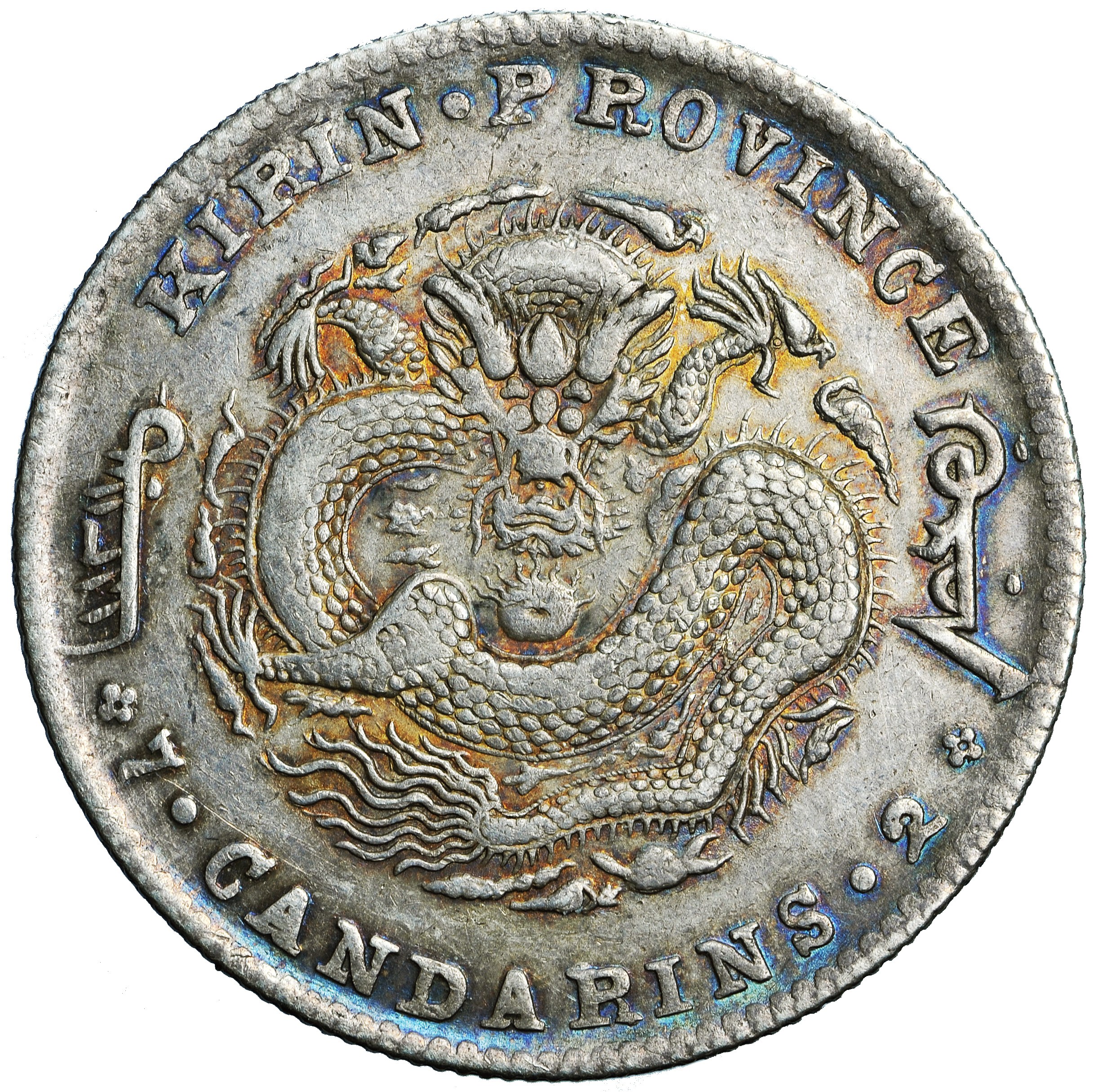
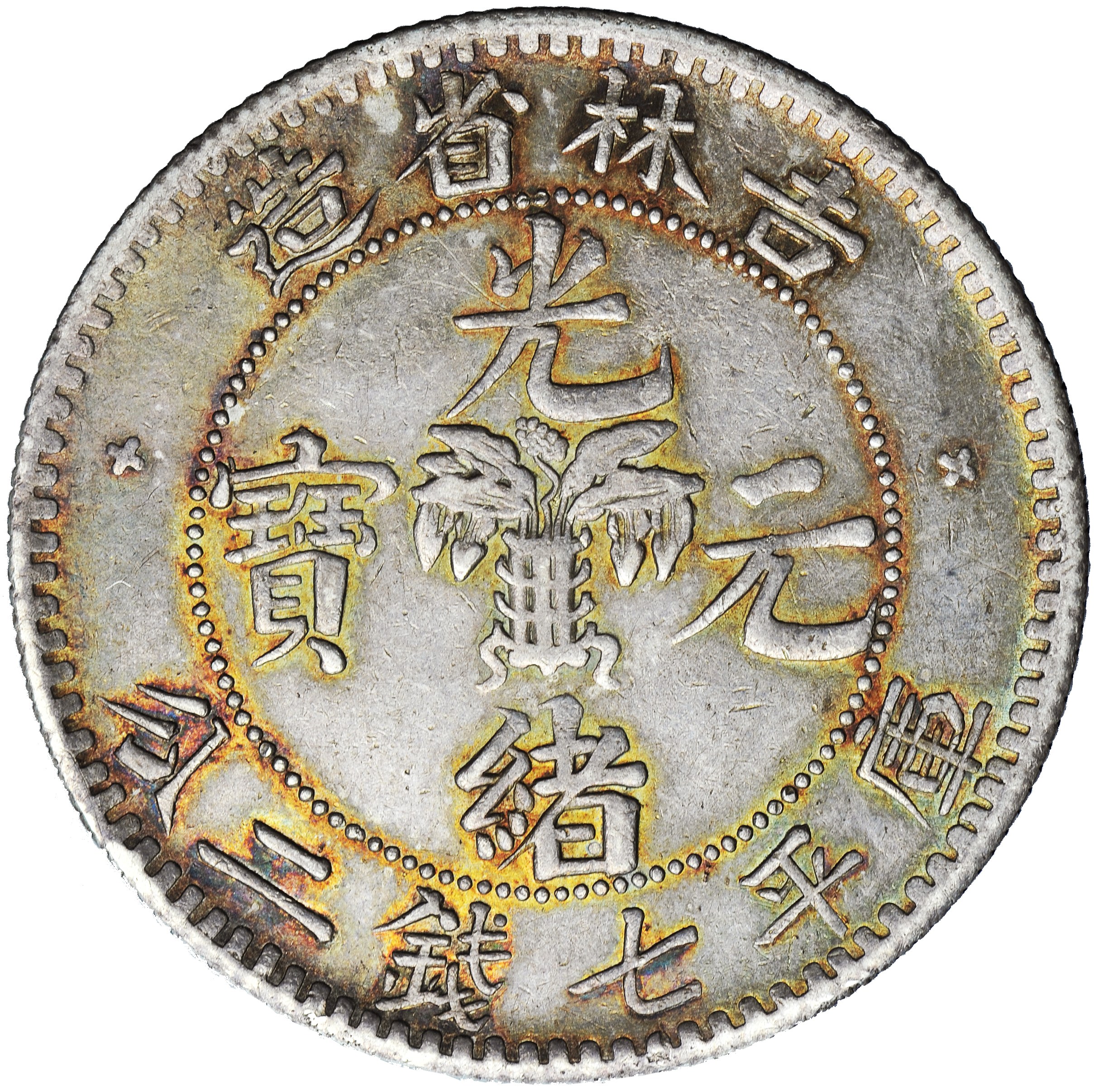
China, Kuang-hsü (Guangxu, 1871-1908), Kirin (Jilin) Province, yuan (‘dollar’, 7 mace 2 candareens) n.d. (1895-1898), Kirin (Jilin) mint.
Obv. dragon; legend with CANDARINS, large rosettes; five rows of large scales on dragon’s neck, no dot in Manchu script.
Rv. Chi-lin Sheng Tsao, small rosettes, in the field, Kuang-hsü Yüan-pao, hooked Kuang and Sheng; flower basket.
Silver, 25.95 g, 38.5 mm. KM-Y-183A.3.
Grade: XF, slightly worn, cabinet patina. Scarce and demanded.
The humiliating defeat that China suffered in the First Japanese War (1894-1895), as well as the constant aggression of Western powers, prompted Emperor Kuang-hsü to modernize the country following the example of the Japanese Meiji Restoration. This led to the so-called Hundred Days’ Reform in 1898. As a result of a coup, the emperor was removed from power and interned by his aunt, Empress Dowager Cixi, and the reformers were executed or exiled. Nominally, Kuang-hsü reigned until 1908, when he was poisoned, probably on Cixi's orders. However, the introduction of Western-style coinage took place earlier and survived the collapse of the reforms. Already in the sixteenth century, European thalers called yuan flowed into China, both through Asia from the west and from the east through the Pacific and the Philippines from Mexico. The latter prevailed and in 1889, instead of cast bronze coins with a square qián hole, the Cantonese mint introduced silver coins minted after Mexican pesos, called dollars in the Anglo-Saxon world. They weighed in Chinese units 7 qián (Europeans used the Malay name mas, in English spelling mace) and 2 fēn (in English candareen from Malay kandūri), i.e. 27.22 g of 900 silver. In the following years, yuan coinage with a dragon spread to other provinces. The yuans are dated by the years of the Chinese calendar cycle or devoid of dates. Because the dies were made with small punches, each issue has many small and large varieties. Today they are sought after around the world and surprisingly highly valued. They can be met with in Polish families and collecting them in Poland can bring a lot of satisfaction. They were probably brought by veterans from the Muscovite-Japanese War in 1905. Thanks to this, there are basically no forgeries among them, which became very popular in the last years of the Qing dynasty and the anarchy that followed its fall in 1912. For more on undated yuan coinage, see https://coinweek.com/china-kirin-1898-dollar-coins/. Prices realized: Stack's Bowers & Ponterio, October 2023 Hong Kong Auction, 5,250 USD; another: 1,600 USD (much worse preserved).