


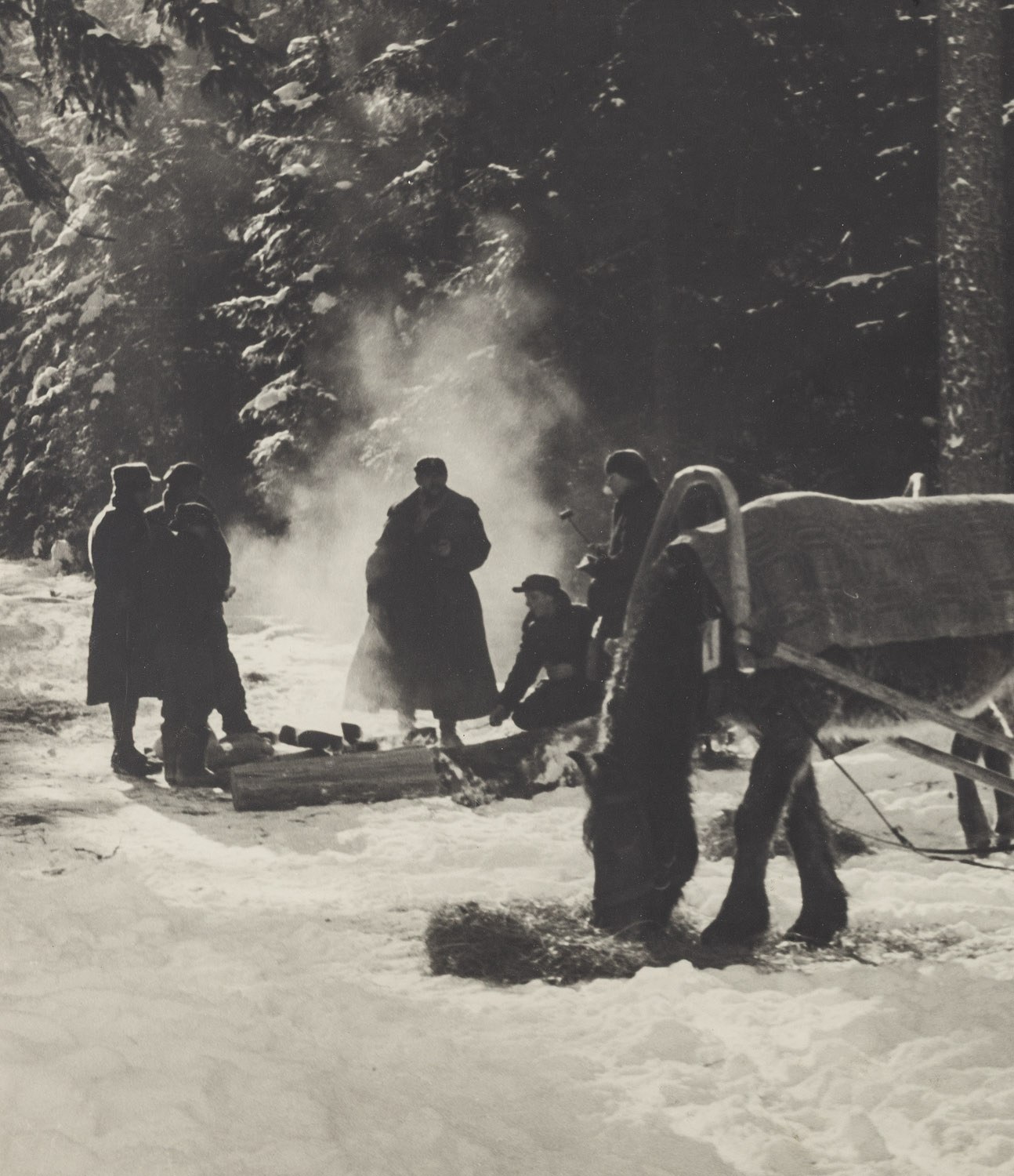

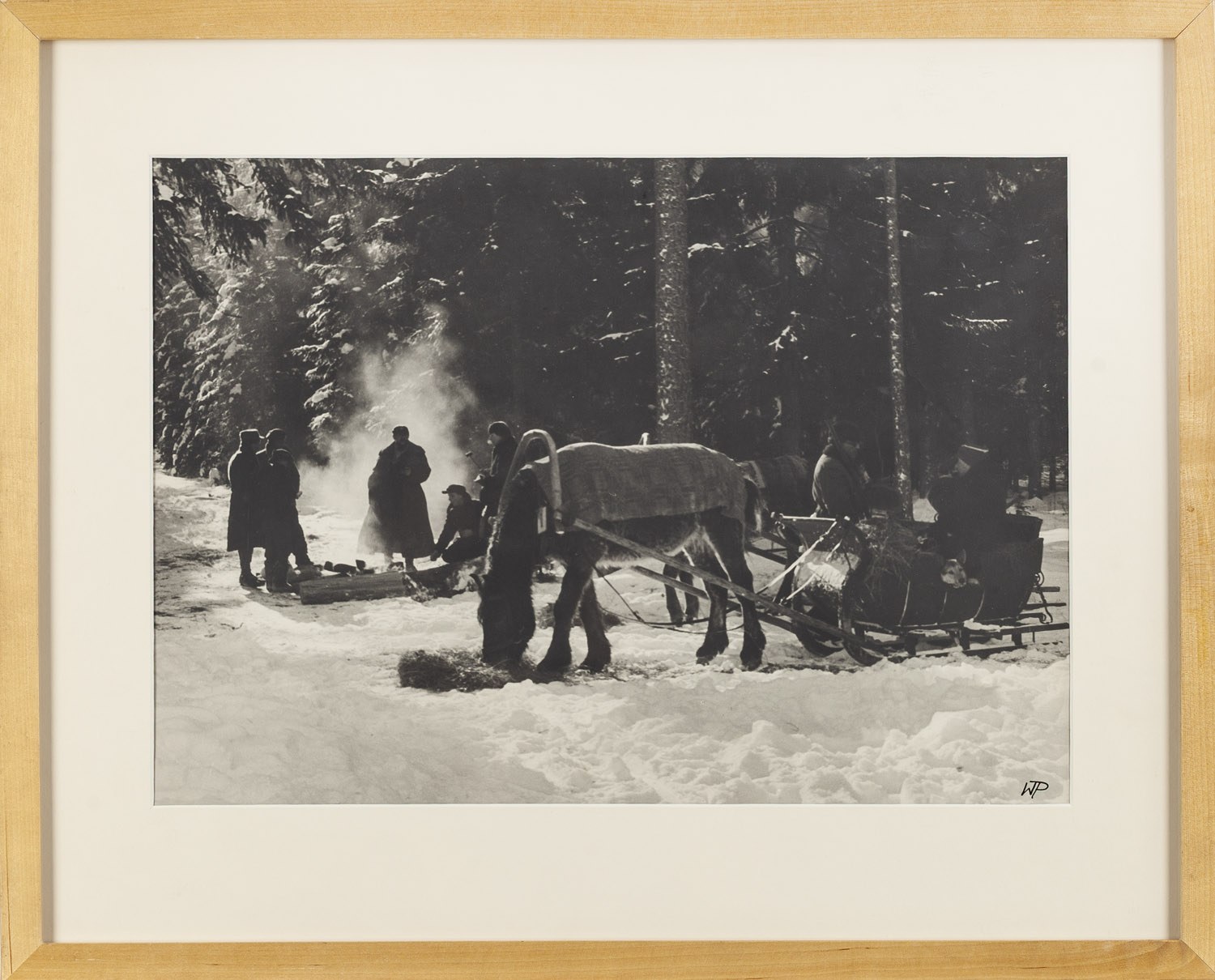
Dimensions: 28.8 x 40.2 cm
Two artist’s stamps on the reverse
Another piece of this item is in the collection of the Niepołomice Museum—the Royal Castle in Niepołomice.
Bibliography
Włodzimierz Puchalski, *In the Land of the Hunt*, Sport i Turystyka, 1966
Biography
Naturalist, photographer, and director of nature films. He was the first to describe nature photography as “bloodless hunting.” Among other subjects, he photographed the floodplain of the Narew River in Tykocin, with which he had strong ties. His father was a wildlife and landscape photographer. In 1931, he began his studies at the Lviv Polytechnic in Dublany in the Faculty of Agriculture and Forestry, graduating with a degree in agricultural engineering. From 1933 to 1936, he served as an assistant to Prof. Witold Romer at the Department of Photochemistry at the Lviv Polytechnic, with whom he co-produced films and developed a method for making nature films. He titled his first nature film “Bloodless Hunt.” In 1936, he organized Poland’s first exhibition on nature and hunting. During World War II, he worked as a forester in the Sandomierz Forest. After liberation, he began working at the Department of Genetics. In 1946, he helped organize the Kraków Film Institute. In 1949, he began working at the Institute of Zootechnics at Jagiellonian University, where he established a department for photographic and film documentation of animals. From 1956, he worked at the Educational Film Studio in Łódź as a cinematographer and director. In 1957 and 1958, he took part in two Arctic expeditions to Spitsbergen. He retired in 1976. In 1978, he traveled to Antarctica with an expedition organized by the Polish Academy of Sciences. He died while filming on King George Island and was buried there. He was colorblind, and nearly all of his films and photographs are in black and white. The exception is the color photographs from his last expedition to Antarctica.










