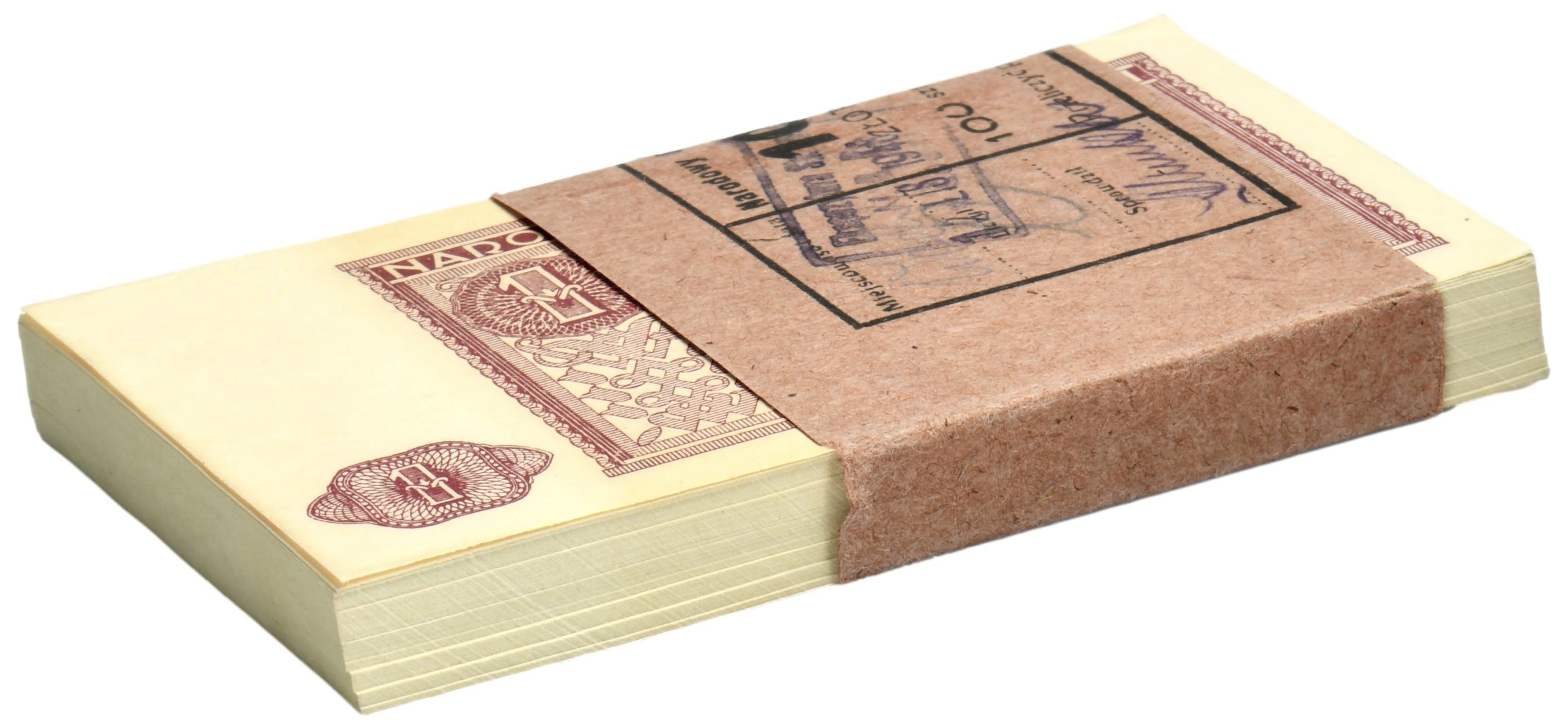
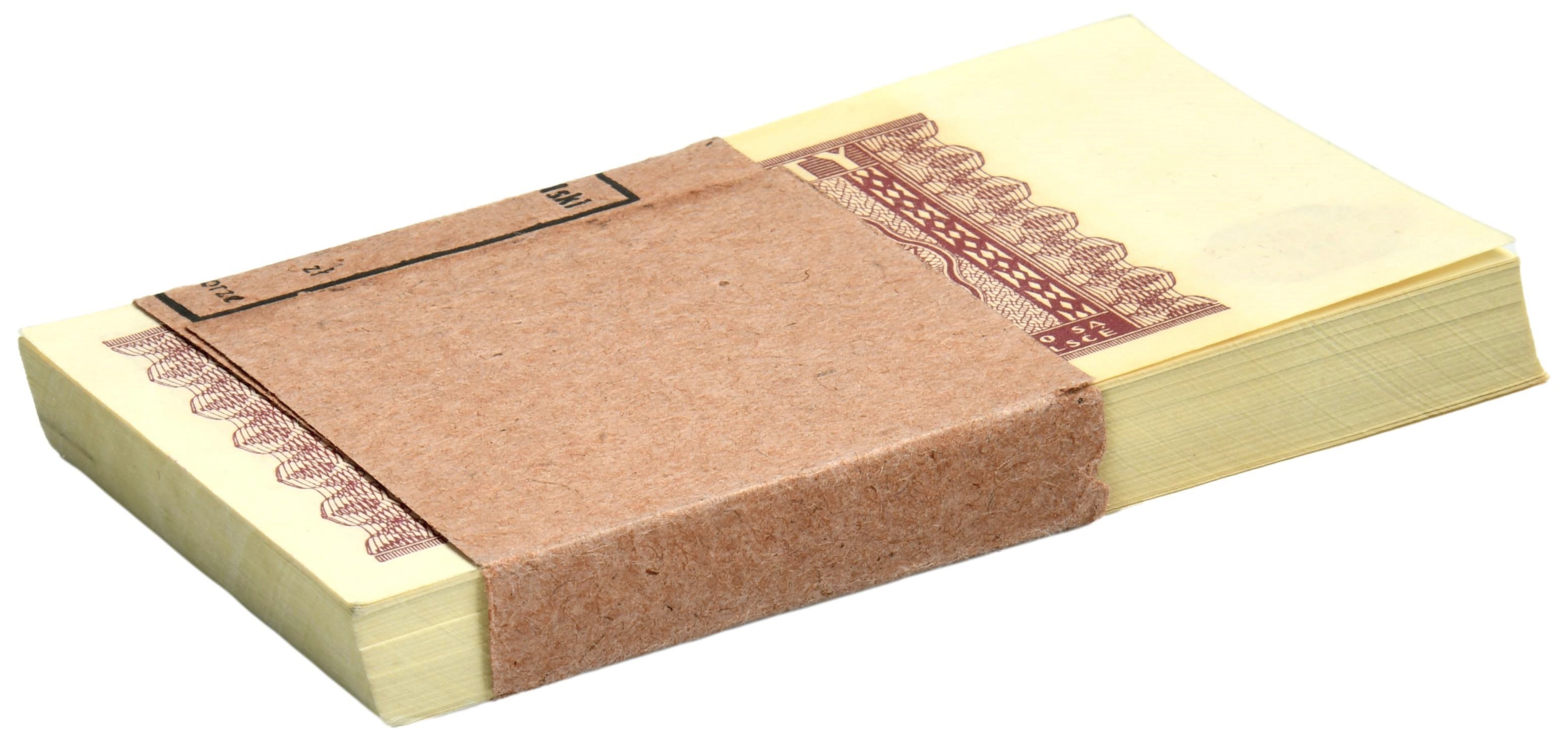
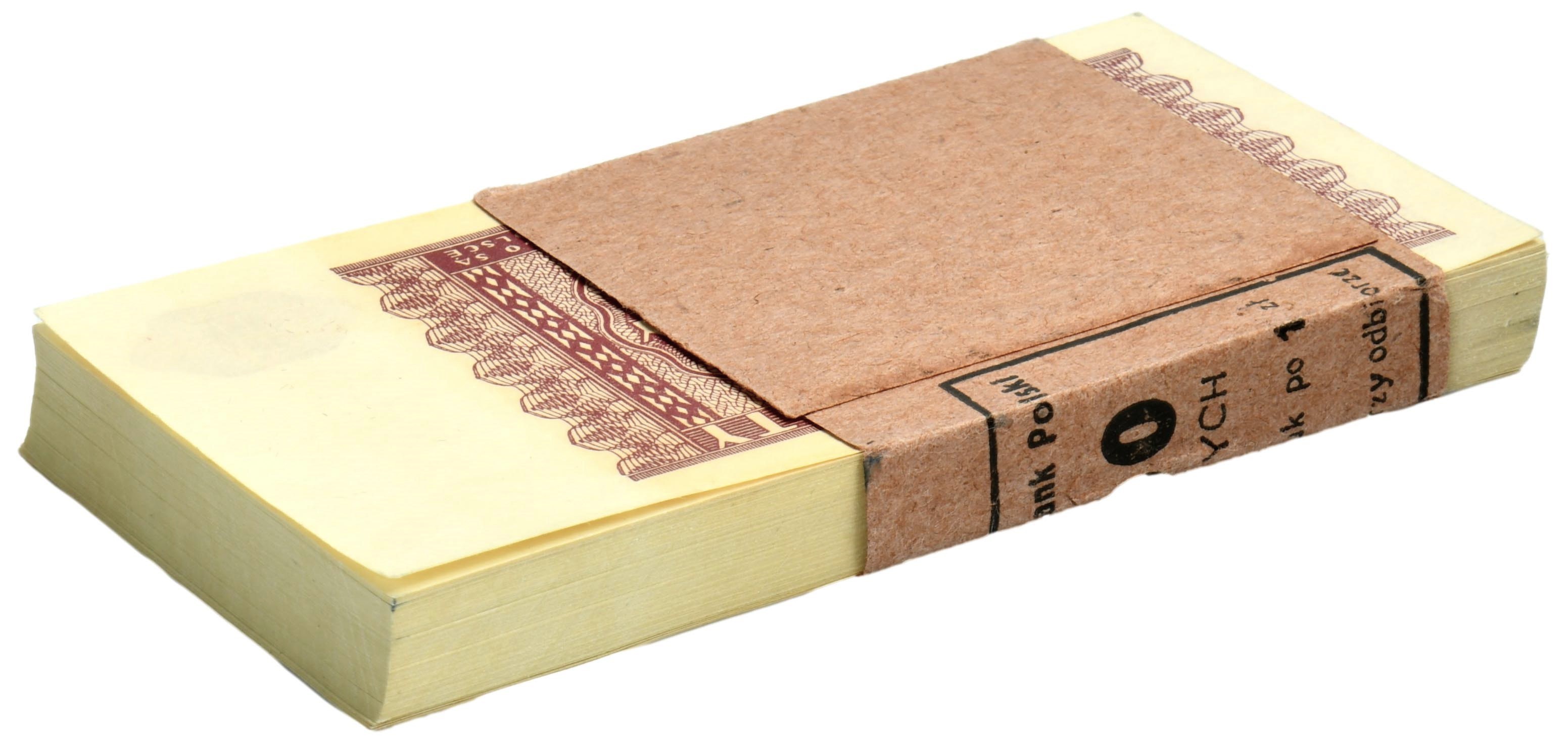


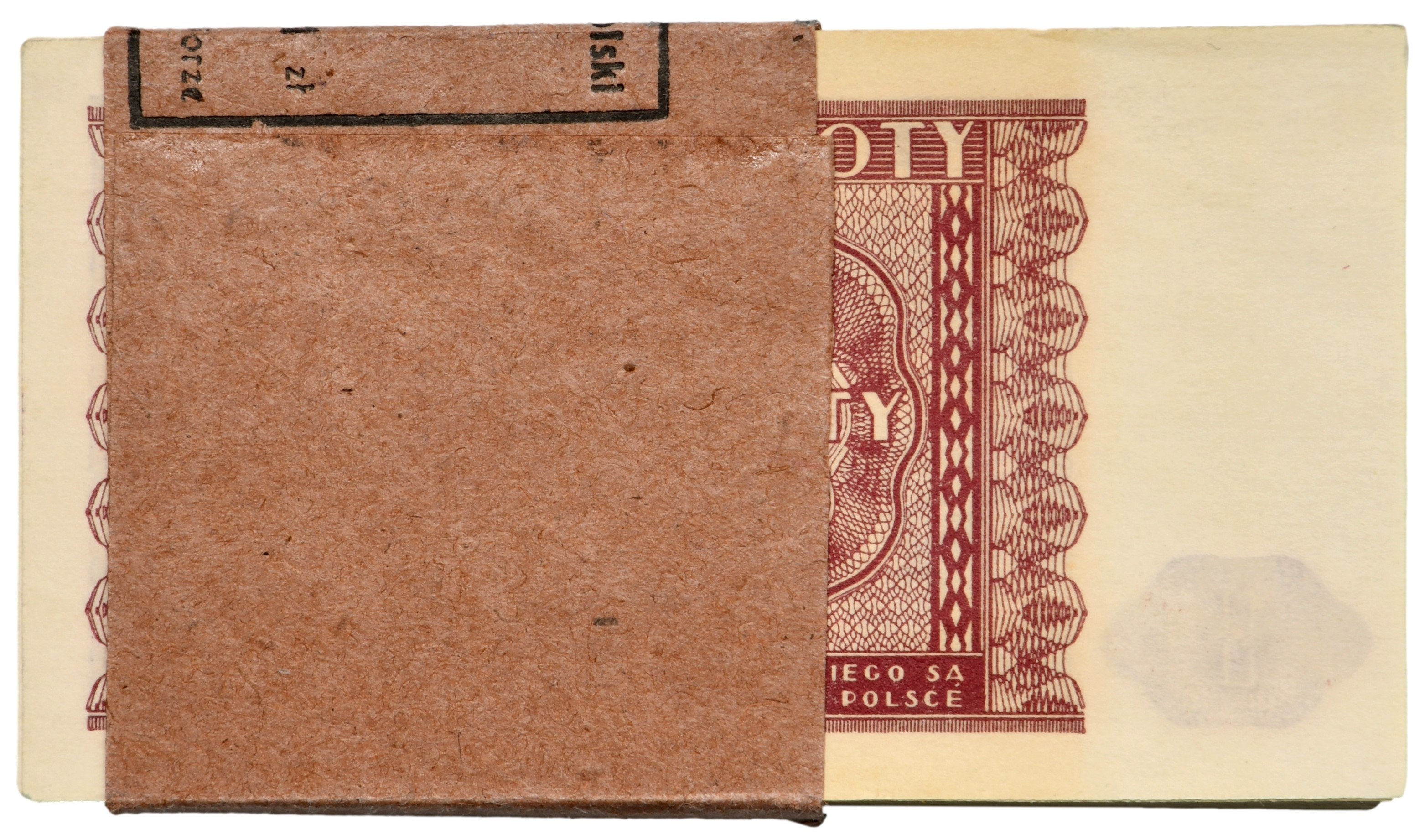
A great treat for collectors of bank parcels.
An original 1946 gold band parcel.
Previously unlisted in the form presented.
Issue condition, only the extreme top and bottom piece with flaws on the corners, but overall the parcel is in excellent condition. Upper piece with discoloration of paper from banding.
Banknotes definitely on very high marks in PMG grading, although in our opinion it is in bank parcel form that this object represents the greatest value.
The bandolier is very well preserved.
A high class value, the bidding of which will undoubtedly excite bank parcel lovers.
In 1944, the Polish lands fell under Soviet influence. In 1944, after the expulsion of German troops beyond the Vistula River, the organization of a new monetary system began. In the conditions of the still ongoing war, the return of the Bank of Poland from London was impossible, and the communist authorities did not agree to maintain the activities of the Bank of Issue in Poland. At the end of August, the Central Treasury Fund was established, which issued paper zlotys with an issue date of 1944. The exchange rate of the zloty was equalized with that of the ruble. In mid-January 1945, the National Bank of Poland was established and took over the duties of the central bank. At the exchange of the Polish Emission Bank's zlotys into NBP zlotys, it was allowed to exchange at a ratio of 1:1 the amount of 500 zlotys for each adult.
In order to restore the country's market balance between monetary circulation, wages and prices, a second monetary reform was necessary. The need for it began to be considered in 1947. At that time, they proceeded to prepare new monetary signs in the form of coins and banknotes to be introduced into circulation.
The monetary reform was introduced by the Sejm with the law of October 28, 1950. At that time, a new monetary unit was introduced with a parity of 1 zloty = 0.222168 grams of pure gold. The reference of the value of the Polish currency to the value of gold was purely theoretical, since the 1950 reform broke with the tradition of money being covered by bullion. The parity of the Polish currency, established in 1950, formally survived until 1982, when it was repealed. The law stipulated that between October 30 and November 8, 1950, all post-war banknotes in circulation would be exchanged for new ones dated July 1, 1948. Existing money ceased to be legal tender on October 29, 1950.
The 1950 money exchange had no restrictions on the amount, but there was a very short time limit on the amount. It occurred in the ratio of 100 old zlotys to 1 new zloty. In 1950, prices and wages were converted at an exchange rate of 100:3. The introduction of such a ratio of old zlotys to new zlotys at the exchange resulted in a significant decrease in the real value of money held by the population. Carrying out a reform of the monetary system in 1950 was intended to prevent inflation and raise the purchasing value of the zloty.
Paper money issued with an annual date of 1946 has a consistent design. The four lowest denominations were designed by Ryszard Kleczewski. They are characterized by the use of geometric patterns and geometrized floral motifs. The design used on the surface of the obverses of the 1, 2 and 10 zloty denominations resembles in its layout folk cut-outs made of paper.
In the center of the obverses was a cartouche with information about the denomination. On the lowest of the denominations, the centrally placed cartouche is flanked by two guilloche rosettes with the numerical value of the denomination written on them. On the fifty-dollar note, it is flanked by two float units. On the 100-, 500- and 1,000-zloty banknotes, the main decorative dominant of the obverses and, at the same time, the carrier of ideological content are pairs of figures endowed with allegorical meaning.
The representations on the backs were placed in frames. On these "frames" were placed small decorations referring to the leitmotif of the banknote. On all the denominations, regardless of which economic field they refer to, we find small floral elements, in which we can see stylized ears of grain.