


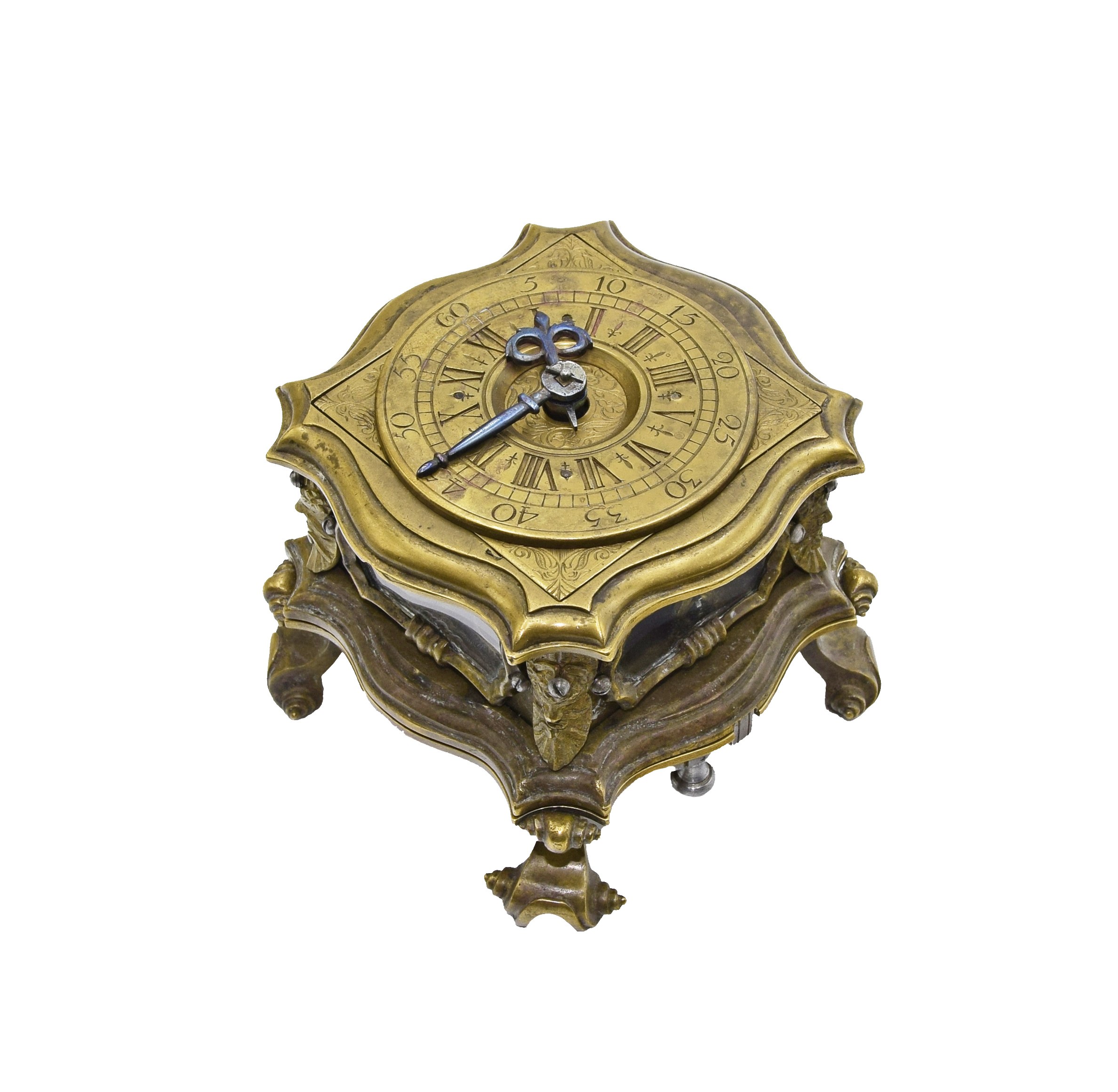
mechanism: brass, steel; bell: bronze; case: partially silver-plated brass; casting, chasing, silver plating, cutting, engraving; 8.3 x 8.5 x 8.5 cm; dial: 5.6 x 5.6 cm; numeric ring: diameter 6.1 cm, width 2.1 cm; bell: diameter 5.9 cm;
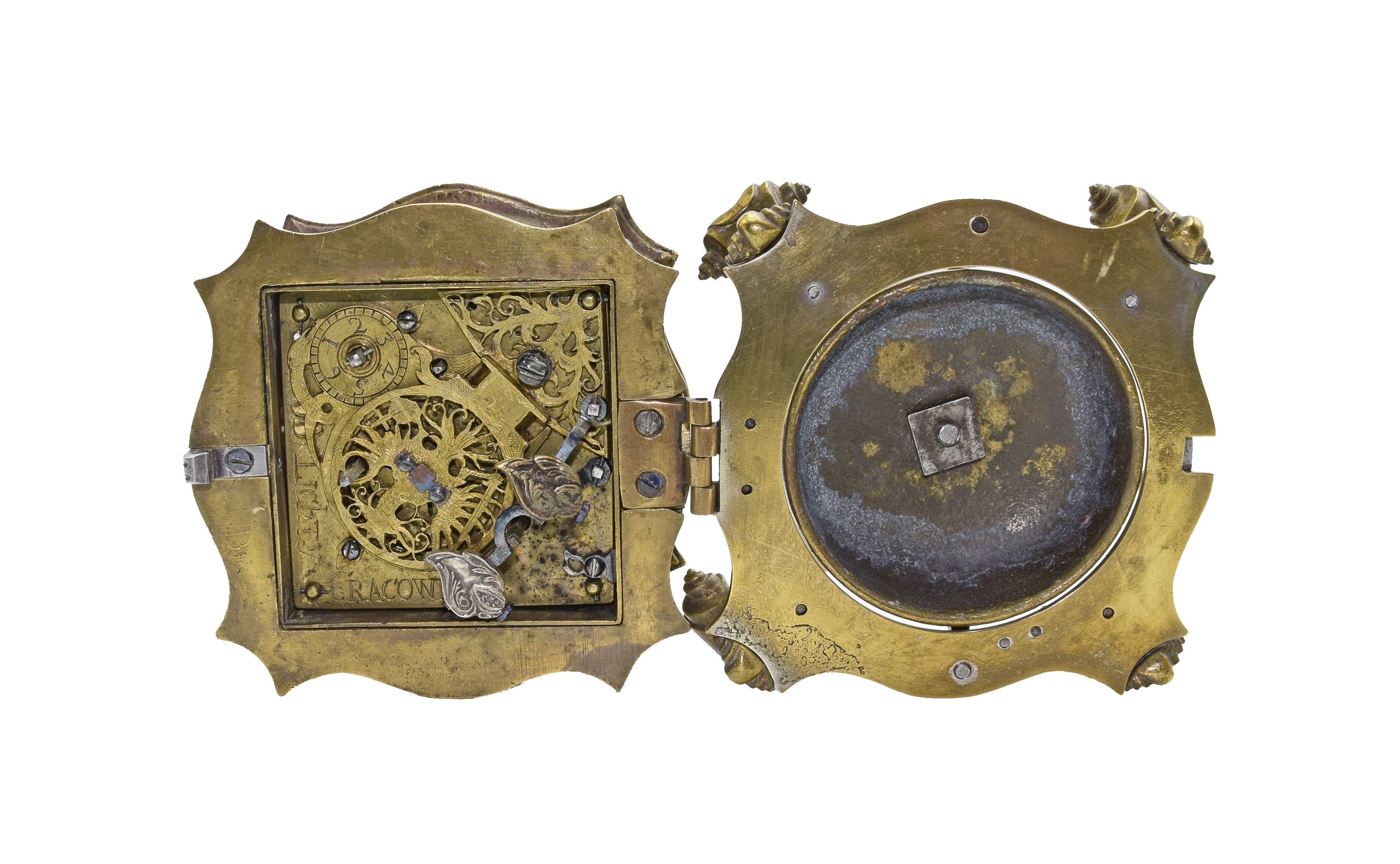
signed on the bottom plate: “JACOB LICHTY CRACOVIAE”
Jacob (Jacobus, Jakub) Lichty, Kraków, ca. 1760.
A two-hand tile clock in a four-sided case, supported by four volute feet, housing a spring-driven mechanism with a two-plate frame, striking the hours. The clock case is made of brass, with upper and lower cornices featuring wavy edging, concave-convex and stepped profiles, and smooth surfaces; the side panels feature oval windows framed by half-cylindrical moldings of irregular shape, decorated in the corners with mascarons, originally silver-plated. The lower cover features a bell. The dial has an applied silver-plated ring, Roman hour numerals, a minute track, and an Arabic minute scale, decorated in the corners with engraved acanthus tendrils and a stylized, schematically rendered palmette; in the central field, an ornament of plant tendrils with a trefoil motif. The hour ring is not original and is mounted with rivets. The hands are made of steel and oxidized; the hour hand is topped with a flower bud with volutes, and the minute hand is spindle-shaped with a distinct tip. The movement features a brass skeleton frame with square plates connected by four circular pillars, decorated with half-cylinders. The movement is driven by a compensating worm gear and a Gall chain. It features a spindle escapement with a balance regulator. The hour strike is operated by a comb mechanism. The striking drum is decorated with geometric engraving. The base plate features an English-style crown with an overlaid engraved openwork decoration depicting the Polish heraldic eagle, an engraved lion’s mask at the base, and a triangular foot adorned with an openwork leafy tendril. Next to the crown is a silver-plated regulator disc with a scale (I–VI) and an adjustment slider decorated with a serpent. Two hammers with steel shafts and silver-plated, engraved heads in the form of stylized fish, raised by a single lever.
Condition: traces of silver plating remain; the hour wheel is not original; the clock has been restored and repaired.
The clock reflects the style popular in Polish clockmaking from around 1750 to the 1770s. It reflects a style popular in Polish clockmaking from around 1750 to the 1770s, characterized by volute feet and a profiled cornice with an irregular edge encircling the square case.
Typical of Lichte’s works are the maskeron masks decorating the edges of the side panels (a clock from 1757, Regional Museum in Tarnów [see Tempus tene 2000, p. 114, item V.8]) and the clock at the Historical Museum of the City of Kraków, dated to ca. 1757 based on decorations analogous to those on the Tarnów clock [see Błażewska 2019, p. 656], can be found, among others, on the “kaflak” by Lublin clockmaker Marek (Marcus) Mayer, which Siedlecka dated too early to the second quarter of the 18th century (National Museum in Lublin [Siedlecka 1988, p. 102]), on the Rococo clock by Gottlieb Starbusch from Gdańsk (National Museum in Kraków [Siedlecka 1988, p. 107]), or the clock by Johann Hakel from Lviv (dated 1760–1780, Royal Castle in Warsaw [Nie tylko Orient 2017, p. 201]).
When discussing Lichty’s clock, one should also note the openwork decoration of the crown—in the form of the Polish heraldic eagle—which is characteristic of his work [see Błażewska 2019, p. 658].
Jacob (Jacobus, Jakub) Lichty (active 1738–c. 1776?) was first recorded in guild records in 1738. At that time, he lived in a tenement house at 5 Grodzka Street. In 1743, he moved to 7 Grodzka Street, where he ran his workshop until 1758. He was certainly still active in his profession after that year, although he no longer participated in the guild’s quarterly meetings. He was listed as an active watchmaker in an undated register of guild masters, likely compiled between 1765 and 1776 [Błażewska 2019, p. 659].










最近浏览过的
登录以查看拍品列表
收藏
登录以查看拍品列表