


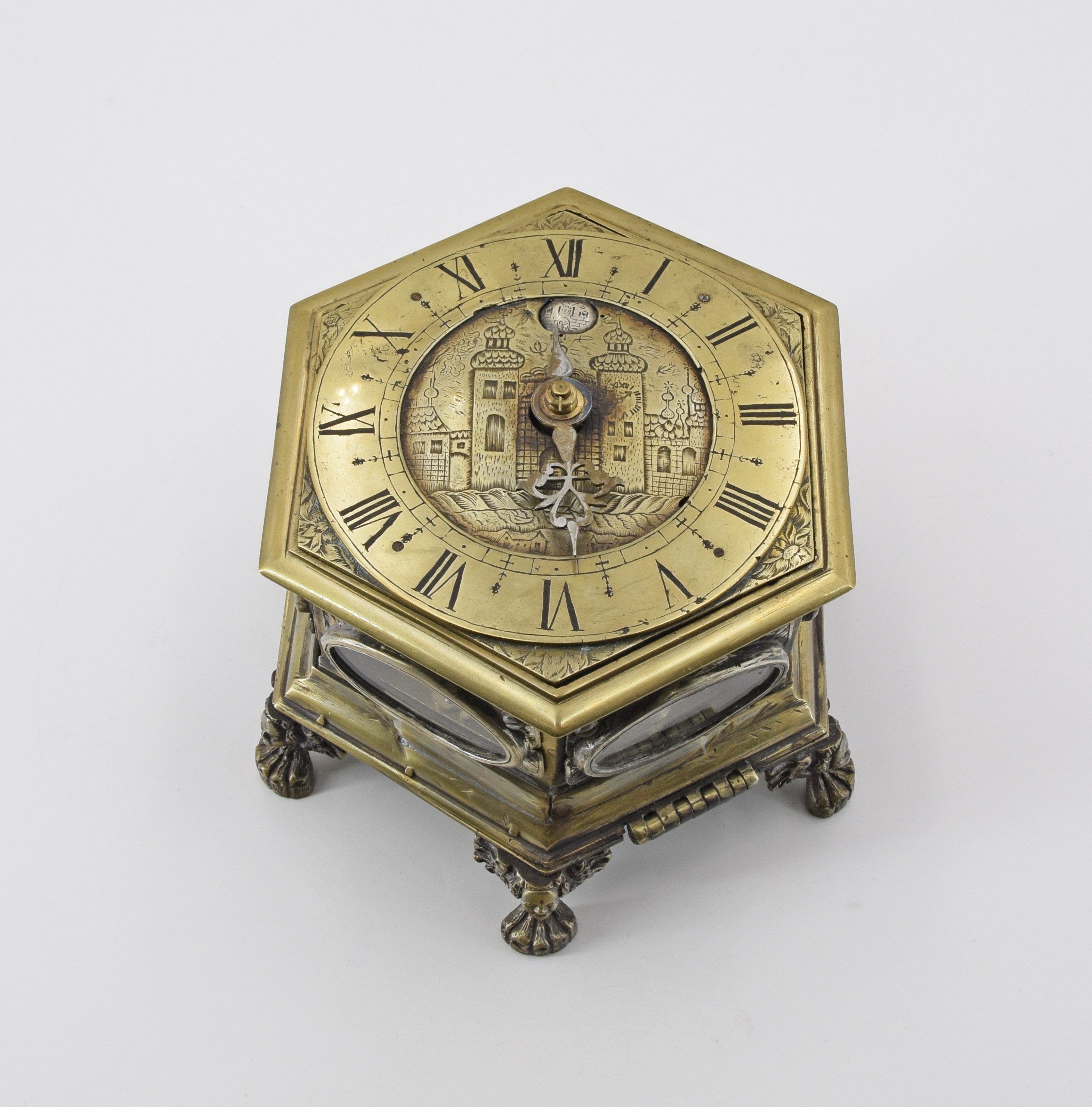
mechanism: brass, steel; bell: bronze; case: gilt and silvered brass; casting chiseling, cutting, engraving, silvering; 11 x 16.4 x 14.5 cm; dial: 12.4 x 10.8 cm; numeral ring: o 10.8 cm, 2 cm wide;
signed on lower panel: Cas Wein Pos;
marks: Ao 1506 - engraved above signature on lower plate; 1506 R. - engraved question soldered on the underside of the lower cover, near one of the feet.
Casper Weinhardt, Poznan, 1670-1690.
A single-indicator tiled clock, with a plate-skeleton, spring-driven, hour-beating mechanism, in a hexagonal case supported on cast legs in the shape of a winged head on a claw. On the straight walls of the casket glazing in silver-plated oval frames framed by four triangular corners decorated with engraved leaves. The cornices with a profile of sima, the so-called heels, with dodges. In the lower lid fixed feet and a bell on a brass stirrup. The digital ring of the dial with Roman hour numerals separated by stylized lilies, on the inner perimeter the half-hour graduation marked with crosses. In the center field an engraved veduta with the façade of a two-towered church, with a clock on the right tower. Above, an oval crest cartouche with an eagle sitting on a city wall with three towers and crossed keys in an open gate, on the sides initials: .EJ". In the corners of the dial, flower heads. Hour hand of steel, openworked composed of channel bars on the sides, in the middle of a heart-shaped element supporting a spearhead, with a counterweight. Brass plates joined by four brass cylindrical pillars. The lower plate with an openwork engraved English-type chignon, in the shape of an eagle surmounted by a wreath and a substantial corona muralis supported on the right by a belt of metal links and on the left by an inkwell pen). The foot of the chignon formed of acanthus thread. On both sides of it an engraved signature, on the right: A 1506.
State of preservation: clock without preserved beat section, with reconstructed gait section and with traces of repairs (including soldering of cracked case and bottom cover).
The engraved signature "Cas Wein Pos" is probably an abbreviation of first name, last name and city. It can be linked to Casper Weinhardtern (son of the Poznań watchmaker Balthasar Weinhardt), who was recorded at the beginning of his master's career in 1659 [Eckhardt 1956, p. 216].
The capital of Greater Poland is probably referred to by the eagle with corona muralis in the decoration of the coke It cannot be ruled out that the motifs supporting the wreath and the great crown - a belt with metal links and a feather in an inkwell - refer to the bourgeois state. In that case, it would be possible to tie the clock in the equipment of the Poznań town hall or the bourgeois recipient. According to Michał Blaszczyński's opinion, the engraved veduta in the center field of the dial may depict Poznań's Water Gate, framed in the mid-17th century by two towers, but not equipped with a clock, or Poznań Cathedral, which just before the mid-17th century gained Baroque helmets of towers, and in 1667 a clock on the southern tower The turrets engraved on the right side could be the three chapels over the choir's bypass, so characteristic of Poznań's tum. The porch going from the cathedral to the building on the left could be the then still existing link between the bishop's residence and the cathedral. The first supposition would be supported by the coat of arms of Poznan (without the figures of St. Peter and St. Paul) placed over the buildings. At the time, Ostrów Tumski was not part of the city and was not sealed with its coat of arms. If these suggestions were confirmed, the depiction would complement the modest 17th-century iconography of Poznań.
The engraved date "Ao 1506" is not related to the creation of the clock. Perhaps it refers to an unknown event or the coronation of Sigismund I the Old. It could have been added later to document the metric of the timepiece
Landscapes and vedutas decorating, like the piece in question, the center fields of the clock faces were fashionable in the early phase of tiled clock making. They were particularly popular in Königsberg, Vilnius and Gdansk, and were also used by Balthazar Weinhardt in Poznań (National Museum in Poznań, inv. no. MNP Rm 2367)











最近浏览过的
登录以查看拍品列表
收藏
登录以查看拍品列表