


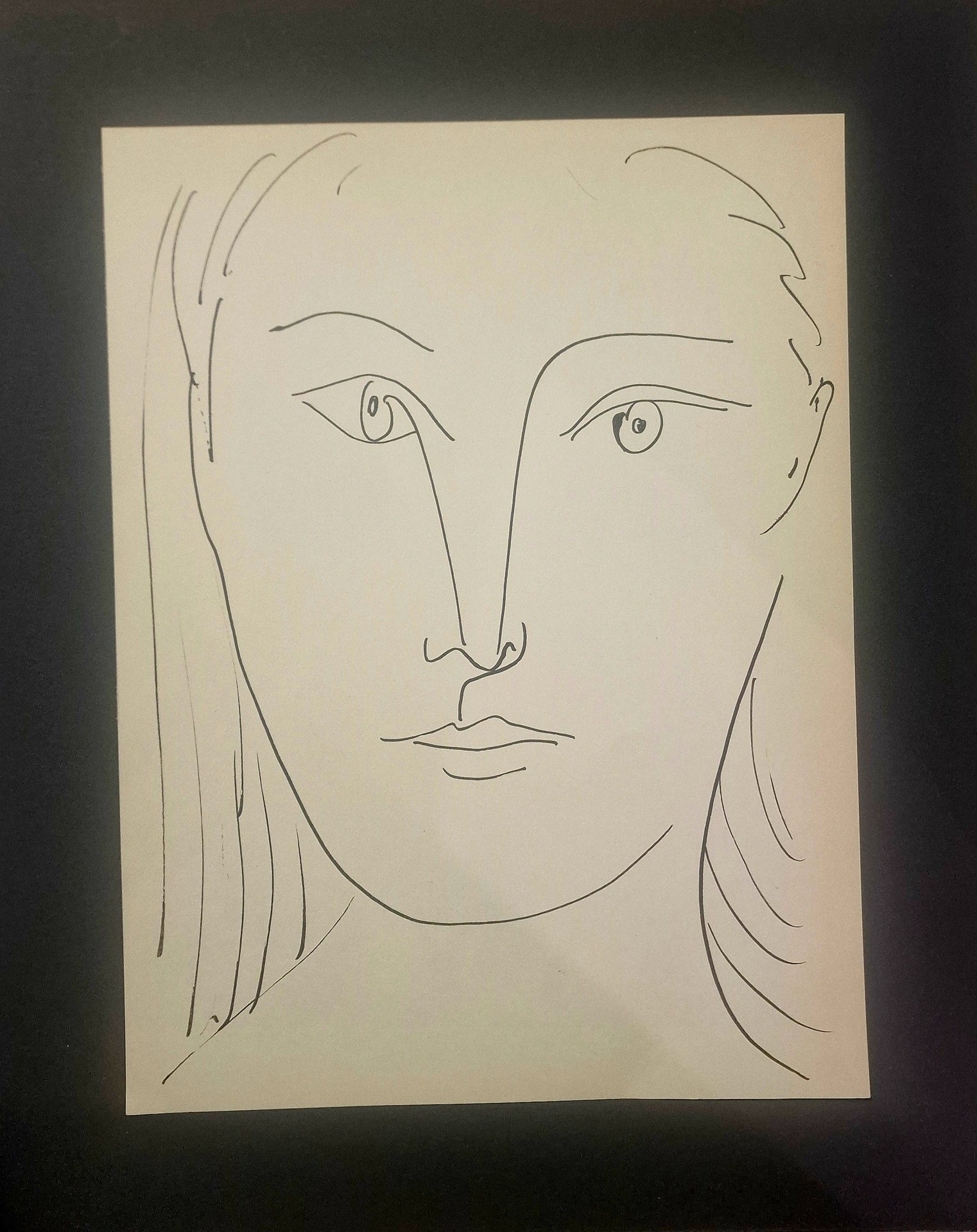
Lithograph on Marais parchment paper; 36 x 27 cm (inside the passe-partout measuring 47 x 38 cm);
Publisher: Henri Paul Jonquières; produced by: Atelier Duval; printed by: Priester Feres.
This lithograph comes from the only-ever publication of these 40 drawings by Picasso in 1957, with the permission of Dora Maar and thanks to the publisher (Henri Paul Jonquières) making available the sole piece of this portfolio containing these drawings. The subsequent history of the original portfolio after Dora Maar’s death in 1997 is unknown.
After the 1942 publication of the series of 31 engravings accompanying Buffon’s texts, Picasso brought a piece of *Histoire naturelle* to his beloved, the surrealist photographer and painter Dora Maar, in 1943. While in her studio, he decorated the margins of this series of prints with human heads, animals, and fantastical creatures, featuring Dora Maar herself as a bird-sphinx woman on the title page. When he gave her this piece, he wrote the dedication: “per Dora Maar tan rebufona!” (for Dora Maar, so pretty!), which is a play on words referring to the surname Buffon and the Catalan word “pretty—bufo.”
On the last page of the portfolio, Picasso wrote a statement in watercolor (see photo) that reads:
“All the drawings in this book were made on Sunday afternoon, January 24, 1943, in Paris at 6 rue de Savoie.”
Dora Maar (1907–1997), born Henriette Theodora Markovitch—half Croatian, half French. She was the daughter of an architect from Zagreb and the owner of a boutique in Cognac. After spending 16 years in Buenos Aires, she returned to her native Paris to study photography at the ENS Louis-Lumière and painting at the famous Académie Julian. It was here, in 1930, that she changed her real name to the pseudonym Dora Maar, which would henceforth become her trademark. In 1935, Dora met Pablo Picasso—her greatest love and, as it would later turn out, the greatest tragedy of her life. They met at the café Les Deux Magots. Picasso is said to have noticed Dora, who was 26 years his junior, sitting at a neighboring table. Reportedly bored, she was playing with a pocket knife, pressing the blade into the tabletop between her fingers, which were clad in a black glove embroidered with roses. On one occasion, she missed her mark and cut her hand, and blood seeped through the fabric. Picasso, noticing this, approached her and, captivated by this peculiar form of masochism, asked if he could have that glove. Thus began their 11-year-long turbulent, toxic, and destructive relationship. Dora photographed Picasso on about 1,800 negatives; he painted her on several dozen canvases. She, however, ended up in poverty, madness, and loneliness. For a long time, she was content with her role as his primary muse. We can even see Dora Maar’s face in *Guernica*, where she is depicted as a woman holding a lamp. The artist accompanied Picasso from the very beginning of the creative process behind this monumental canvas, which she meticulously documented in photographs, creating a record of immense value to art history.










最近浏览过的
登录以查看拍品列表
收藏
登录以查看拍品列表